Pressure Washer Nozzle Colors and Degrees Explained
The colored pressure-washer tips look simple enough.
Red, yellow, green, white, black. Pick a color and start spraying.
The problem is that the colors are attached to very different spray patterns, and the wrong tip can make the same pressure washer dramatically more aggressive.
For the common quick-connect set:
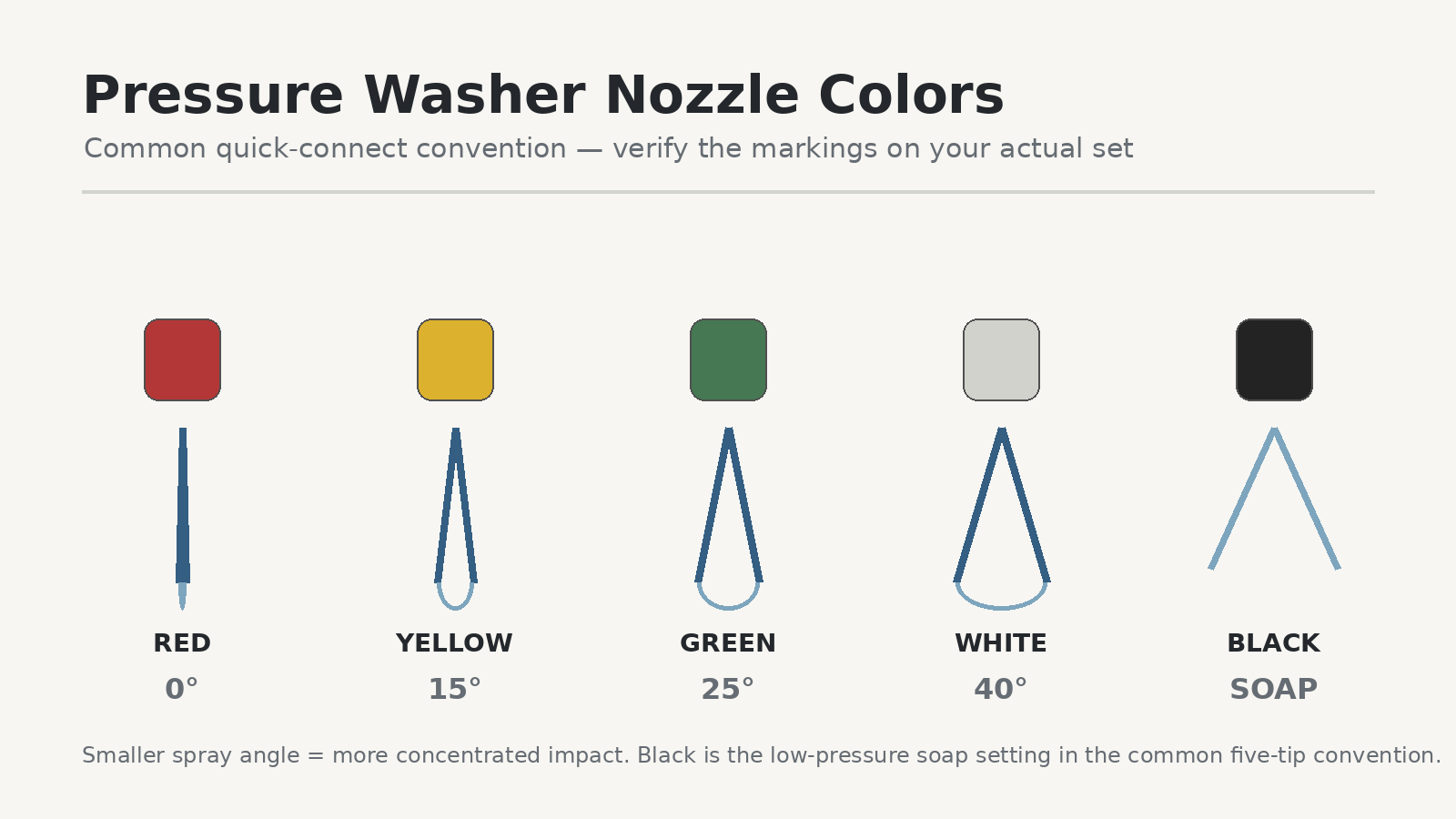
- Red = 0 degrees
- Yellow = 15 degrees
- Green = 25 degrees
- White = 40 degrees
- Black = soap / low pressure
The common quick-connect convention uses red, yellow, green, white, and black tips; it is documented in both published nozzle guidance and a separate manufacturer pressure-washer guide. Always verify the degree markings and manual for your set.
If you remember nothing else, remember this: the smaller the spray angle, the more concentrated the impact.
Red 0-degree nozzle: the one I would use least
The red nozzle takes the pressure washer’s output and concentrates it into a very narrow stream.
That makes it aggressive.
The cited nozzle guidance describes the 0-degree tip as intended for tough cleaning jobs. That is true, but it is also the tip most likely to punish a mistake.
I would not start an unfamiliar cleaning job with the red nozzle.
I would not use it casually on:
- cars;
- wood decks;
- painted siding;
- soft masonry;
- anything I would be upset to gouge or strip.
There are jobs where a concentrated stream is useful, but “maximum force” is not a normal default setting.
If the dirt only comes off when you are using a 0-degree tip inches from a delicate surface, I would stop and rethink the cleaning method before deciding the surface needs more punishment.
Yellow 15-degree nozzle: aggressive fan spray
The yellow tip spreads the water into a 15-degree fan.
It is still a strong cleaning pattern but covers more area than the red tip.
The cited guidance describes 15 degrees as suitable for heavy-duty cleaning and stripping.
I would think of it for hard, durable surfaces where the 25-degree tip is not doing enough.
Examples can include:
- dirty concrete;
- some masonry;
- metal equipment;
- paint preparation where removing loose material is actually the goal.
Again, test first. “It removed the dirt” and “it removed the surface along with the dirt” can look surprisingly similar for the first second.
Green 25-degree nozzle: the general-purpose starting point
If I had to choose one high-pressure nozzle to start ordinary cleaning, it would often be the green 25-degree tip.
It gives you a useful fan pattern without concentrating everything into a tiny line.
The cited guidance calls 25 degrees a general-purpose cleaning pattern.
That makes sense for jobs such as:
- driveways and sidewalks;
- patios;
- general outdoor cleaning;
- some siding work at appropriate distance;
- rinsing heavier dirt without jumping straight to the narrow tips.
I would still start farther away and move closer. A 25-degree nozzle attached to a strong machine is not harmless just because the tip is green.
White 40-degree nozzle: wide and gentler
The white tip spreads the water into a much wider 40-degree fan.
The cited guidance describes it as useful for general wash-down, lighter cleaning, rinsing, and more delicate or painted surfaces.
This is the tip I would want available for:
- vehicles;
- siding;
- outdoor furniture;
- wider rinsing;
- surfaces where the narrow tips are unnecessarily aggressive.
If you are nervous about damaging a surface, wide fan plus distance is a sensible place to begin.
Black soap nozzle: deliberately low pressure
The black nozzle is different from the others.
It is a low-pressure soap/detergent nozzle.
On many pressure washers, the detergent injection system works only when the machine is in low-pressure mode. The cited manufacturer guidance notes that cleaning solution cannot be applied through the red, yellow, green, or white high-pressure tips on the systems it describes.
The normal sequence is:
- apply the correct pressure-washer-safe detergent with the soap nozzle or designated detergent setting;
- give it the appropriate dwell time without letting it dry;
- switch back to a suitable rinse nozzle;
- rinse from a safe distance.
Follow the detergent and machine instructions. Pressure washers are not chemistry experiments with wheels.
What about turbo nozzles?
A turbo nozzle takes a narrow, high-impact stream and rotates it rapidly in a circular pattern.
The goal is to get much of the cleaning force of a concentrated stream while covering more area.
That can be excellent on tough concrete and similar durable surfaces.
It also makes a turbo nozzle something I would treat as aggressive equipment rather than a magic faster-cleaning attachment.
Published nozzle guidance includes turbo nozzles as one of the basic nozzle types.
I would not make a turbo nozzle my first choice on wood, paint, cars, or anything delicate.
Can I use any nozzle with any pressure washer?
No.
This is where buyers sometimes look only at spray angle and miss the other specification printed on the nozzle.
A pressure-washer nozzle also has an orifice size. That opening has to be matched appropriately to the machine’s pressure and flow.
Too small an orifice can make the system operate incorrectly and may overload components. Too large an orifice can reduce working pressure.
Replacement nozzle sets are normally rated for a maximum PSI and list an orifice size.
For example, manufacturers sell quick-connect nozzle sets with different orifice sizes even when both sets use the familiar 0/15/25/40/soap color pattern.
So “green tip” is not the entire specification.
What nozzle should I use on concrete?
I would usually start with 25 degrees and see what the surface needs.
For stubborn areas on sound concrete, 15 degrees may clean faster.
A turbo nozzle or surface cleaner can be more productive on larger jobs.
I would reserve the 0-degree tip for very specific uses rather than walking the whole driveway with a red pencil jet.
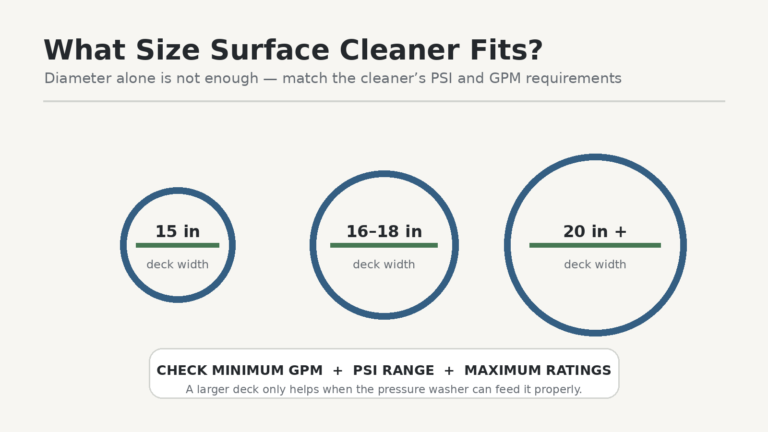
If you have a large flat area, a compatible surface cleaner is usually the more interesting upgrade.
What nozzle should I use on siding?
Published home-exterior instructions use 25- or 40-degree nozzles in their example.
I would favor the wider option first, especially on painted, older, or unfamiliar siding.
The danger is not only surface damage. High-pressure water can be driven behind siding and around openings.
Distance and spray direction matter.
What nozzle should I use on a car?
I would start with a wide fan such as 40 degrees and keep reasonable distance.
I would avoid aiming a concentrated jet at:
- paint chips;
- loose trim;
- weather seals;
- sensors and cameras;
- badges and decals;
- damaged tires;
- electrical openings.
If car washing is one of your main uses, you probably do not need the highest-PSI machine on the shelf. See How Much PSI Do You Really Need?.
What nozzle should I use on a wood deck?
I would begin with the widest practical fan and plenty of distance.
Wood can be gouged or raised by an aggressive spray.
The cited manufacturer guidance recommends moderate pressure on wooden decks and starting away from the surface before approaching gradually.
There is no medal for finishing the deck five minutes faster if you spend the next weekend sanding pressure-washer stripes out of it.
Why distance matters with every color
The nozzle angle does not exist by itself.
A white nozzle held an inch from a delicate surface can still cause damage. A narrower nozzle used from farther away can produce a much less concentrated impact by the time the spray reaches the surface.
That is why manufacturer guidance so often says to start farther away.
I would treat distance like a continuously adjustable control that works alongside the nozzle.
Do nozzle colors ever differ?
The red/yellow/green/white/black convention is very common, but I would still read the markings rather than trust color blindly.
Specialty nozzles, adjustable wands, 5-in-1 nozzles, aftermarket parts, and commercial equipment do not have to follow the exact little five-tip rack you remember.
Combination 5-in-1 heads can place 0-, 15-, 25-, and 40-degree patterns plus soap in one twistable nozzle.
Read the degree marking.
The nozzle routine I would use
- Identify the surface.
- Choose the widest nozzle likely to do the job.
- Start farther away than you think you need to.
- Test an inconspicuous area.
- Move closer gradually.
- Switch to a narrower pattern only when the wider one is not cleaning effectively.
- Keep the wand moving.
That routine is not exciting.
It is also cheaper than replacing whatever you just engraved with the red nozzle.