How Much PSI Do You Really Need in a Pressure Washer?
Pressure-washer shopping would be easier if PSI worked like a difficulty setting.
1,800 PSI for easy dirt. 2,500 for medium dirt. 3,200 for dirt that has made bad life choices.
Unfortunately, the machine does not know whether you are pointing it at a concrete driveway or the clear coat on your car.
PSI matters, but more PSI is not automatically better. The useful pressure at the surface also depends on nozzle angle, distance, flow rate, and what you are cleaning.
That is why I would not buy the highest-PSI pressure washer in the price range and assume I had solved the problem.
The short answer
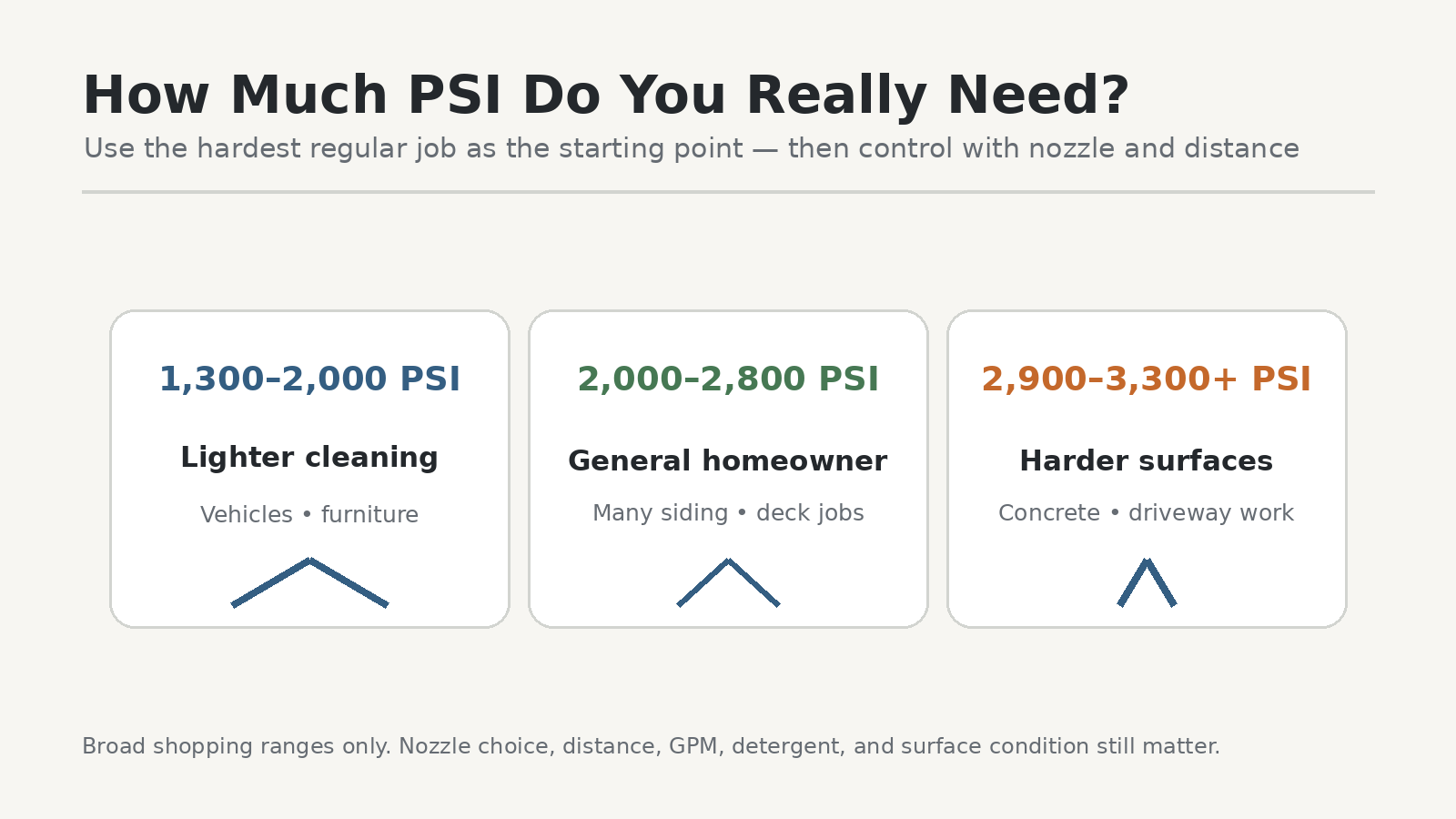
For a homeowner choosing one machine, these broad ranges are a reasonable shopping starting point:
- Roughly 1,300–2,000 PSI: lighter cleaning such as vehicles, outdoor furniture, and other surfaces where control matters more than brute force.
- Roughly 2,000–2,800 PSI: general homeowner cleaning, including many siding and deck jobs when used with the correct nozzle and technique.
- Roughly 2,900–3,300+ PSI: harder surfaces and heavier cleaning such as concrete and serious driveway work.
Those are not universal safe-pressure limits. A current manufacturer buying guide publishes similar task ranges, but even a machine rated for a high maximum pressure can be used more gently by changing the nozzle, distance, and machine settings when available.
The important part is matching the whole setup to the surface.
PSI is only half of the basic performance story
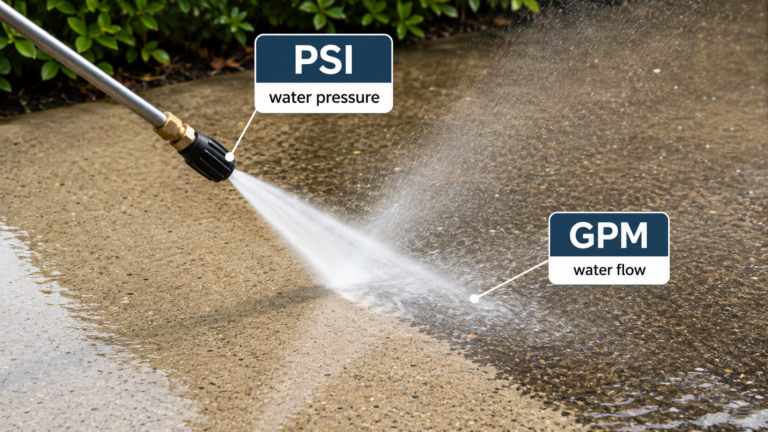
PSI is pounds per square inch. It describes pressure.
GPM is gallons per minute. It describes water flow.
Simpson puts it in useful terms: PSI provides the force that helps lift dirt and grime, while GPM supplies the water that carries it away.
A very high-pressure machine with weak flow can be less productive on a large driveway than the PSI number makes it sound.
DDB already has a separate PSI-versus-GPM article, and I would keep the jobs separate:
- that article explains what the specifications mean;
- this one answers the buyer’s next question: how much machine do I need?
For cars: I care more about control than maximum PSI
A pressure washer can be useful for vehicle washing, but I would not make “maximum cleaning force” the goal.
The paint, trim, seals, tires, badges, sensors, and damaged areas on a vehicle are not concrete.
For car washing, I would favor:
- a lower-pressure or adjustable machine;
- a wide fan nozzle;
- plenty of working distance;
- soap made for the application;
- common sense around damaged paint, trim, electrical components, and seals.
That same guide places cars and furniture in its light-duty 1,300–2,000 PSI category. I think that is a much more useful shopping direction than buying a 4,000-PSI machine because you may clean the driveway once a year.
A stronger machine can still wash a car if used correctly. The point is that you do not need the extra pressure for the car.
For siding: pressure is not the same thing as cleaning ability
House siding often needs detergent, dwell time, and rinsing more than it needs a narrow jet trying to remove the siding with the dirt.
Simpson’s exterior-cleaning guidance recommends using 25- or 40-degree nozzles in its example procedure. Its nozzle guide describes the 40-degree white tip as a wide fan suitable for lighter cleaning and rinsing on more delicate surfaces.
I would rather start gentle and move closer only if necessary.
Also think about where the water is going. High pressure can drive water behind siding, around openings, or into places that were designed to shed rain rather than accept a concentrated jet.
This is not a job where the largest PSI number automatically wins.
For wood decks: enough to clean, not enough to carve
Wood is where pressure-washer overconfidence becomes visible.
Published deck-cleaning guidance recommends roughly 1,500–2,500 PSI as a starting range for wooden decks and specifically warns about gouging wood with too much pressure.
Even within that range, the nozzle and distance matter enormously.
I would:
- start with a wide fan nozzle;
- start farther from the wood;
- test an inconspicuous area;
- move closer gradually only if needed;
- keep the wand moving rather than drilling one spot.
If the board starts looking fuzzy, gouged, or striped, the wood has already answered the question.
For concrete and driveways: this is where more power starts earning its keep
Concrete is one of the reasons homeowners move toward stronger pressure washers.
Published concrete-cleaning guidance calls for at least 3,000 PSI for concrete cleaning.
I would take those as practical manufacturer guidance, not a law of physics. Concrete age, condition, surface finish, stains, detergent, nozzle, and a surface cleaner all change the job.
But if your main goal is cleaning a large dirty driveway, I would not buy a tiny light-duty machine and expect miracles.
Flow matters here too. Large flat surfaces reward GPM because you are trying to move dirty water and cover area, not just make one tiny spot very clean.
Do I need 3,000 PSI?
If you have a mixed list of homeowner jobs, around 3,000 PSI is a very common and useful class.
Generac sells residential machines around 2,900 PSI and says they can handle jobs ranging from patio furniture to driveways and decks. Simpson’s current residential and professional lines also cluster heavily around 3,000 PSI and above.
I would consider that range if you want one machine that can tackle concrete while still being controllable on gentler jobs with the right nozzle and distance.
I would not consider 3,000 PSI a requirement if your heaviest job is washing cars and patio furniture.
Do I need 4,000 PSI?
Probably not for ordinary homeowner cleaning.
Machines around 4,000 PSI and 4 GPM move into serious commercial and professional territory. They can clean fast, but they are usually heavier, louder, more expensive, and less forgiving.
If you are buying for a cleaning business, farm equipment, regular paint preparation, or heavy commercial work, that is a different conversation.
If you are buying because your vinyl chairs are dirty, it is a lot of machine to own for the privilege.
The nozzle can change the job more than buyers expect
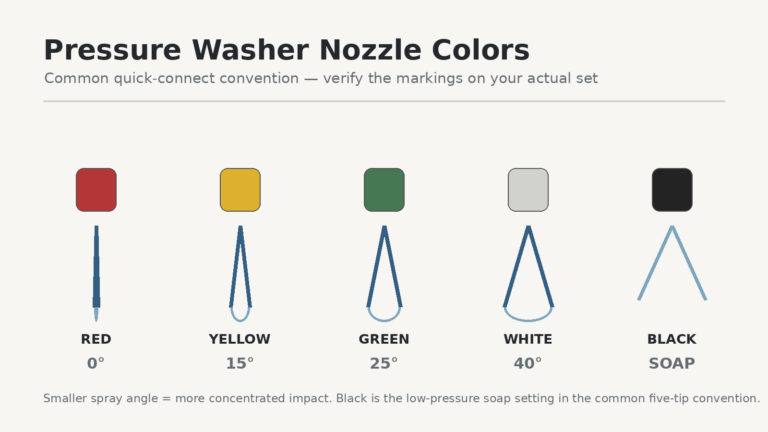
A 3,000-PSI pressure washer does not deliver the same impact with every nozzle.
A 0-degree nozzle concentrates the spray into a tiny area. A 40-degree nozzle spreads the water into a much wider fan.
That means the nozzle can turn the same pressure washer from “wide rinse” to “why is there now a line carved in this surface?”
This is important enough that I wrote a separate guide: Pressure Washer Nozzle Colors and Degrees Explained.
Distance is your built-in pressure adjustment
Move the nozzle away from the surface and the spray spreads out and loses impact.
Move closer and it becomes more aggressive.
Simpson’s own nozzle guidance tells users to start well away from the surface and slowly move closer while watching for damage.
That is exactly how I would approach an unfamiliar surface.
You can always move closer.
Putting wood fibers back into a deck is harder.
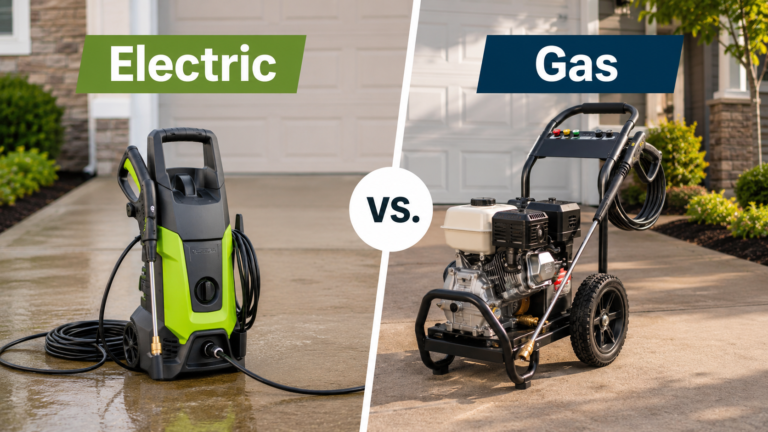
What about electric vs gas?
Power source and cleaning class overlap, but they are not the same question.
Electric pressure washers dominate the lighter and midrange homeowner market because they are convenient, quiet compared with gas engines, and low maintenance.
Gas models still dominate much of the higher-PSI/high-GPM market and are useful when you need more sustained cleaning power away from an electrical outlet.
DDB already has an Electric vs Gas Pressure Washer article. I would use that after deciding what kind of cleaning performance you actually need.
What PSI do I need for a surface cleaner?
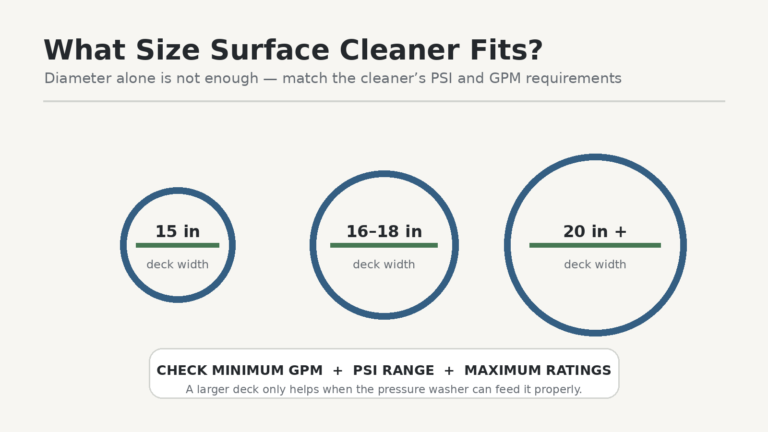
Do not choose a surface cleaner by saying, “My pressure washer is 3,200 PSI, so any 3,200-PSI surface cleaner should work.”
The accessory may have both a maximum PSI and a minimum GPM/PSI recommendation.
For example, Simpson currently lists different 15- and 16.5-inch surface cleaners with different minimum flow requirements.
I break that down in What Size Surface Cleaner Fits Your Pressure Washer?.
The buying decision I would make
If I wanted one pressure washer for cars, siding, patio furniture, a deck, and occasional driveway cleaning, I would look for a good midrange machine rather than the highest PSI I could find.
I would care about:
- enough PSI for my hardest regular job;
- enough GPM that large jobs do not take forever;
- a useful set of nozzles;
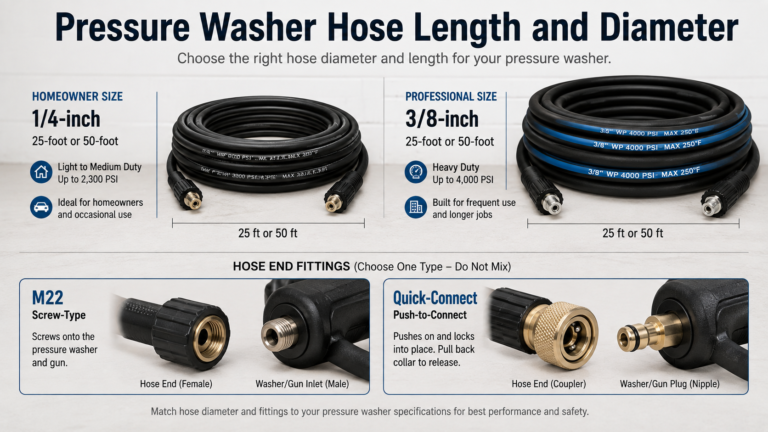
- hose and cord length;
- surface-cleaner compatibility if I have much concrete;
- weight, storage, noise, and maintenance;
- pump and engine/motor quality.
Buy for the hardest job you do regularly, then make sure the machine can be used gently enough for everything else.
Buying 1,500 extra PSI for one imaginary project is not automatically getting more for your money.