Can You Use a Shop Vac for Drywall Dust? Filters, Bags, and HEPA Explained
Drywall dust has a special ability to appear in rooms where you are fairly sure no drywall work happened.
It is fine, it travels, and it can clog a vacuum filter fast.
So yes, a compatible wet/dry shop vac can be useful for collecting drywall and joint-compound sanding dust. But I would not treat fine construction dust like the wood chips under a workbench.
The filter and bag setup matters. The material you are sanding matters. And if you are creating the dust continuously with a power tool, a purpose-built dust extractor can make much more sense than a basic cleanup vacuum.
The short answer
For ordinary home drywall work:
- Check the vacuum manufacturer’s filter recommendations for fine dust.
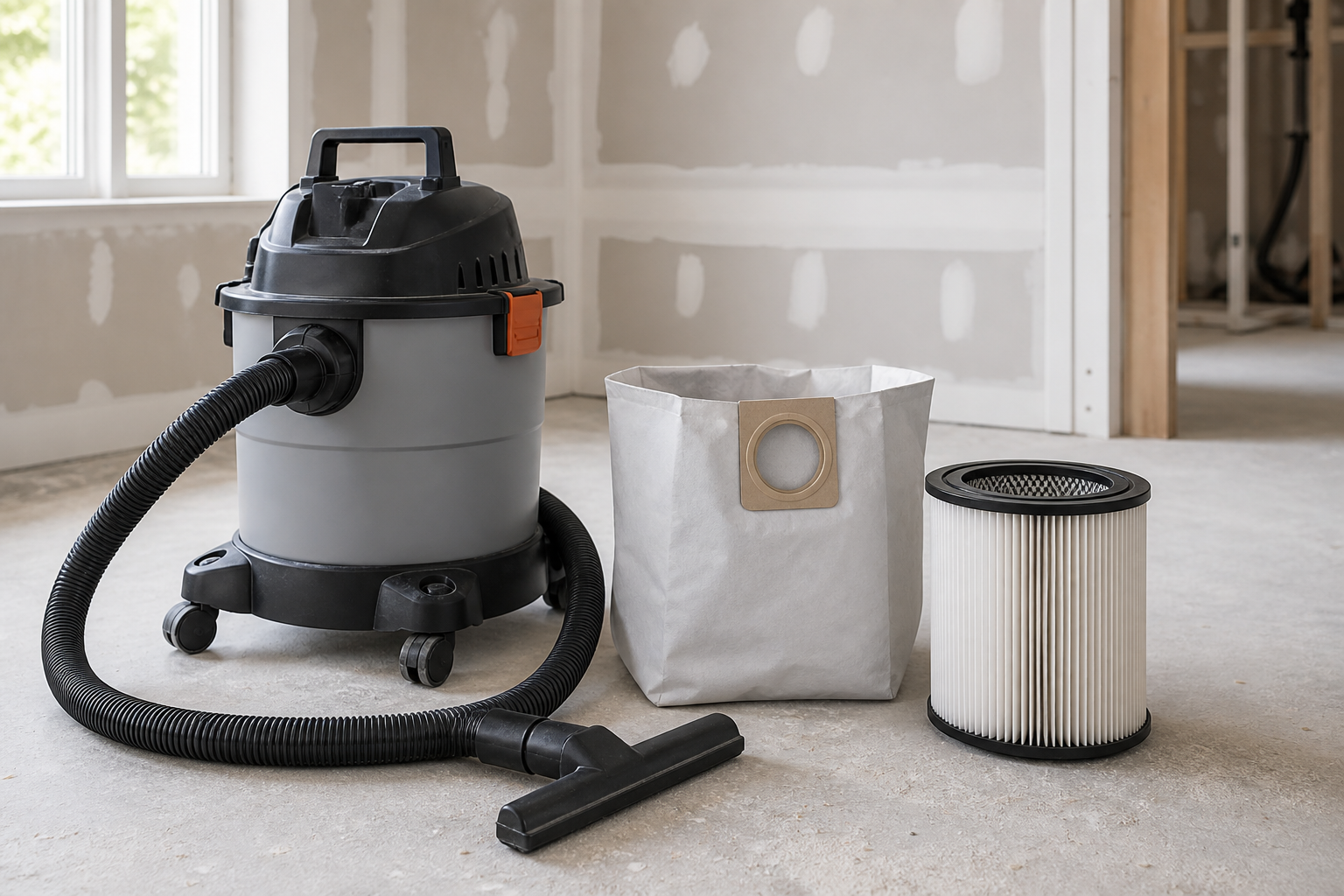
- Use a compatible collection bag when the manufacturer recommends one for fine dust.
- Do not run a basic general-debris filter until it packs solid and then wonder where the airflow went.
- Keep the dust contained rather than blowing it around with compressed air.
- Check the Safety Data Sheet for the joint compound or material you are sanding.
- If hazardous or regulated dust may be involved, follow the material and safety requirements rather than relying on generic shop-vac advice.
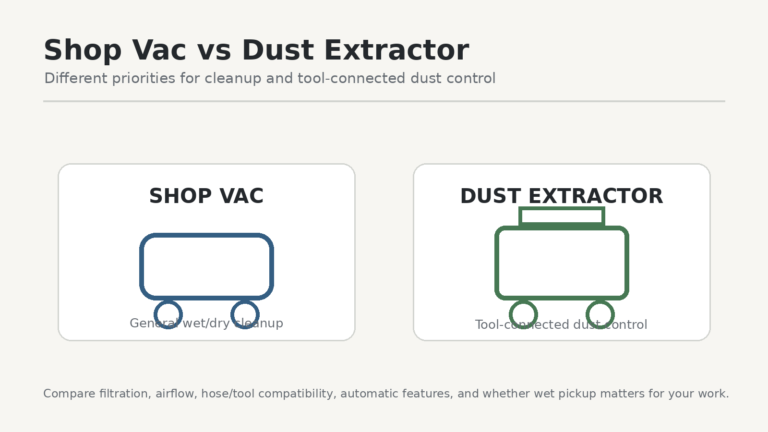
If you are sanding drywall regularly with a power sander, I would also read Shop Vac vs Dust Extractor.
Why drywall sanding dust is hard on a shop vac
The problem is not that the vacuum cannot physically pull the dust through the hose.
The problem is what happens after the dust reaches the filter.
Very fine particles can load a filter quickly. As the filter becomes restricted, airflow falls. That is why a vacuum can start a sanding cleanup sounding healthy and then feel half-dead ten minutes later.
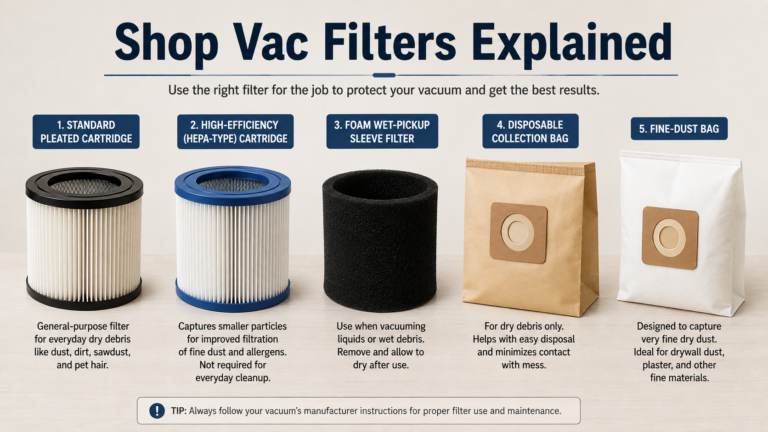
Shop-Vac’s filter guide includes fine-dust collection bags specifically for extra-fine dry messes. Other manufacturers similarly offer fine-dust filters and bags for compatible machines.
I would use those systems the way the manufacturer intends rather than treating the included general-purpose filter as universal.
Bag plus filter is usually a much nicer arrangement
For fine dry dust, a collection bag can do more than make emptying cleaner.
It can keep a large portion of the material from loading directly onto the main filter.
Bosch, for example, recommends a fleece bag with one of its HEPA filters to help maximize airflow and protect the filter from direct exposure to abrasive material and sharp objects.
Your shop vac may use a different design, so follow its instructions. But the general logic is useful:
Do not make the expensive filter catch every spoonful of dust if the machine is designed to collect much of that material in a bag first.
Does drywall dust contain silica?
This needs a more careful answer than “drywall dust is silica dust.”
Drywall and joint compounds are not all the same product.
USG explains that respirable crystalline silica can occur as a natural impurity in raw materials used to make ready-mixed joint compound and says that if respirable crystalline silica is present it will be identified in Section 3 of the product’s Safety Data Sheet.
For example, a current USG Sheetrock Durabond setting-type joint compound SDS lists crystalline silica (quartz) as an impurity at up to 1 percent by weight.
That does not mean every drywall project creates the same silica exposure, and OSHA’s silica rules cited in this article are workplace standards rather than a homeowner instruction manual.
It does mean I would stop treating “drywall dust” as one chemically identical substance.
If you are sanding a specific joint compound, read that product’s SDS.
What HEPA actually means
HEPA stands for high-efficiency particulate air.
That is a filter-performance definition.
Here is the distinction I would keep in mind:
A vacuum that accepts a HEPA-labelled filter is not automatically proven to be an appropriate HEPA vacuum system for every hazardous-dust application.
The complete machine matters: seals, airflow, bags, filter installation, leakage, maintenance, and how the manufacturer has designed and tested the system.
For ordinary homeowner dust cleanup, you may simply be choosing a better filter.
For asbestos, lead, silica-generating work, or another regulated/hazardous material, do not improvise from a filter listing. Follow the applicable requirements and product guidance.
What OSHA’s silica guidance is useful for — and what it is not
OSHA’s construction silica standard applies to occupational exposure, so I am not using it here to tell a homeowner “OSHA says you must do X in your spare bedroom.”
I am using it because it demonstrates something important about fine hazardous dust: dust-control systems are treated as complete systems, not as “any vacuum with something called a filter.”
OSHA’s rules and interpretations include specific uses of HEPA-filtered vacuums and dust collectors with efficiency and filter-cleaning requirements for particular silica-generating tasks.
That is a good reason not to make casual safety claims about a random shop vac.
Can I just vacuum the dust after sanding?
You can collect settled dust with an appropriate vacuum setup, but catching dust after it spreads through the room is the losing version of the game.
Whenever practical, control the dust while you make it:
- use dust-control sanding equipment;
- connect a compatible vacuum or extractor at the tool;
- contain the work area;
- use products and methods designed to reduce airborne dust when appropriate;
- follow the manufacturer’s instructions for personal protective equipment and cleanup.
USG even sells a Dust Control joint compound designed to produce less airborne sanding dust than conventional compounds.
Less dust created is easier than more dust collected.
Why a dust extractor can be better for sanding
If you sand drywall once every few years, buying a professional extractor may make no sense.
If you sand regularly, the advantages become easier to justify.
Purpose-built dust extractors commonly add features such as:
- automatic filter cleaning;
- HEPA filtration systems;
- fine-dust collection bags;
- power-tool auto start;
- hoses and adapters intended for tool connection;
- designs intended to maintain extraction while fine dust is being generated.
Bosch’s HEPA dust extractors, for example, use automatic filter cleaning every 15 seconds on certain models to help maintain suction. DeWalt and Festool offer similar fine-dust-oriented systems in their extractor lines.
A normal wet/dry vacuum can still be useful. The extractor is just more deliberately built around this exact annoyance.
What filter should I use?
There is no universal filter number because wet/dry vacs use different filter systems.
Go to the manufacturer’s compatibility chart for your exact model.
Look for a filter or bag specifically described for fine dust, drywall dust, cement dust, or the actual material you are collecting — and check any limitations the manufacturer gives.
Do not assume:
- all same-size vacuums take the same filter;
- a HEPA filter fits because the tank diameter looks right;
- a general debris filter is fine because the vacuum still runs;
- an aftermarket adapter preserves a manufacturer’s filtration claim.
What happens if the filter clogs?
Airflow drops.
This is why filter condition belongs right alongside CFM and water lift when diagnosing a vacuum.
If you have not already read it, our guide to shop-vac CFM, water lift, and peak horsepower explains why the motor’s big number on the box does not tell you how the complete system behaves with a loaded filter.
Should I remove the filter for drywall dust?
Not for normal dry fine-dust pickup unless the manufacturer’s instructions for your exact vacuum explicitly tell you to use a different dry-pickup configuration.
Wet pickup and dry pickup can require different filter arrangements. That is another reason to read the manual rather than carrying over a trick somebody used for sucking up water.
Fine dry dust needs to stay in the machine, not leave through the exhaust.
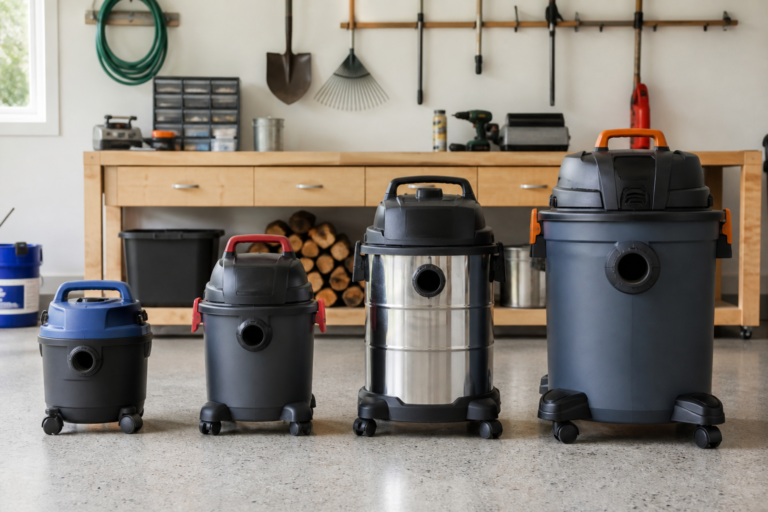
Do I need a giant shop vac?
No.
Drywall dust is usually more of a filtration problem than a tank-volume problem.
A huge tank can be useful during a renovation, but I would rather have a smaller compatible machine with the right fine-dust bag and filter than a 16-gallon vacuum wearing the wrong filter.
If you are choosing capacity, see What Size Shop Vac Do You Need?.
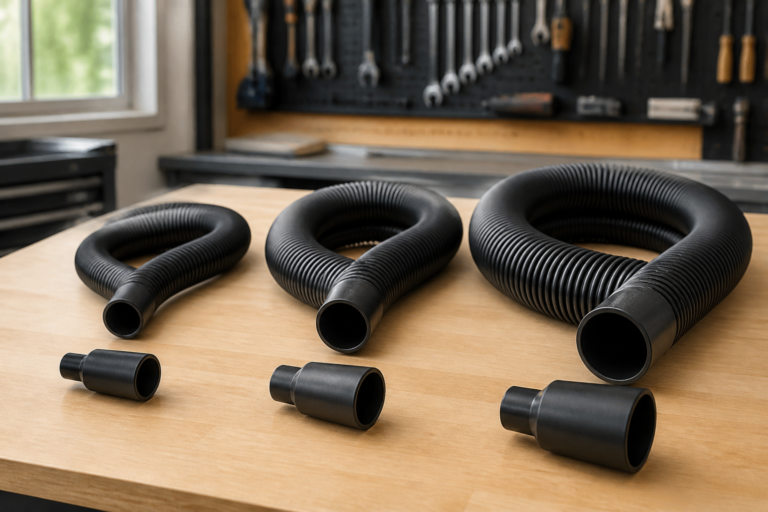
What about the hose?
For settled drywall debris, a larger hose can help with chunks.
For a drywall sander or other power tool, compatibility and handling matter more. A huge stiff hose attached to a hand tool can make the tool unpleasant to use.
That is one reason dust extractors often use tool-oriented hoses rather than the biggest debris hose available.
See Shop Vac Hose Size Explained if you are trying to make the pieces fit.
A practical setup for occasional DIY drywall work
For a normal small home project, I would think through it in this order:
- Identify the material. Check the joint compound or other product’s SDS and instructions.
- Control dust at the source where practical.
- Check the wet/dry vac manual. Find the specified fine-dust filter and bag options.
- Use a bag if the system is designed for one. It makes fine-dust cleanup much friendlier.
- Watch airflow. If performance drops, stop and service the filter/bag according to the manual rather than cooking the machine with a packed filter.
- Empty the dust carefully. The last thing you want is to collect the dust successfully and launch it back into the room while emptying the tank.
When I would stop using a normal shop vac
I would move away from a basic cleanup setup when:
- the work is creating fine dust continuously;
- I am sanding often enough that filter clogging is constant;
- I want the vacuum to start with the tool;
- the work involves a material with specific hazardous-dust controls;
- I need a tested or specified dust-control system rather than a homeowner cleanup arrangement.
At that point, the shop vac has not “failed.” You have simply moved into a job the dust extractor was designed around.
The part I would not cheap out on
I would rather use a modest-size vacuum with the right bag and filter than a giant high-horsepower vacuum with the cheapest filter I could find.
Drywall and joint-compound dust is exactly the kind of job that exposes the weakness in shopping by tank size and peak horsepower.
The boring parts — filtration, bags, compatibility, and dust control — are the parts that matter.
Unfortunately, the boring parts are usually printed in much smaller letters on the box.