What Size Surface Cleaner Fits Your Pressure Washer?
A surface cleaner looks like the easiest pressure-washer accessory to buy.
Your pressure washer says 3,200 PSI. The surface cleaner says 3,700 PSI. Three thousand two hundred is less than 3,700. Done.
Not quite.
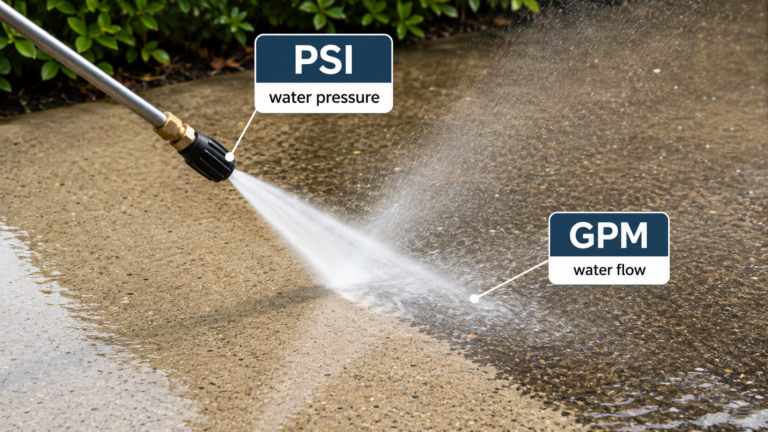
Maximum PSI tells you whether the accessory can tolerate the pressure. It does not tell you whether your pressure washer supplies enough water flow to run the surface cleaner well.
For that, GPM matters a lot.
The short answer
Before buying a pressure-washer surface cleaner, check:
- Maximum PSI: your pressure washer must not exceed the cleaner’s pressure rating.
- Minimum PSI: some cleaners publish a minimum working pressure.
- Minimum GPM: the machine needs enough water flow to spin the nozzles and clean effectively.
- Maximum GPM: commercial accessories may specify an upper flow limit too.
- Diameter: larger decks cover more area but usually demand more flow to perform well.
- Nozzle/orifice setup: replacement nozzles must be appropriate for the machine and cleaner.
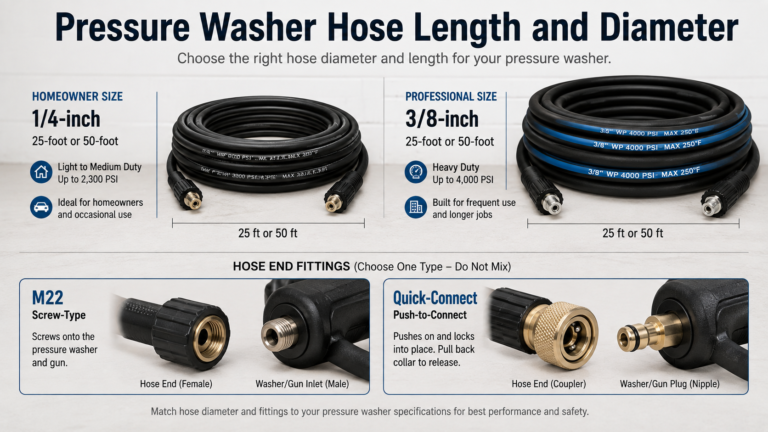
- Connection: check quick-connect size, gun/wand compatibility, and whether the cleaner is designed for consumer or commercial equipment.
- Water temperature: many homeowner surface cleaners are cold-water only.
If the manufacturer gives a compatibility range, use it. Do not replace it with an Internet rule of thumb.
Why GPM gets overlooked
Pressure is the number printed largest on pressure washers.
Surface cleaners, however, have two or more nozzles rotating under the deck. They need enough water flow for that system to work as intended.
This is why two surface cleaners with similar maximum PSI ratings can have different minimum-GPM requirements.
Published specifications for a 15-inch cleaner recommend at least 1,500 PSI and 1.8 GPM, while a separate 15-inch model requires 2,200 PSI and 2.3 GPM. A 16.5-inch example recommends 2,000 PSI and 2.5 GPM and lists 4.0 GPM as its maximum.
Same general product category. Different compatibility windows.
The lesson is read the actual minimum flow specification for the exact cleaner.
What happens if the pressure washer is too small?
The cleaner may connect physically and still work poorly.
Possible symptoms include:
- slow or weak bar rotation;
- poor cleaning;
- having to crawl across the driveway;
- uneven results;
- the temptation to move so slowly that the accessory has defeated the reason you bought it.
A large 20-inch cleaner attached to a low-flow consumer pressure washer may look impressive but cover no more useful area per minute than a smaller cleaner the machine can actually drive.
This is one place where “bigger” can make the system worse.
What happens if the pressure washer is too powerful?
Do not exceed the accessory’s maximum pressure or flow rating.
A surface cleaner is a pressure-containing rotating assembly. Its hose, swivel, nozzles, deck, and fittings are designed around limits.
If your pressure washer exceeds those limits, choose a properly rated cleaner rather than assuming you can be careful with the trigger.
Commercial cleaners exist for higher-flow, higher-pressure machines.
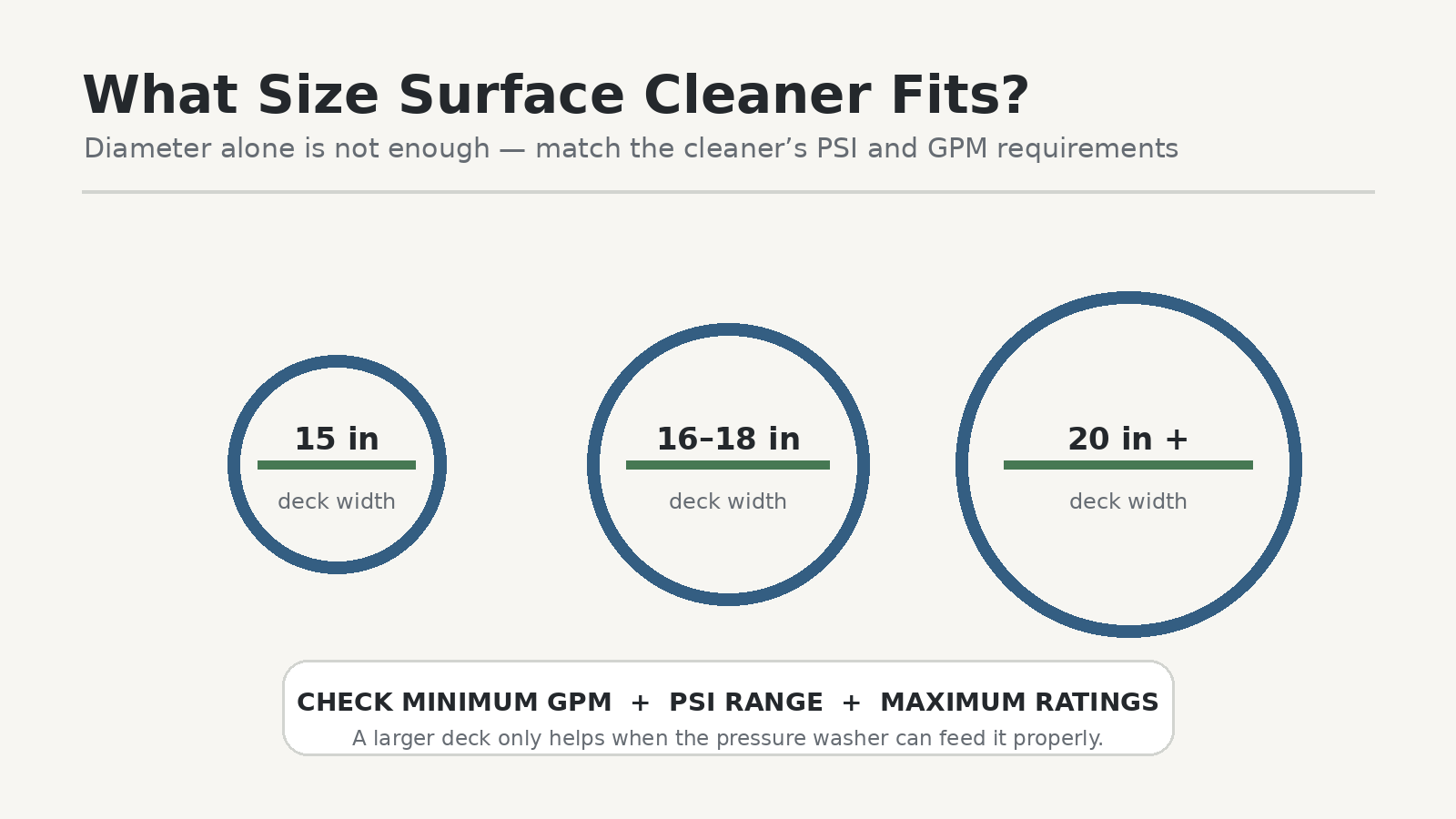
Is 15 inches a good size for homeowners?
Often, yes.
Fifteen-inch surface cleaners are common because they can pair with a wide range of residential gas pressure washers and some stronger electric units.
The exact match still depends on the model.
The published 15-inch examples above illustrate why you cannot shop by diameter alone: similarly sized cleaners can require different minimum PSI and GPM.
If your pressure washer makes around 2 GPM, I would be looking at the lower-flow-compatible end of the surface-cleaner market rather than assuming every 15-inch deck is equivalent.
What about 16- to 18-inch surface cleaners?
These can be a very useful match for stronger homeowner gas machines.
They cover more width per pass without immediately jumping into big commercial equipment.
But again, check minimum flow.
The 16.5-inch example above recommends at least 2.5 GPM.
If your machine is rated at 1.8 GPM, the fact that its PSI falls under the maximum does not mean that 16.5-inch cleaner is a good match.
What about 20 inches and larger?
Now I start thinking about higher-flow gas machines and professional work.
Published specifications for a 20-inch industrial cleaner list 3.0 GPM and a 4,500-PSI maximum.
That is a different accessory class from a lightweight consumer cleaner designed around a 1.8-GPM machine.
A large surface cleaner makes sense when the pressure washer can feed it and you actually have enough flat area to make the width useful.
If your entire concrete job is a short front walk, a commercial-size deck may mostly give you a storage problem.
Does a surface cleaner reduce pressure?
The cleaner divides the available flow across its rotating nozzles.
The nozzle sizes are selected so the pressure/flow system works appropriately with the target machine range.
This is why replacement tips matter.
Changing surface-cleaner nozzles is not just choosing a different spray color. Orifice size affects pressure and flow through the rotating bar.
If replacement nozzles are needed, I would use the manufacturer’s specified size or calculate the proper orifice for the complete system rather than guessing.
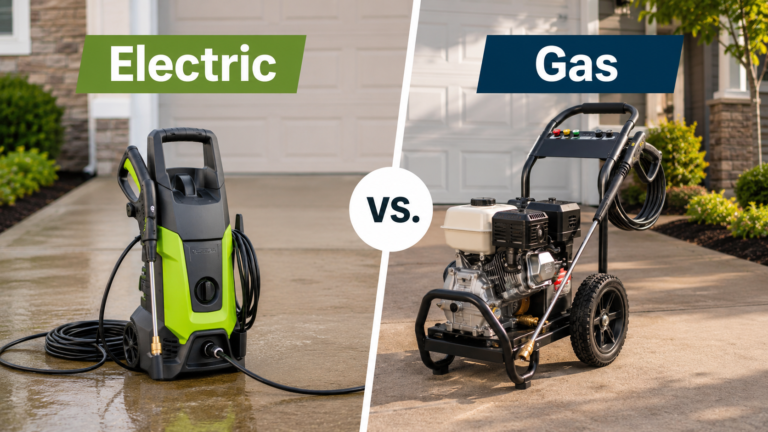
Can an electric pressure washer run a surface cleaner?
Yes, if the cleaner is designed for its pressure and flow.
This is where the minimum-GPM specification becomes especially useful because many electric pressure washers have lower flow than larger gas machines.
A small surface cleaner designed for electric/homeowner equipment can be a great match.
A 20-inch industrial cleaner is not magically useful because you found an adapter that lets it click onto the wand.
Will a bigger surface cleaner clean faster?
Only if the pressure washer can support it.
In theory, a wider deck covers more area with each pass.
In practice, if the cleaner is too large for the machine’s flow, you may have to move so slowly that you lose the advantage.
I would rather have a 15-inch cleaner spinning properly than a 20-inch cleaner that turns my pressure washer into an underpowered floor polisher.
PSI still matters
GPM is the compatibility number people forget, but pressure still has two jobs here.
First, the accessory has to survive the pressure. Never exceed its maximum rating.
Second, the cleaner needs enough pressure to do useful work on the surface.
This is why manufacturer listings may provide both minimum and maximum PSI.
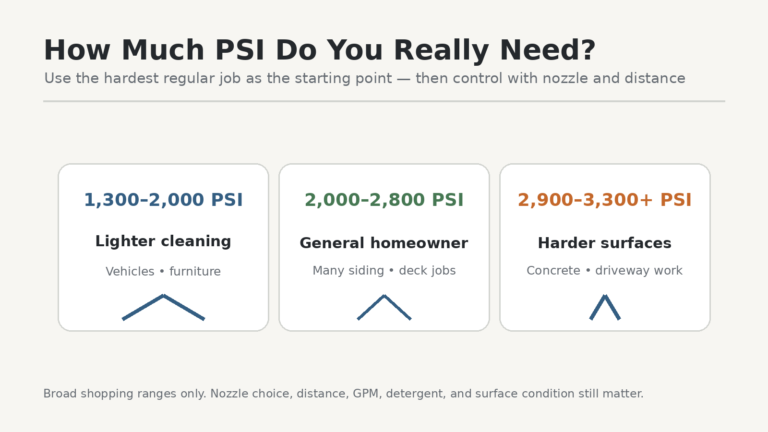
If you are still deciding what pressure washer class to buy, see How Much PSI Do You Really Need in a Pressure Washer?.
The pressure-washer nozzle article still matters
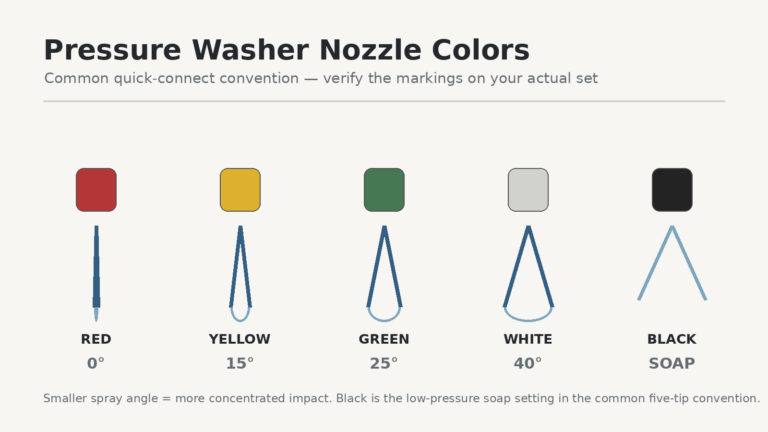
A surface cleaner has nozzles under the deck rather than one colored nozzle at the end of your wand, but the underlying idea is the same: nozzle orifice and spray pattern shape how pressure and flow are delivered.
For the normal wand tips, see Pressure Washer Nozzle Colors and Degrees Explained.
What surfaces are surface cleaners for?
They shine on large, flat surfaces:
- concrete driveways;
- sidewalks;
- patios;
- some decks, when the cleaner and pressure are appropriate for the material;
- large flat commercial surfaces with equipment designed for them.
I would be much more cautious with soft, damaged, painted, sealed, or uneven surfaces.
The enclosed rotating bar makes cleaning more uniform, but it does not make excess pressure harmless.
Why surface cleaners often beat a wand on driveways
A normal pressure-washer wand cleans a narrow strip at a time.
It is easy to overlap inconsistently, change your distance, or leave visible “cleaning lines.”
A surface cleaner holds its nozzles at a more consistent distance and rotates them through a fixed path under the deck.
That can make large concrete jobs faster and more even.
It also reduces the amount of dirty spray flying back at your legs, although it certainly does not turn pressure washing into a clean indoor hobby.
My compatibility checklist
If I were standing in a store with my phone and the model number of my pressure washer, I would check these in this order:
- Pressure washer rated PSI.
- Pressure washer rated GPM.
- Surface cleaner minimum PSI.
- Surface cleaner minimum GPM.
- Surface cleaner maximum PSI and GPM.
- Cold- versus hot-water rating.
- Connection type.
- Recommended nozzle/orifice setup.
- Diameter only after all of the above.
That last point is the one I would underline.
Choose the biggest surface cleaner your pressure washer can properly run, not the biggest one that can physically attach to the wand.