Why Longer Extension Cords Need Heavier Gauge Wire
Extension-cord gauge has one wonderfully backwards feature built into it:
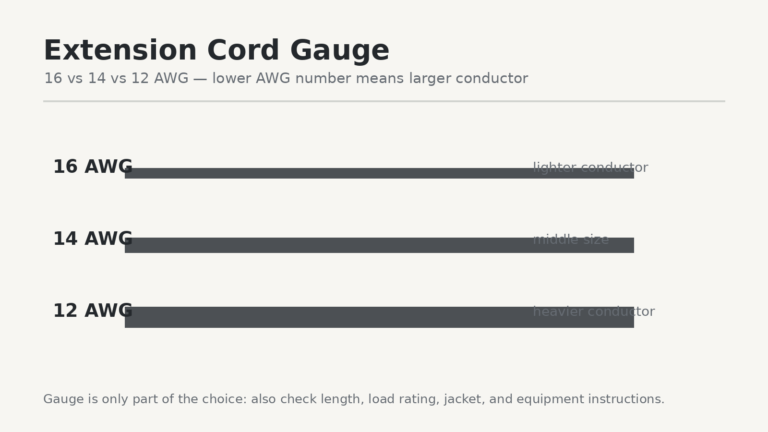
The smaller the gauge number, the thicker the wire.
So 12-gauge is heavier than 14-gauge, which is heavier than 16-gauge.
Then length gets involved.
A 16-gauge cord that may be perfectly reasonable for a small load at 25 feet can be the wrong cord for a heavier tool at 100 feet. The reason is not that electricity gets tired on the walk. The reason is resistance and voltage drop.
For the broad 16 vs. 14 vs. 12 AWG comparison, start with Extension Cord Gauge: 16 vs 14 vs 12 AWG Explained. This article stays focused on why cord length can change the gauge a load requires.
The short answer
As an extension cord gets longer, its electrical resistance increases.
Under load, that resistance causes some voltage to be lost before the electricity reaches the tool or appliance.
Using heavier wire — a lower AWG number — reduces resistance and helps limit that voltage drop.
That is why manufacturer extension-cord tables often call for progressively heavier gauge as total cord length increases.
DeWalt, for example, publishes a cord-set table showing that a 6–10 amp load can use 18 AWG at 25 feet, 16 AWG at 50 feet, 14 AWG at 100 feet, and 12 AWG at 150 feet. Higher-amperage tools require heavier wire sooner.
Do not treat that one table as a universal rule for every product. Use the tool or appliance manual when it provides its own requirement.
What voltage drop actually means
Your receptacle may supply about 120 volts, but the tool at the far end of a long, undersized extension cord can see less voltage while it is working.
The cord itself is using some of the available voltage to push current through its resistance.
Southwire’s voltage-drop calculator exists for exactly this reason: wire size, current, and conductor length all affect voltage drop.
For a homeowner, you do not need to turn every leaf-blower job into an electrical-engineering assignment.
You do need to understand the direction of the problem:
- more current makes voltage drop worse;
- more length makes voltage drop worse;
- smaller wire makes voltage drop worse;
- heavier wire reduces the problem.
Why an undersized cord can make a tool feel weak
DeWalt warns in multiple corded-tool manuals that an undersized extension cord can cause line-voltage drop, resulting in loss of power and overheating.
That is the part buyers notice first.
The saw feels lazy. The blower does not sound right. The motor takes longer to get up to speed.
The temptation is to blame the tool.
If the same tool runs normally when plugged directly into a receptacle but struggles on a long light-duty cord, the cord deserves a look.
Why heat is the part I care about more
Voltage drop is inconvenient. Overheating is the part that gets my attention.
Current flowing through resistance produces heat.
If a cord is undersized for the load, that heat can become excessive. Plugs and connections can add their own resistance if they are loose, damaged, corroded, or poorly made.
I would stop using a setup if:
- the cord is getting noticeably hot;
- the plug or receptacle is hot;
- the tool is repeatedly slowing or struggling;
- a breaker trips;
- the cord jacket is damaged;
- a connection is loose or discolored.
The solution is not to put electrical tape over everything and hope the electrons become more cooperative.
25 feet vs 50 feet vs 100 feet
The exact required gauge depends on the load, but this is how I would think about length.
25 feet
This is forgiving territory for many normal household loads. You still need a cord rated for the equipment, but you are not adding a huge conductor run.
50 feet
Still common and practical, but this is where I would stop buying the lightest cord available simply because it is cheaper.
For tools that draw real current, 14- or 12-gauge cords start looking much more useful.
100 feet
Now length is a major part of the buying decision.
DeWalt’s own tables step several common tool loads up to heavier gauge by 100 feet. Southwire also uses a 100-foot cord as an example when explaining greater voltage drop compared with a shorter/heavier setup.
If I regularly needed 100 feet for power tools or outdoor equipment, I would rather buy one appropriately heavy cord than spend years wondering whether a skinny bargain cord is “probably fine.”
150 feet and beyond
At this point I would specifically consult the equipment manual or a proper voltage-drop calculation.
Some manufacturer tables list high-current loads as not recommended at long distances with ordinary portable cord sizes.
A longer extension cord is not an unlimited substitute for getting power closer to the work.
Do two 50-foot cords equal one 100-foot cord?
Electrically, the total conductor length still matters.
If you connect two 50-foot extension cords, the tool is about 100 feet from the receptacle through 100 feet of cord.
DeWalt’s manuals specifically tell users that when multiple extension cords are combined, each cord should meet at least the minimum wire-size requirement for the total length.
You also added another plug-and-connector junction.
I would rather use one correctly sized 100-foot cord than daisy-chain a pile of random cords if I know in advance I need 100 feet.
Can I just buy 12-gauge for everything?
You can use a heavier cord than the minimum in many ordinary applications, provided the plugs, receptacles, voltage, current rating, environment, and equipment are all compatible.
A 12-gauge outdoor cord can be a useful “I do not want to think about this every time” general-purpose cord for higher-load homeowner tools.
But heavier cords cost more, weigh more, take up more storage space, and are more annoying when you only need to power a phone charger ten feet away.
I would not replace every household extension cord with something that looks like it belongs on a construction site.
Why 16 gauge is not automatically junk
Sixteen-gauge cords get treated online as though they are decorative ribbon.
That is too simplistic.
A properly rated 16-gauge cord can be perfectly appropriate for lower-current equipment and shorter runs.
The problem is using a light cord for a high-current load over a long distance.
Gauge is not a quality score. It is a conductor size.
Check amps, not just watts
Most extension-cord selection tables are based on current.
Look at the equipment nameplate or manual for its amp rating.
If you only have watts for a simple 120-volt load, current can be estimated from watts divided by volts, but motors and startup loads complicate the picture. When the manufacturer gives an amp rating or extension-cord table, use it.
I would not size a cord from a guessed running wattage when the manual is sitting online for free.
Generators make cord length especially easy to underestimate
Portable generators often sit away from the equipment for noise and exhaust reasons, which means long cords are common.
DeWalt’s generator guidance gives progressively heavier wire recommendations as both wattage and cord length increase. Southwire likewise notes that a 100-foot 15-amp 12/3 generator cord can have greater voltage drop and deliver less power than a shorter 10/3 setup with higher-rated connectors.
The extension cord is part of the generator system. Do not spend money on generator capacity and then choke the load through the cheapest long cord you own.
Outdoor use is a separate question
A cord can be heavy enough electrically and still be the wrong cord for the environment.
If you are using it outside, look for an outdoor-use rating. UL explains that a W at the end of the flexible-cord type designation indicates suitability for wet locations and sunlight resistance.
That is the subject of the companion article: What Do SJTW, SJT, and SJOOW Mean on Extension Cords?.
The buying rule I would use
Start with the tool, not the cord rack.
- Find the tool’s amp rating.
- Decide the longest cord you actually need.
- Check the tool manufacturer’s extension-cord table if one is provided.
- Choose at least that wire size.
- Make sure the cord’s plugs, current/voltage rating, grounding, and environmental rating are appropriate too.
If the choice is borderline, I would go one gauge heavier rather than one gauge lighter.
In AWG terms, moving to the smaller number means moving to the larger conductor; the equipment manual still decides the minimum requirement.