Extension Cord Gauge: 16 vs 14 vs 12 AWG Explained
Extension cords look simple until the labels start piling up: 16/3, 14/3, 12/3, SJTW, 13 amps, 15 amps, indoor, outdoor, light duty, heavy duty.
Gauge matters, but it does not make the decision by itself. A cord also has a length, a maximum load, a jacket, connectors, and an intended environment. The tool has its own requirements. Ignore any one of those details and a cord that looks heavy-duty may still be wrong for the job.
This guide explains 16 vs. 14 vs. 12 gauge extension cords in plain English, including what the numbers tell you—and what they leave out. It follows the same buyer-first approach as the site’s Specs Explained guides.
If you are comparing a corded tool with a battery-powered alternative, the numbers answer different questions. See Cordless Tool Battery Voltage vs Amp-Hours: What Actually Matters? for the corresponding battery-platform explanation.
Quick Answer: 16, 14, or 12 Gauge?
- 16 gauge: light and easy to handle. It can suit lower-demand equipment and shorter runs when the cord’s marked rating covers the load.
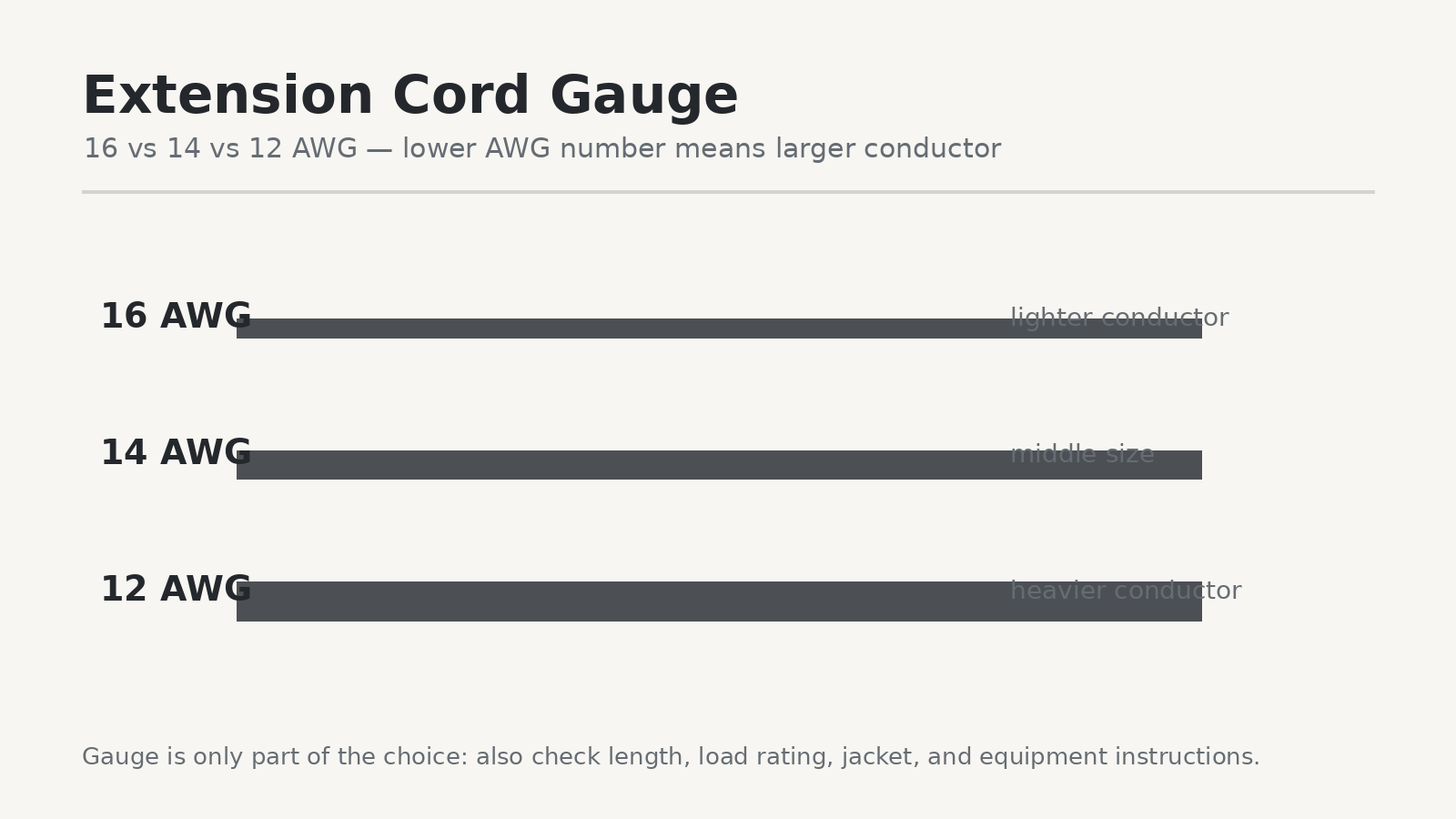
- 14 gauge: a useful middle option for many homeowner tools. It carries more current with less voltage drop than an otherwise comparable 16-gauge cord.
- 12 gauge: larger conductors and less resistance than 14 or 16 gauge. It may be required for a higher-amp tool or a longer run, but it is heavier and more expensive.
A lower AWG number means a larger conductor. That part is simple. The part that trips people up is length: a gauge that works at 25 feet may not be acceptable at 100 feet.
Use the equipment manual first, then confirm the actual rating printed on the cord. A general chart is a screening tool, not permission to ignore either label.
How Gauge, Amperage, and Length Work Together
Current traveling through a cord meets electrical resistance. A longer cord adds more resistance, while a larger conductor reduces it. Under load, resistance can lower the voltage reaching the equipment.
DeWalt warns in its corded-tool manuals that an undersized extension cord can cause voltage drop, loss of power, and overheating. Its published table gives the following minimum wire sizes for representative 120-volt cord sets:
| Tool nameplate rating | 25 feet | 50 feet | 100 feet |
|---|---|---|---|
| More than 0, up to 6 amps | 18 AWG | 16 AWG | 16 AWG |
| More than 6, up to 10 amps | 18 AWG | 16 AWG | 14 AWG |
| More than 10, up to 12 amps | 16 AWG | 16 AWG | 14 AWG |
| More than 12, up to 16 amps | 14 AWG | 12 AWG | Not recommended |
Source: DeWalt Minimum Gauge for Cord Sets. This is a manufacturer table for the equipment covered by that manual, not a universal substitute for your tool’s instructions.
The pattern is more useful than memorizing every cell. As amperage or distance increases, the recommended conductor gets larger. The table also shows why “I bought a 15-amp cord” is not the end of the discussion.
For a closer look at distance rather than the full gauge comparison, see Why Longer Extension Cords Need Heavier Gauge Wire.
Representative Real-World Cord Ratings
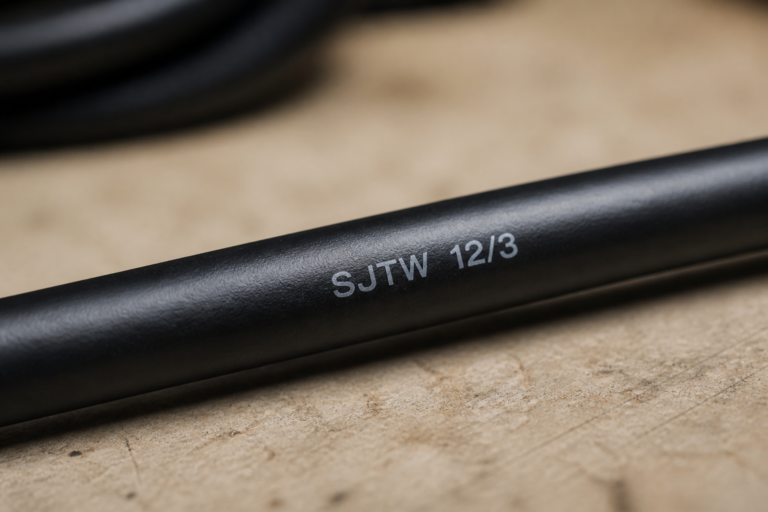
Southwire’s published specifications make the length issue easy to see. Within one 16/3 SJTW outdoor-cord series, the company rates its 25-foot and 50-foot versions at 13 amps, but the 100-foot version at 10 amps.
Same gauge. Same number of conductors. Different marked capacity at the longer distance.
That does not mean every 16/3 cord follows those exact ratings. It means you should read the label on the cord you are actually buying.
What AWG and “/3” Mean
AWG stands for American Wire Gauge. The numbering runs backward: 12 AWG is larger than 14 AWG, and 14 AWG is larger than 16 AWG.
A label such as 14/3 normally describes 14-gauge conductors in a cord containing three conductors. On a typical grounded household cord, those conductors are hot, neutral, and ground.
The “3” does not mean the cord can power three devices. It describes what is inside the cable. If equipment has a three-prong plug, use a properly grounded three-wire cord. Do not remove the grounding prong or use an adapter that defeats it.
Is a Heavier-Gauge Cord Than Required Acceptable?
Usually, yes. If a manual calls for a minimum of 14 AWG, a properly constructed 12 AWG cord can normally meet the conductor-size requirement because 12 gauge is larger.
“Heavier gauge” does not erase the other requirements. The cord still needs:
- A marked amp or watt rating that covers the equipment
- The correct plug, receptacle, and grounding arrangement
- A suitable jacket for indoor or outdoor use
- A length allowed by the equipment manufacturer
- Connectors and construction appropriate for the job
- Use on a circuit capable of supplying the load
A 12-gauge cord cannot turn a 15-amp household circuit into a 20-amp circuit. It also cannot make extension-cord use acceptable when the appliance manual says to plug directly into a wall outlet.
Does a 15-Amp Cord Work With Every 15-Amp Tool at Every Length?
No.
The cord’s 15-amp marking tells you the maximum load for that particular cord under its rated conditions. It does not promise that every 15-amp motor will start and run properly at every distance, or that the equipment manufacturer allows that setup.
Motor-driven tools can draw a brief inrush of current while starting. Low voltage at the tool can also make starting and operation harder. A properly sized cord reduces avoidable voltage drop, but it does not diagnose a tripping breaker or fix an overloaded circuit.
If protection trips, stop and find the cause. It could involve the tool, total circuit load, a poor connection, the cord, or the branch circuit. Moving to a thicker cord is not a safe substitute for troubleshooting.
Why 16 Gauge Can Be Enough—or Too Small
A 16-gauge cord can be practical for low- and moderate-demand equipment, especially over shorter distances. It is lighter, more flexible, and easier to store than a 12-gauge cord.
It becomes a poor choice when the load exceeds its marked capacity, the run is longer than the equipment permits, or the manual specifies a larger conductor. Do not assume that an orange jacket makes it a tool cord. Color improves visibility; it is not an electrical rating.
Where 14 Gauge Fits
Fourteen gauge offers more conductor than 16 gauge without the weight of 12 gauge. For many garage and yard tools, that makes it a practical comparison point.
It is not a universal answer. The DeWalt example above allows 14 AWG at 25 feet for loads above 12 through 16 amps, but calls for 12 AWG at 50 feet and does not recommend a 100-foot cord in that range. The job determines whether 14 gauge is enough.
When 12 Gauge Makes Sense
Twelve gauge becomes useful when amperage, distance, or the equipment manual calls for a larger conductor. It provides more margin against voltage drop than the same length of 14- or 16-gauge copper cord carrying the same load.
The tradeoffs are weight, bulk, and cost. Buy 12 gauge because the specifications support it, not because “heaviest” automatically means “best.” A short cord for a low-draw light does not become more useful just because it is difficult to carry.
Read the Cord, Not the Marketing
Words such as light duty, medium duty, and heavy duty are not enough information. Price is not an electrical specification either.
Compare these details:
- AWG size and number of conductors
- Length
- Maximum amps and watts
- Indoor or outdoor marking
- Grounded plug configuration when required
- Jacket type and temperature suitability
- Certification from a recognized testing laboratory
OSHA’s flexible-cord rules reinforce the underlying point that flexible cords must be suitable for their conditions of use and are not a substitute for permanent wiring. Those workplace rules are not a homeowner sizing chart, but they are useful support for treating cord construction, grounding, environment, and damage as separate questions from gauge.
The U.S. Consumer Product Safety Commission advises checking the capacity on the cord or its packaging and looking for listing by a recognized laboratory such as UL, ETL, or CSA. CPSC also warns against cords with undersized wire, inadequate strain relief, improper polarity, or other missing safety characteristics. See the CPSC household extension-cord guidance.
What SJTW Means
SJTW is a common marking on outdoor extension cords. According to UL’s wire and cable guide:
- SJ means hard-usage flexible cord.
- T means thermoplastic insulation and jacket when it follows the first designation.
- W at the end means the cord is suitable for wet locations and sunlight resistant.
UL also notes that a cord evaluated for outdoor use has a “W” in its type designation, such as SJTW. See the UL Wire and Cable Application Guide.
The jacket code does not replace the amp rating. It tells you about construction and intended conditions, not how much load every length can carry. For the markings themselves, see SJTW vs SJT vs SJOOW Extension Cord Ratings Explained.
Indoor and Outdoor Use
Use a cord outdoors only when it is marked for outdoor use. An outdoor jacket is designed for conditions an indoor cord may not withstand, but outdoor-rated does not mean the plug connection should sit in water.
Keep connections dry and use GFCI protection where required or recommended. Before each use, look for cuts, crushed areas, cracked insulation, loose blades, or signs of heat. Replace a damaged cord rather than wrapping the problem in tape.
Do not run cords under rugs, through doorways where they can be pinched, or across sharp edges. CPSC specifically warns that rugs can prevent heat from escaping and that damaged or overloaded cords can create fire and shock hazards.
Common Homeowner Situations
Lights and Low-Draw Devices
A short 16-gauge cord may be enough when the device falls comfortably within the cord’s marked rating. Match the jacket to the location.
Drills, Sanders, and Yard Tools
Start with the tool’s nameplate amperage and its manual’s length table. Fourteen gauge may suit many moderate loads; a longer run or higher demand may move the requirement to 12 gauge.
Shop Vacuums and Air Compressors
Motor size varies widely, so the name of the tool tells you very little. A small shop vacuum and a large compressor do not belong in the same electrical category. Use the nameplate and the manufacturer’s minimum-gauge instructions.
Electric Pressure Washers
Water and electricity make guessing especially unwise. Some manufacturers restrict extension-cord use or specify gauge, length, grounding, and GFCI requirements.
If you are deciding whether an electric machine’s outlet and cord requirements are worth the tradeoff, see Electric vs Gas Pressure Washer: Which One Should Homeowners Buy?
Space Heaters and High-Wattage Appliances
A thick cord does not override an instruction to plug directly into a wall outlet. If the appliance manual prohibits extension cords, do not use one.
Common Buying Mistakes
- Buying by color: Orange and yellow improve visibility. They do not tell you gauge or amp capacity.
- Ignoring total distance: Two 50-foot cords create roughly a 100-foot run plus another plug connection.
- Treating extra outlets as extra capacity: A three-outlet end does not triple what the cord can carry. Add the connected loads together.
- Using an indoor cord outside: Check for an outdoor-use marking and a suitable jacket.
- Keeping a damaged cord: Cuts, loose connectors, heat damage, and exposed conductors are reasons to replace it.
- Using cords as permanent wiring: Extension cords are temporary flexible connections, not substitutes for permanent wiring. If power is regularly needed in the same place, have the need evaluated appropriately.
A Simple Buying Checklist
- Find the equipment’s amps or watts.
- Check whether its manual allows an extension cord.
- Use the manual’s minimum AWG for the full distance.
- Confirm the cord’s marked load rating.
- Match the plug, grounding, jacket, and environment.
- Choose one cord that reaches without unnecessary extra length.
- Look for a recognized testing-laboratory listing.
Bottom Line
Sixteen gauge can be enough for lower-demand equipment and shorter runs. Fourteen gauge is a useful middle option. Twelve gauge may be needed as amperage or distance increases.
None of those statements works without the rest of the label. The useful buying decision combines gauge, length, marked capacity, connectors, jacket, equipment instructions, and circuit limits.
Do not buy by color or by the words “heavy duty.” Read the tool. Read the cord. Make sure the numbers agree.