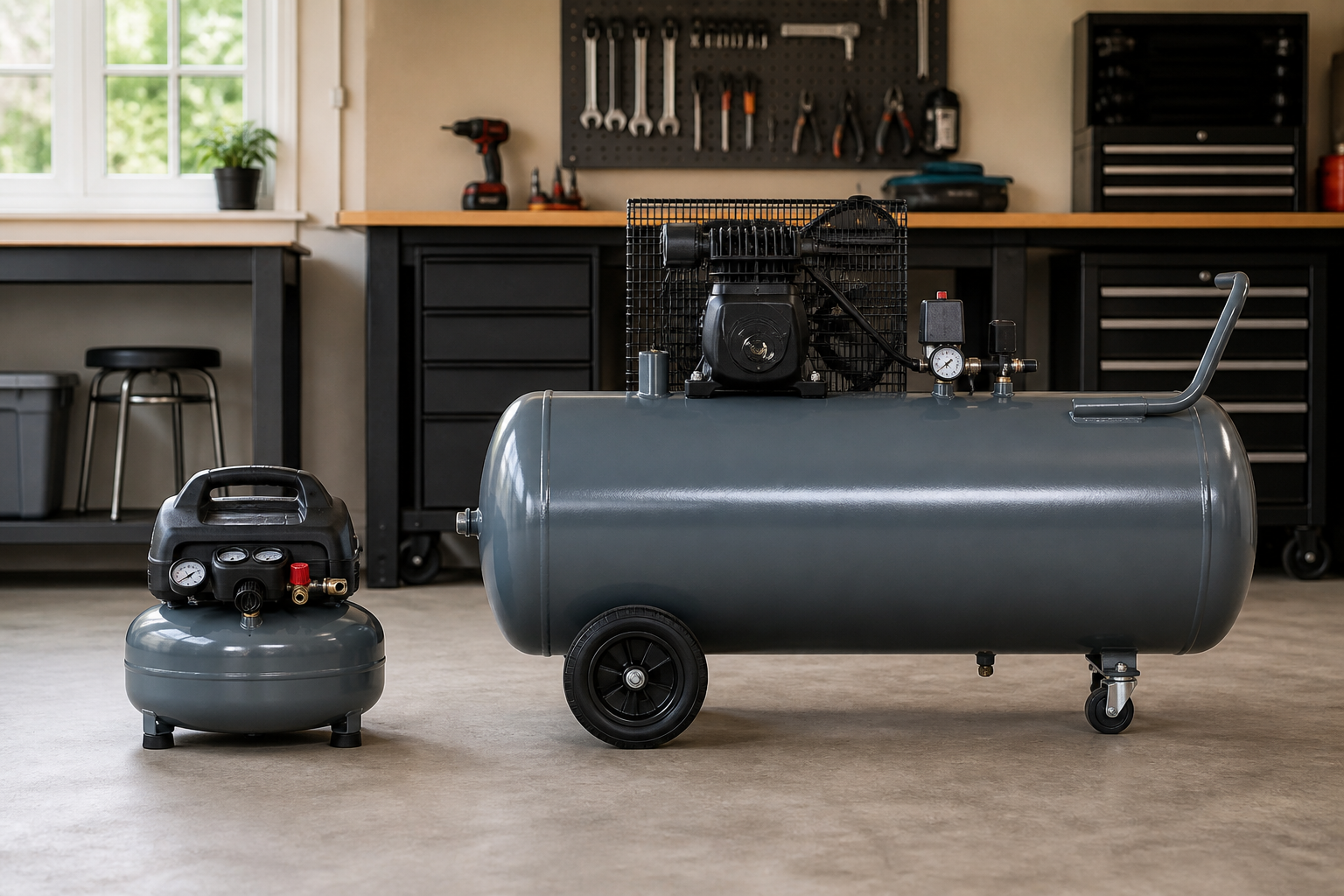
Air Compressor Tank Size Explained: Does a Bigger Tank Matter?
Air-compressor tank size is easy to overvalue because gallons are printed in big type. A 6-gallon pancake compressor looks small next to a 20- or 60-gallon machine, so it is tempting to assume the larger tank is automatically more powerful.
That is not what tank size measures.
Quick answer
The tank is compressed-air storage. A larger tank can provide a bigger reserve, stretch the time between pressure swings, and help with short bursts of demand. It does not increase the pump’s CFM or magically make a compressor suitable for a continuous tool that consumes air faster than the pump can replace it.
Start with airflow and pressure. Then use tank size to decide how much storage and recovery behavior you want.
What the tank actually does
The receiver tank stores compressed air between the compressor pump and the tool. Ingersoll Rand describes receiver tanks as extra air storage, which is the useful way to think about them. See Ingersoll Rand’s receiver-tank page.
When a tool draws air, pressure in the tank falls. The compressor cycles or remains running according to its controls and duty design, replacing the air that leaves.
What a larger tank can improve
More stored reserve for short bursts
A larger tank can supply a burst-demand tool for longer before tank pressure falls to the cut-in point. That can be useful for intermittent work where the tool consumes air quickly for a short period and then rests.
Longer intervals between some cycles
With more stored air, a compressor may take longer to fall from cut-out pressure to cut-in pressure under the same intermittent load. That can make operation feel less frantic than a tiny tank that cycles frequently.
More buffer between changing demands
Storage can smooth brief changes in demand. This is one reason receiver tanks are used in larger compressed-air systems as well as homeowner compressors.
What a larger tank cannot fix
It does not increase pump output
If a compressor pump delivers 4 SCFM at 90 PSI, bolting on more storage does not make the pump deliver 8 SCFM at 90 PSI. You simply have more stored air before the same pump has to replace it.
It does not increase the tool’s available pressure beyond system limits
The tank cannot safely create pressure above the compressor’s rated controls or the tool’s allowed pressure. Regulate the outlet according to the tool manual.
It does not create a higher duty cycle
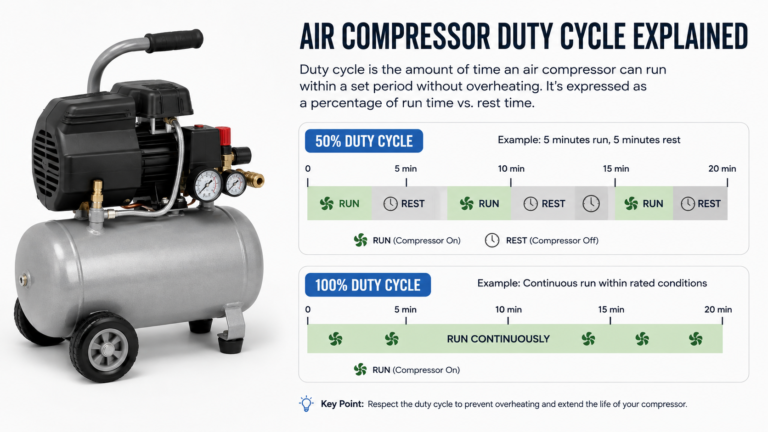
A larger receiver can change how frequently the machine cycles under intermittent use, but it does not change what the compressor pump and motor are designed to tolerate. Duty-cycle limits still matter.
Same gallons, different CFM: a useful reality check
Ingersoll Rand’s single-stage electric line includes multiple 60-gallon models. The nominal tank size stays the same while published airflow at 90 PSI varies by model.
| Ingersoll Rand example | Tank | Flow at 90 PSI |
|---|---|---|
| SS3L3 | 60 gallons | 11.3 CFM |
| SS4L5 | 60 gallons | 14 CFM |
| SS5L5 | 60 gallons | 18.1 CFM |
Source: Ingersoll Rand single-stage specifications.
That table is a clean reminder: gallons describe storage; CFM describes flow.
Small tanks can be perfectly appropriate
A small compressor can be a good match for inflation, blowing out small items within the manufacturer’s safe-use instructions, and intermittent fastening work if its airflow and pressure satisfy the tool.
Smaller tanks also make the compressor lighter and easier to carry. That matters if the machine moves from room to room or goes into a vehicle after every project.
The tradeoff is less stored reserve. A small tank can cause the pump to cycle frequently when demand rises.
Why nailers often tolerate smaller tanks
Nailers typically consume air in short events rather than as a continuous stream. The tank can recover between bursts, especially when the firing rate is modest.
That does not mean every small compressor can run every nailer at every pace. Makita’s AF601 manual, for example, ties required compressor output to operating pressure and firing interval. See Makita AF601 manual.
Why sanders, grinders, and spray work change the equation
Continuous tools can drain stored air faster than an undersized pump can replace it. A larger tank may delay the pressure drop, but once the stored reserve is depleted, the pump’s delivered airflow becomes the limiting factor.
This is why a big tank should not be used as a substitute for proper air-compressor sizing.
Cut-in and cut-out pressure change how much of the tank you can use between cycles
The whole tank does not empty every time the compressor cycles. The control system normally lets pressure fall from a higher cut-out point to a lower cut-in point and then starts the pump again.
That usable pressure band, along with tank volume and the tool’s regulated pressure, affects how long a stored-air burst feels. This is another reason gallons by themselves are incomplete: two compressors with the same tank size can use different control pressures and have different pump outputs.
Recovery time matters
Recovery is the compressor’s ability to rebuild tank pressure after air has been used. A large tank attached to a modest pump may provide a long working burst but also take longer to refill. A smaller tank with a capable pump may recover quickly but cycle more often.
There is no universal “best” combination. The right balance depends on whether you value portability, short high-demand bursts, or sustained use.
Maximum PSI and tank size are still separate
Maximum PSI tells you the top pressure the system is designed to reach under its controls. Tank gallons tell you stored volume. Neither number replaces the compressor’s delivered airflow.
Campbell Hausfeld’s 8-gallon DC080500, for example, is published at 125 max PSI and 2.4 SCFM at 90 PSI. Its 20-gallon DC200100 is listed at 4.0 CFM at 90 PSI. Those machines differ in several ways, and the airflow number has to be checked independently of the tank number. Sources: DC080500 specifications and DC200100 specifications.
How tank size feels in common homeowner jobs
| Use pattern | What tank capacity changes | What still matters more |
|---|---|---|
| Occasional inflation | How long you can draw from stored air before cycling | Portability, hose reach, inflation controls |
| Finish or brad nailing | Reserve between bursts and cycling frequency | Tool airflow/PSI and firing rate |
| Impact wrench in short bursts | How long stored air can support a burst | Loaded airflow and hose/fitting size |
| Sanding/grinding | How long before stored reserve is depleted | Continuous pump CFM and duty cycle |
| Spraying | Buffer during passes | Required SCFM at spray pressure plus air quality |
These are relationships, not gallon recommendations. The exact tool specification still controls the compressor choice.
Tank shape: vertical vs horizontal
Tank orientation mainly changes footprint and portability. A vertical stationary tank saves floor space. A horizontal tank may fit under a bench or work better on a wheeled portable chassis.
Do not treat shape as a performance rating. Compare the pump, delivered airflow, pressure, duty cycle, and electrical requirements separately.
Stationary tanks change the ownership decision
Once you move into larger vertical receivers, you are often also moving into heavier compressors with different electrical and installation requirements. A 60-gallon stationary machine may need 230-volt service, a permanent location, and more planning for ventilation, drainage, and hose routing.
That can be a worthwhile trade for sustained garage work, but “buy the biggest tank you can afford” is poor advice if the compressor will not fit the space, cannot be powered correctly, or provides far more machine than the actual tools require.
Do not ignore draining and tank condition
Compressing air also condenses moisture. Follow the manufacturer’s draining and maintenance instructions. Do not exceed rated pressure, defeat safety devices, or treat a damaged or heavily corroded receiver as a DIY repair project.
Tank maintenance is not glamorous, but a larger tank only helps if the whole compressor is maintained according to its manual.
A practical tank-size decision
- First make sure the compressor meets the tool’s CFM/SCFM and PSI needs.
- Check duty cycle for the way you will use the tool.
- Decide how much portability matters.
- Ask whether the work is short-burst or continuous.
- Use tank size to choose the storage/recovery behavior you prefer among compressors that already meet the air requirement.
If you are still sorting out the numbers, start with Air Compressor CFM vs PSI.
Bottom line
A bigger tank is a bigger buffer, not a bigger pump. It can make intermittent work smoother and give you more stored air before pressure falls, but it cannot compensate indefinitely for insufficient airflow.
Buy enough CFM at the PSI your tools require. Then choose tank capacity based on burst demand, recovery, cycling, portability, and how you actually work.