How Much CFM Do Air Tools Need?
Search for “air tool CFM chart” and you will find neat tables that make compressor sizing look easy. The problem is that two tools in the same category can have different air demands, and manufacturers do not always define their CFM figures the same way.
The safer way to size a compressor is to use the specification for the exact tool you plan to run.
Quick answer
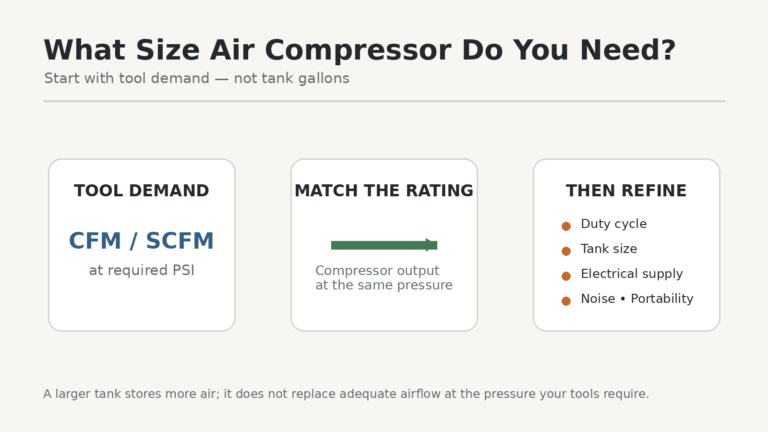
Find the tool’s required CFM or SCFM and its required PSI in the manual or manufacturer specifications. Then compare that with the compressor’s delivered airflow at the same or a higher stated pressure.
If tools run together, add their simultaneous airflow requirements. If they run one at a time, size around the most demanding tool plus whatever margin is appropriate for the manufacturer’s guidance and your workload.
Why one universal CFM chart can mislead you
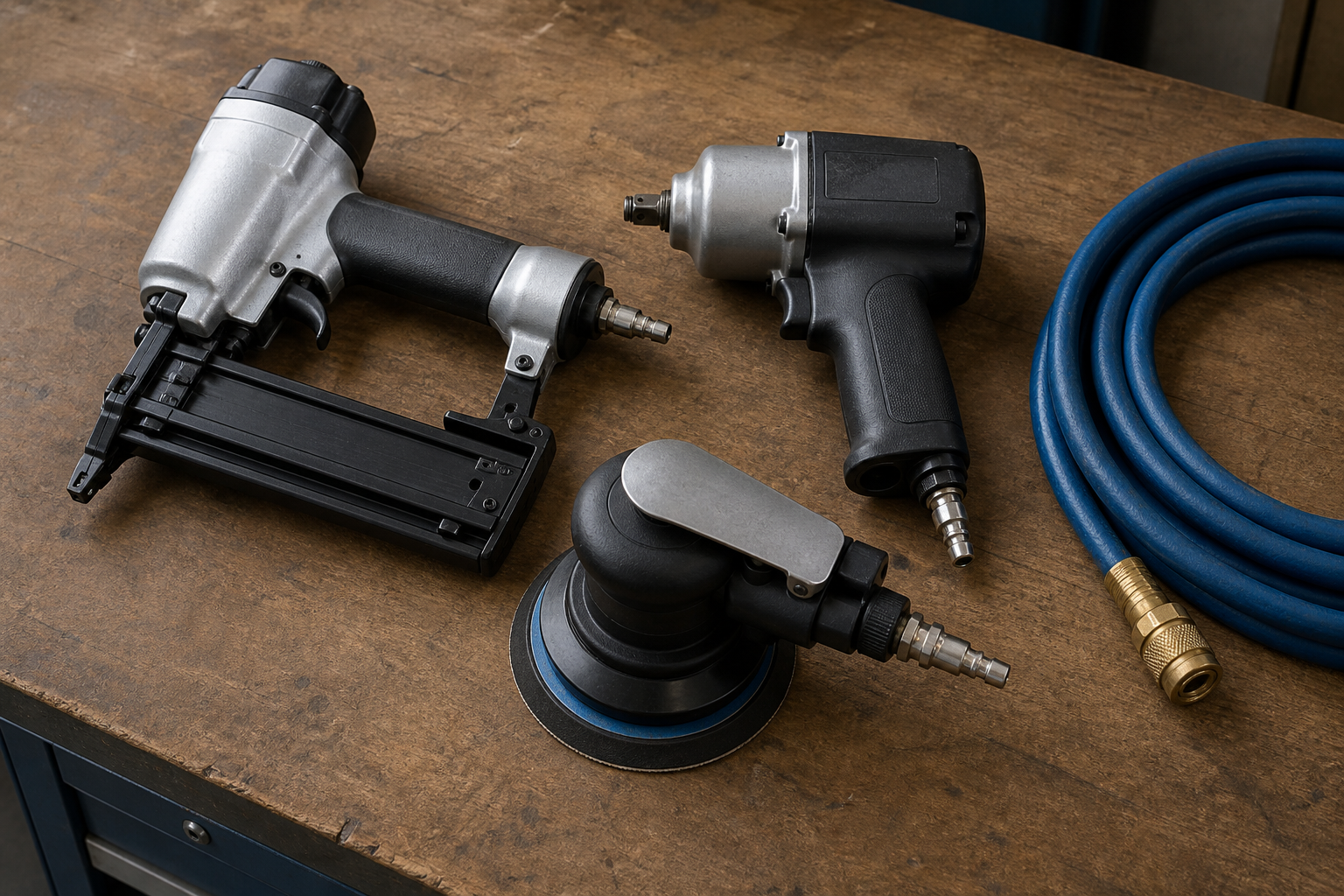
“Impact wrench,” “sander,” and “nailer” are categories, not air-consumption specifications.
An impact wrench used for a few seconds at a time behaves differently from a sander held on continuously. A small finish nailer fired slowly behaves differently from the same nailer being cycled rapidly. A spray gun can demand substantial airflow at a lower pressure.
That is why this article uses manufacturer examples to show the range rather than pretending they are universal defaults.
Example 1: a finish nailer
Makita’s AF601 finish-nailer manual provides a concrete example of how firing rate affects demand. Under one rapid-use example, Makita says compressor output over 3.0 CFM at 70 PSIG is required when the interval between nails is 0.5 second.
Source: Makita AF601 instruction manual.
The takeaway is not “all finish nailers need 3 CFM.” It is that operating pressure and usage rate matter.
Example 2: a spray gun
Campbell Hausfeld’s DH650001AV spray gun specifies a compressor capable of at least 7.0 SCFM at 40 PSI. That is a useful reminder that lower PSI does not automatically mean low air demand.
Source: Campbell Hausfeld DH650001AV specifications.
Example 3: an impact wrench
Ingersoll Rand’s 2015MAX/2025MAX right-angle impact wrench specifications list both average air consumption and air consumption at load. The 2015MAX is listed at 3.5 CFM average consumption but 19 CFM at load at 90 PSI.
Source: Ingersoll Rand 2015MAX/2025MAX specifications.
If you copied only the smaller average number into a continuous-use sizing calculation, you could misunderstand what the tool needs while it is actually working.
Example 4: an air sander
Ingersoll Rand’s random-orbital sander line publishes average air consumption in its specifications. These are the types of tools that can spend far more time running continuously than a nailer or occasional impact wrench.
Source: Ingersoll Rand random-orbital sander specifications.
For sustained sanding, check the exact model’s airflow, pressure, hose, and duty requirements rather than treating a generic “sander CFM” figure as sufficient.
Average air consumption vs air consumption at load
These terms are not interchangeable.
Average consumption may incorporate an assumed usage pattern or duty factor. Consumption at load is closer to what the tool uses while it is actively doing work under the stated condition.
Manufacturers may publish air-consumption ratings using different assumptions or definitions. Read the label or data sheet before comparing numbers.
For one conservative method, see Quincy Compressor’s garage-sizing guide.
Keep PSI attached to the CFM number
A tool requiring 6 CFM at 90 PSI is not automatically matched by a compressor that produces 6 CFM at 40 PSI.
Our CFM vs PSI guide explains why the pressure condition matters. For shopping, the simplest rule is to compare delivered airflow at the pressure the tool needs.
What if the tool only gives an operating-pressure range?
Some nailers publish a range such as 70–120 PSI rather than one fixed number. Follow the tool manual for regulation and use. Do not automatically run the tool at the top of the range just because the compressor can.
Makita’s AF506, for example, publishes an operating-pressure range of 70–120 PSI. The range describes allowed operation, not a reason to use maximum pressure for every nail. See Makita AF506 specifications.
One tool at a time vs simultaneous use
If one person operates one pneumatic tool at a time, the highest individual airflow requirement is usually the main sizing input.
If two tools operate at the same time, add the simultaneous demand. Quincy Compressor recommends totaling the CFM requirements of equipment that may operate simultaneously, then multiplying by 1.5 for reserve capacity in its garage-sizing example. See Quincy Compressor’s garage-sizing guide.
This is also why a two-port compressor does not automatically mean it can run two high-demand tools at full performance. Two couplers are connection points, not double the pump output.
Short-burst tools vs continuous tools
Air demand over time changes the practical compressor size.
- Intermittent tools: nailers, staplers, and an impact wrench used in short bursts can benefit from stored air between events.
- More continuous tools: sanders, grinders, and many spray applications can keep drawing air long enough for pump output and duty cycle to become the limiting factors.
A tank can provide a buffer, but it does not create more continuous airflow. See Air Compressor Tank Size Explained.
Regulators do not create airflow
The regulator sets downstream pressure; it does not make an undersized compressor produce more air. If the tool pressure collapses during use even though the tank gauge looks healthy, the restriction can be in the regulator, hose, fittings, or couplers—or the tool may simply be demanding more air than the compressor can deliver.
Diagnose the whole air path rather than turning the regulator above the tool’s allowed pressure.
Do hose and coupler sizes matter?
Yes. Restrictive hoses and fittings can create pressure drop and limit flow between the compressor and tool.
Many Ingersoll Rand pneumatic-tool specification tables publish minimum hose size along with air inlet and consumption data. Follow the exact tool requirement rather than assuming the smallest convenient hose is good enough.
Why the same tool can feel fine for five seconds and weak after thirty
A tank can cover a short burst even when the pump’s continuous output is below the tool’s loaded demand. As the stored reserve falls, the compressor reaches a point where pump output has to keep up with the tool by itself.
That is why a small compressor may remove a few lug nuts successfully and then struggle during extended use, or run a sander briefly before pressure falls. The symptom is not necessarily “too little PSI.” It can be too little sustained airflow.
For that reason, test-drive thinking should distinguish burst performance from continuous capacity.
A better way to build your own air-tool demand list
| Tool | Required flow | Required PSI | Usage pattern | Source |
|---|---|---|---|---|
| Your impact wrench | From manufacturer | From manufacturer | Short bursts or sustained | Manual/spec page |
| Your sander | From manufacturer | From manufacturer | Usually sustained | Manual/spec page |
| Your nailer | From manufacturer | From manufacturer | Intermittent; firing rate matters | Manual/spec page |
| Your spray gun | From manufacturer | From manufacturer | Often sustained during a pass | Manual/spec page |
That table is less satisfying than a universal chart because you have to look up your tools. It is also much more useful.
Build the list from exact model numbers
If you already own the tools, record the model number next to each demand figure. That makes it much harder to accidentally mix a retailer’s generic chart with the requirement for a different tool.
If you are buying the compressor before the tools, research at least the most demanding likely tool first. A compressor chosen for a low-demand brad nailer can be a poor foundation for future sanding or spraying.
How much extra compressor capacity should you buy?
Manufacturer guidance varies. Campbell Hausfeld recommends 1.5 times the required SCFM in its DIY sizing guidance. Quincy recommends adding a safety margin after totaling expected demand.
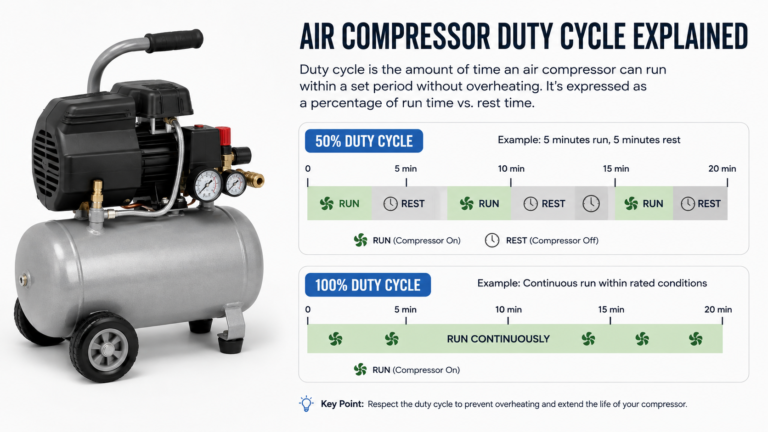
Use those as examples of why margin exists, not as permission to ignore the exact compressor manual or tool requirements. If your job is continuous and demanding, duty cycle may matter as much as the margin.
For a step-by-step process and calculator, use What Size Air Compressor Do You Need?
Compressed-air safety still matters
Do not use compressed air casually on skin or clothing. OSHA’s workplace standard restricts compressed air used for cleaning and requires effective guarding and protective equipment under its conditions. The homeowner takeaway is straightforward: compressed air can injure people and launch debris.
See OSHA 1910.242 and follow the specific tool and compressor manuals.
Bottom line
There is no single trustworthy “CFM for every air tool” chart. Use the exact tool’s airflow and PSI requirement, understand whether the published figure is average or loaded consumption, and account for how long and how often the tool will run.
Then match that demand to the compressor’s delivered airflow at the relevant pressure. The extra five minutes spent checking the manufacturer’s numbers is cheaper than buying a compressor that spends every project trying to catch up.