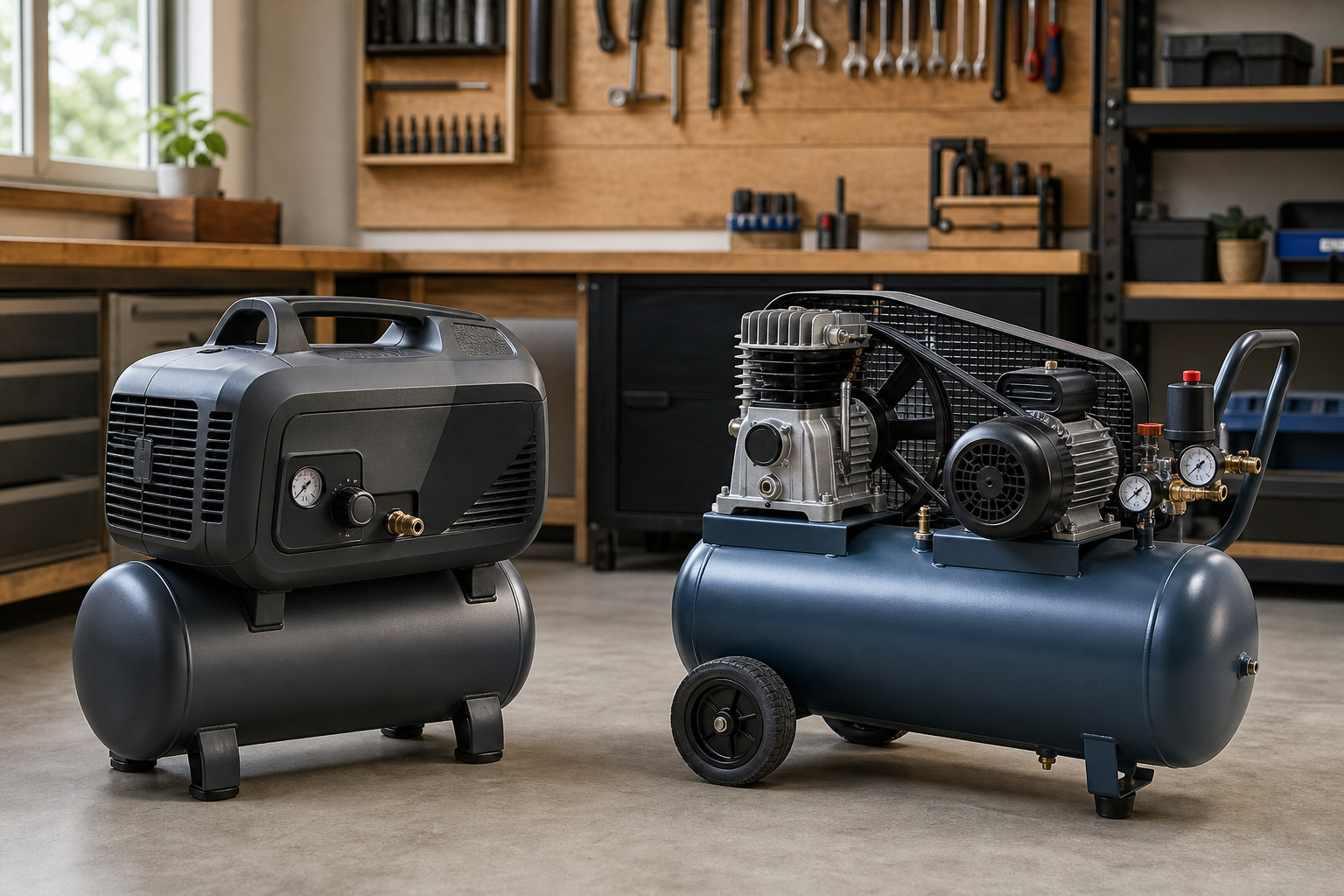
Oil-Free vs Oil-Lubricated Air Compressors: Which Is Better for Home Use?
Oil-free and oil-lubricated air compressors can both be good homeowner machines. The difference is not “cheap versus professional,” and the label does not tell you everything about noise, durability, air quality, or maintenance.
The useful question is which pump design fits the way you plan to use and maintain the compressor.
Quick answer
- Oil-free compressors do not require the user to add lubricating oil to the compressor pump. They are convenient for occasional use and portable machines because there is no pump-oil level to monitor.
- Oil-lubricated compressors use compressor oil in the pump and require oil checks and changes according to the manual. They are common in heavier-duty reciprocating machines.
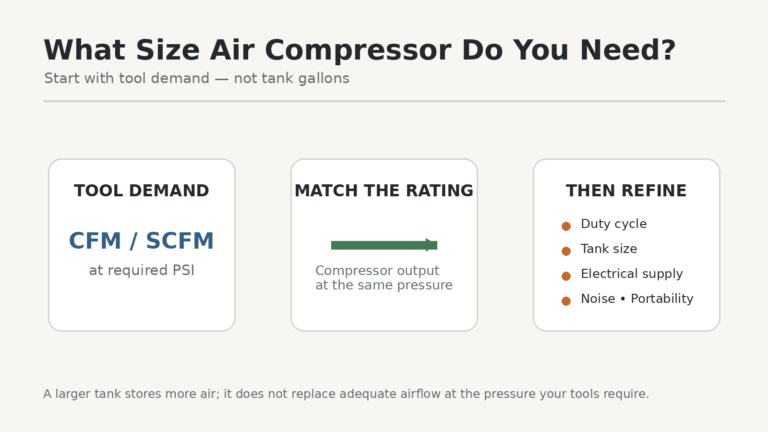
Do not choose between them until both machines meet the CFM/SCFM, PSI, duty-cycle, electrical, and tank requirements of your tools.
What “oil-free” actually means
Oil-free refers to the compressor’s compression mechanism not requiring user-added lubricating oil in the pump. It does not mean the entire machine has no maintenance, and it does not mean the air leaving the tank is automatically dry, particle-free, or suitable for breathing.
Quincy explains that oil-free designs use materials or lubrication approaches that eliminate the need to add oil to the compression process. See Quincy’s compressor-oil guidance.
What an oil-lubricated compressor asks from you
An oil-lubricated pump needs the correct compressor oil and a maintenance schedule. The manual may call for checking the oil level, changing oil after a certain interval, and using a specific viscosity or formulation.
Do not substitute automotive engine oil because it happens to be on the shelf. Quincy specifically warns that detergent additives common in motor oil can be inappropriate for compressor pumps. Use the oil specified by the manufacturer.
Maintenance: oil-free wins on simplicity
For an occasional homeowner who wants to pull the compressor out for trim work, tire service, or a few garage jobs, not having a pump-oil level to maintain is genuinely convenient.
Campbell Hausfeld markets several homeowner oil-free compressors as maintenance-free at the pump. Its DC080500, for example, uses an oil-free pump and is sold as a quiet portable model. See Campbell Hausfeld DC080500.
“Maintenance-free pump” does not mean “maintenance-free compressor.” Tanks still need draining, filters and intakes need attention as specified, hoses and fittings wear, and safety devices should not be ignored.
Durability and duty cycle: compare the actual machine
Oil-lubricated pumps are common in machines designed for heavier or more sustained duty. Quincy notes that lubricated designs are often chosen for higher duty cycles and longer service expectations.
That does not make every oil-free compressor disposable. Product design, materials, pump speed, cooling, duty rating, and workload matter. Compare the exact manufacturer’s duty guidance rather than turning the lubrication label into a universal lifespan prediction.
Noise: do not rely on the oil label
Oil-lubricated pumps are often associated with quieter operation, and Quincy cites quieter running as one reason lubricated compressors are common in workshops and industrial settings.
But modern oil-free machines can also be intentionally designed for low noise. Campbell Hausfeld publishes a 68 dBA rating for its oil-free DC080500 quiet-series compressor. So the useful shopping number is the manufacturer’s dBA rating under a stated condition—not the word “oil-free.”
Source: Campbell Hausfeld DC080500 specifications.
Portability
Many small portable pancake, hot-dog, and quiet-series compressors are oil-free. Eliminating pump oil can simplify moving and storing the unit because you do not have to worry about maintaining an oil sump in the same way as a lubricated pump.
Oil-lubricated portable models still exist. Makita’s MAC2400 and MAC5200, for example, use oil-lubricated pumps and publish substantial airflow for portable reciprocating machines. Sources: Makita MAC2400 and Makita MAC5200.
Serviceability can matter more than the oil change itself
Oil changes are only one part of long-term ownership. Before buying a compressor you expect to keep for years, look at whether the manufacturer publishes parts diagrams, service instructions, filters, belts, valves, and local service options for that model.
An oil-lubricated pump that can be maintained and serviced may appeal to someone building a permanent garage setup. An inexpensive oil-free portable may make more sense for a homeowner who values simplicity and uses it a few weekends each year.
The point is to compare the ownership path of the exact models, not to assume the lubrication label determines repairability.
Air quality: oil-free does not mean breathing air
Oil-free compression reduces one source of oil contamination, which matters in applications that require very clean compressed air. But homeowner compressed air can still contain moisture, particles, and contaminants from the intake, tank, hoses, and environment.
Do not use a normal shop compressor for breathing air unless the entire system is specifically designed, treated, monitored, and approved for that purpose.
What about painting?
Painting requires more than choosing oil-free or oil-lubricated. The spray gun has an airflow and pressure requirement, and the air supply also has to manage moisture and contamination.
An oil-lubricated compressor can be used in many painting setups with appropriate filtration and air treatment, while an oil-free pump removes one potential source of oil carryover. Neither design eliminates the need to follow the spray-equipment and compressor manufacturer’s air-quality requirements.
For example, Campbell Hausfeld’s DH650001AV spray gun requires a minimum 7.0 SCFM at 40 PSI. That airflow requirement does not disappear because the compressor is oil-free. See Campbell Hausfeld spray-gun specifications.
Cold storage and seasonal use
Temperature can affect starting, lubricant viscosity, condensation, and general compressor operation. If the machine will live in an unheated garage, check the operating-temperature and lubricant guidance in the specific manual rather than assuming one pump type automatically handles winter better.
DEWALT, for example, publishes an operating-temperature range for its compressors. The broader lesson is useful even if you buy another brand: the storage location is part of the specification check.
Oil-free can make sense when…
- You want simple pump maintenance.
- The compressor is moved and stored frequently.
- Your use is intermittent rather than all-day continuous work.
- The exact machine meets your airflow, pressure, and duty needs.
- You value a compact or quiet-series design that happens to use an oil-free pump.
Oil-lubricated can make sense when…
- You are comfortable checking and changing compressor oil.
- You are shopping for a more stationary or sustained-duty machine.
- The exact lubricated model offers the airflow and duty cycle your tools require.
- You value serviceability and the manufacturer’s long-term maintenance path.
Four realistic ownership profiles
| Owner | What may matter most |
|---|---|
| Occasional trim/DIY user | Low maintenance, easy carrying, adequate nailer airflow, reasonable noise |
| Home auto/garage user | Loaded airflow, hose size, reserve, duty cycle, serviceability |
| Frequent sanding/spraying user | Sustained airflow, duty cycle, air treatment, noise, electrical supply |
| Permanent workshop setup | Long-term service path, electrical installation, tank/drain access, sustained output |
Oil-free or oil-lubricated can appear in more than one of those rows. Start with the job, then evaluate the design.
The buying order matters more than the lubrication label
- Match required airflow and PSI.
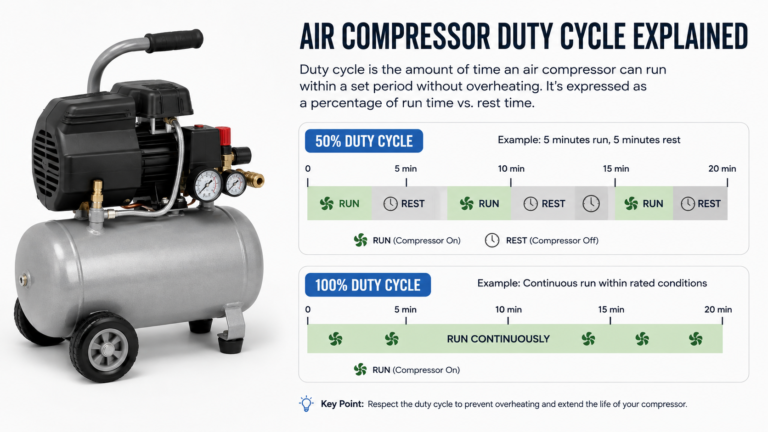
- Check duty cycle for your use pattern.
- Choose tank storage and portability.
- Verify electrical supply.
- Compare noise using published dBA where available.
- Then decide whether oil-free convenience or lubricated-pump maintenance better fits you.
If the first two steps are still fuzzy, start with Air Compressor CFM vs PSI and What Size Air Compressor Do You Need?
Bottom line
Oil-free is simpler to maintain at the pump. Oil-lubricated asks more from the owner but is common in compressors built for demanding use. Neither label is a shortcut for CFM, PSI, duty cycle, noise, tank size, or durability.
Choose the compressor that meets the air demand first. Then choose the lubrication system whose maintenance and ownership tradeoffs fit the way you will actually use it.