Air Compressor CFM vs PSI: What Size Do Homeowners Need?
Air compressor shopping gets confusing because the biggest number on the tank is usually PSI, while the number that decides whether an air tool keeps working is often CFM.
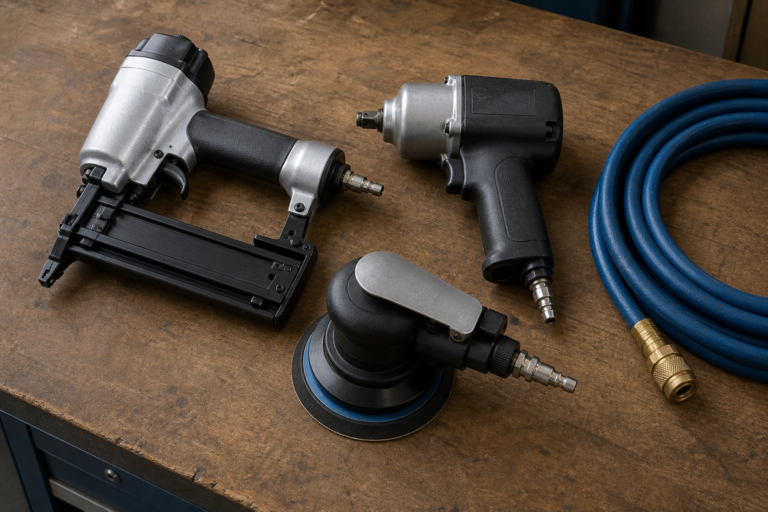
Then there are gallons, horsepower, SCFM, duty cycle, decibels, oil-free pumps, and “maximum” ratings. A compressor can look powerful on the box and still be a poor match for a sander, spray gun, impact wrench, or even the outlet in your garage.
This guide explains what the specifications mean and how to size a homeowner compressor around the tools you will actually use. It belongs with the site’s Specs Explained guides because the largest number on the label is often not the number that answers the buying question.
Quick Answer: CFM Usually Decides Tool Compatibility
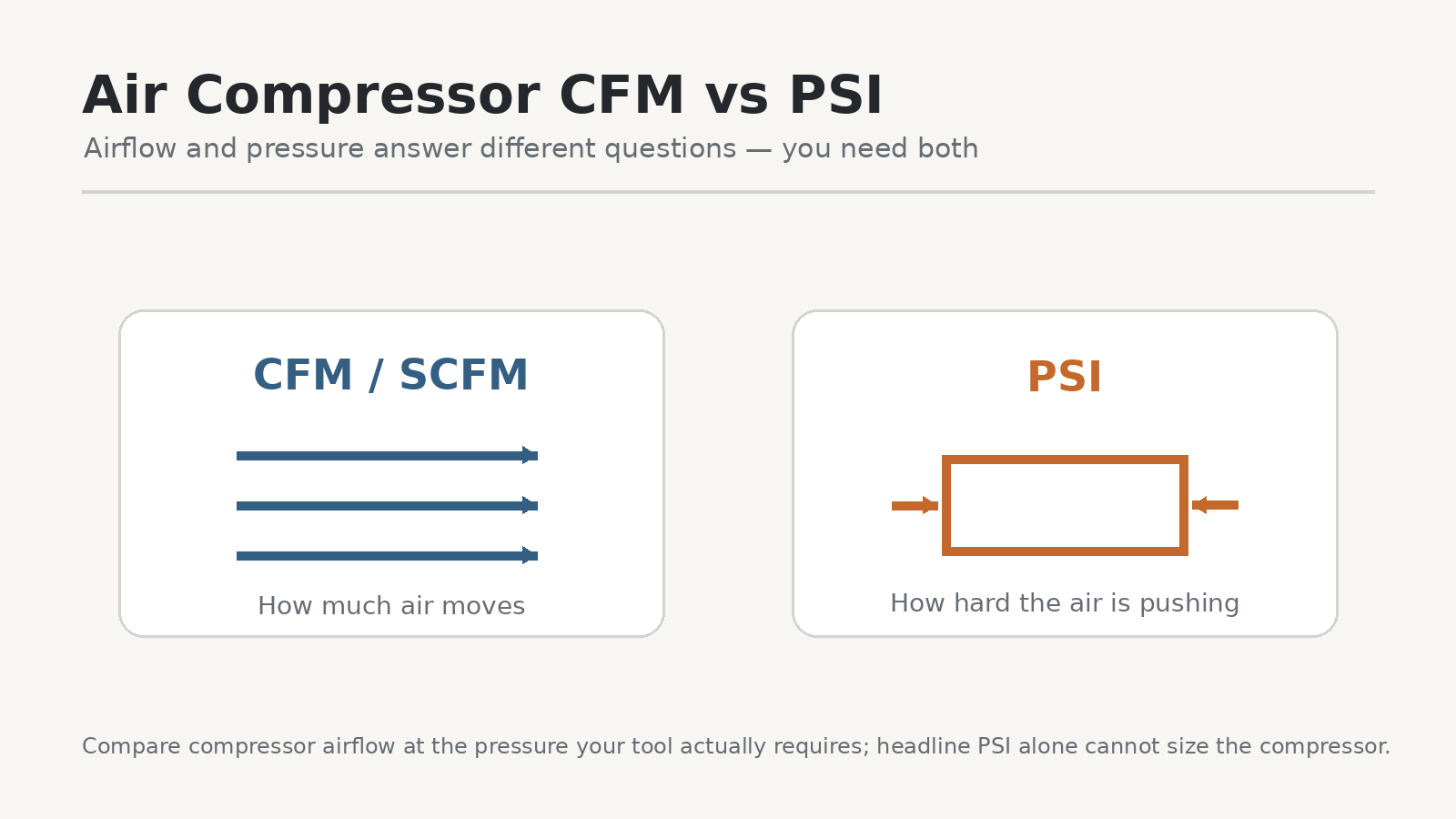
PSI is pressure. It tells you how much air pressure the compressor can produce.
CFM is airflow. It tells you how much air volume the compressor can deliver over time. Compressor output should always be compared at a stated pressure, such as SCFM at 90 PSI.
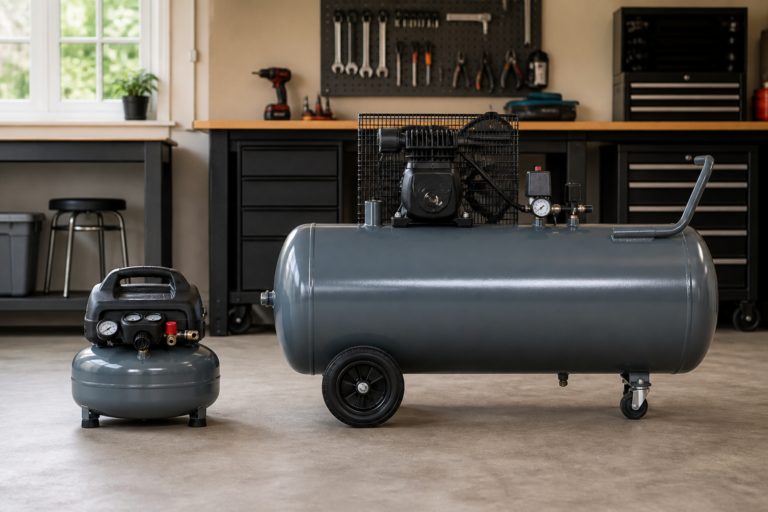
Tank gallons are stored air. A larger tank can provide a longer buffer before the pump cycles, but it does not turn a low-CFM pump into a high-CFM compressor.
Start with the air tool that requires the most CFM at its specified PSI. If tools will run together, add their simultaneous airflow requirements. Then use the tool and compressor manufacturers’ guidance to choose output margin and duty cycle. A universal percentage is less useful than documentation for the equipment being matched.
What PSI Means
PSI stands for pounds per square inch. Air tools need enough pressure to operate correctly. Many handheld pneumatic tools publish requirements around 90 PSI, but the exact tool specification controls the decision.
Maximum tank pressure is not the same as delivered working pressure. A compressor may store air at a higher pressure and regulate it down for the tool.
Once a compressor can provide the required working PSI, a larger maximum-PSI number does not automatically make the tool work faster. Airflow becomes the next question.
What CFM and SCFM Mean
CFM stands for cubic feet per minute. It describes airflow volume. A tool that consumes air continuously can outrun a compressor that does not produce enough CFM, even if the tank initially reaches the required PSI.
SCFM means standard cubic feet per minute. It expresses airflow normalized to stated reference conditions. The word “standard” does not guarantee that two listings used identical reference conditions or pressure points. Compare output at the same working PSI and check the manufacturer’s rating notes.
A listing of “5 SCFM at 90 PSI” is more useful than “high airflow.” The first can be checked against a tool requirement. The second is marketing.
CFM Must Be Compared at the Same PSI
A compressor can deliver more airflow at a lower pressure. That is why CFM without PSI is incomplete.
| Compressor listing | What it tells you | Can it be compared directly? |
|---|---|---|
| 5.0 SCFM at 90 PSI | Airflow at a common tool pressure | Yes, against another 90-PSI rating |
| 6.5 SCFM at 40 PSI | Airflow at a lower pressure | No, not directly against 90 PSI |
| 135 PSI maximum | Highest tank/system pressure | No, it does not state airflow |
| 6-gallon tank | Stored-air volume | No, it does not state pump output |
The numbers in this table are examples of rating formats, not a recommendation for a particular tool.
How to Size a Compressor for Your Air Tools
- List the pneumatic tools you expect to use.
- Find each tool’s required CFM or SCFM and required PSI from its manual or data plate.
- Identify the highest-demand tool used by itself.
- If tools will operate at the same time, add their airflow requirements.
- Choose a compressor whose delivered CFM at the required PSI exceeds that demand.
- Check duty cycle, tank size, electrical requirements, and hose losses.
Quincy Compressor recommends sizing portable equipment with airflow margin above the combined CFM of tools used simultaneously. Its current portable-compressor guidance uses a 25% margin. Other manufacturers may specify a different approach, so use the compressor and tool documentation rather than treating 25% as a universal law.
See Quincy’s portable compressor sizing guidance.
A Practical Sizing Example
Suppose your actual tool manual requires 4 SCFM at 90 PSI. Quincy’s 25% sizing method would point to at least 5 SCFM at 90 PSI:
4 SCFM × 1.25 = 5 SCFM
If a second tool will run at the same time, add its requirement before applying the margin. If the tools alternate, size around the highest demand rather than pretending everything will run together.
This is a calculation example, not a claim that a certain class of tool always uses 4 SCFM. Use the number printed for your tool.
Why Tank Size Does Not Replace CFM
The tank stores compressed air. A larger tank lets a tool draw from that reserve longer before pressure falls and the pump must catch up.
That helps with short bursts such as nailers, staplers, inflating, and occasional impact-wrench use. It does not create continuous airflow. If a sander consumes more air than the pump produces, a larger tank delays the slowdown; it does not prevent it.
| Work pattern | Tank effect | Specification that still controls |
|---|---|---|
| Short nailer bursts | Provides useful reserve between cycles | Tool PSI and average air demand |
| Occasional tire inflation | Reduces how often the pump starts | Required pressure and desired fill speed |
| Continuous sanding or grinding | Only delays pressure drop | Continuous CFM at working PSI |
| Spray work | Can smooth short demand changes | Gun CFM, pressure, and air quality |
What Duty Cycle Means
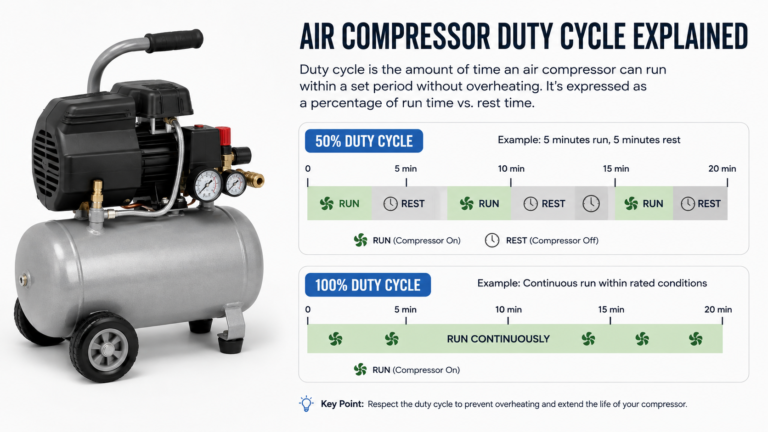
Duty cycle describes how much of a given period the compressor is designed to run. A 50% duty-cycle rating generally means the pump should spend about half the period running and half resting under the stated conditions.
A small compressor can have enough tank pressure and still be a poor choice for continuous work if its pump must run beyond its rated duty cycle to keep up.
Check how the manufacturer defines the period and conditions. “Professional” or “heavy duty” is not a duty-cycle specification. Quincy explains the operating-time distinction in its duty-cycle guide.
Does Horsepower Matter?
Horsepower describes motor or engine power, but it is not the best shortcut for delivered air.
Quincy advises comparing CFM and PSI because those numbers describe the air available to the tool. Two compressors with similar horsepower can have different pump efficiency, airflow, pressure, and duty cycle.
Use horsepower to check electrical and mechanical context. Use CFM at PSI to decide whether the compressor can run the tool.
Common Homeowner Uses
Inflating Tires and Sports Equipment
Required pressure, hose reach, portability, and fill speed matter. CFM demands may be modest, but a very small inflator can still be slow.
Nailers and Staplers
These are intermittent loads. A smaller portable compressor can often keep up because each shot uses a brief pulse of air and the tank recovers between bursts. Rapid production work changes that calculation.
Impact Wrenches and Ratchets
Tool ratings vary, and short trigger bursts can hide an undersized compressor. Check the tool’s air-consumption definition and whether it assumes intermittent use.
Sanders, Grinders, and Cutoff Tools
These can consume air continuously. Pump output and duty cycle matter more than a large tank sticker.
Paint Sprayers
Match the spray gun’s CFM and pressure requirements. Also account for moisture control, filtration, hose size, and the quality of air the finish requires.
Electrical Requirements Can Limit the Purchase
A portable compressor may use a substantial share of a 120-volt circuit, especially during motor startup. Check the nameplate amperage, plug type, and manual.
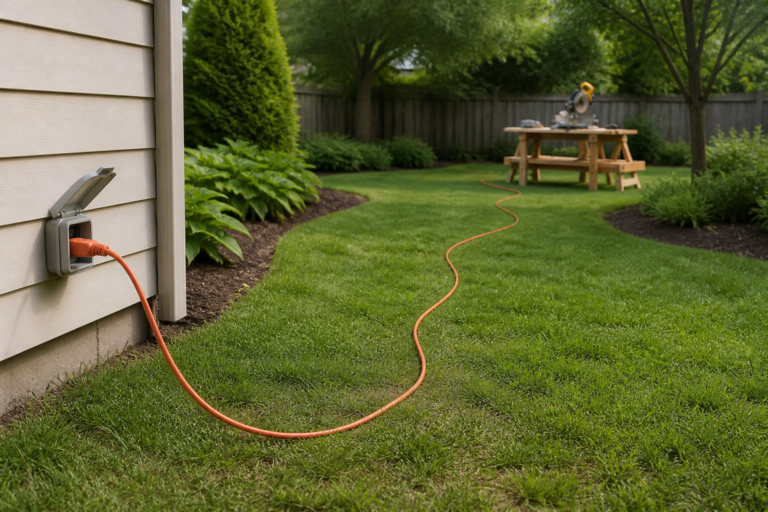
Do not assume any long extension cord is acceptable. Manufacturers may restrict cord use, length, or conductor size. If the manual directs you to add air hose instead, follow its hose-diameter and length limits because the air line can also lose pressure.
If the manual allows an extension cord, use Extension Cord Gauge Explained: 16 vs 14 vs 12 AWG for Homeowners to understand gauge, load, and distance.
Oil-Free vs Oil-Lubricated
Oil-free pumps remove oil changes from the routine pump-maintenance list and are common on portable compressors. Oil-lubricated pumps require oil checks and changes but may be offered on machines intended for different work cycles.
Neither label establishes durability by itself. Compare duty cycle, pump speed, warranty, service parts, and the manufacturer’s maintenance schedule. An oil-free compressor still requires the tank-draining, inspection, and maintenance schedule in its manual; “oil-free” describes the pump design, not a maintenance-free machine.
Noise Ratings Need Context
Compare dBA ratings only when the test distance and operating condition are stated. A number measured farther away or under a lighter load can look better without representing a quieter machine in the same test.
Pump speed, enclosure, vibration isolation, motor design, and test method can all affect the published result.
Compressed Air Is Not Harmless
Do not use compressed air to clean your body or clothing. For workplace cleaning, OSHA requires compressed air to be reduced below 30 PSI and used with effective chip guarding and personal protective equipment.
That rule is not a suggestion that 30 PSI air is safe to point at skin. Use an appropriate safety nozzle, eye protection, guarding, and the equipment instructions. See OSHA’s compressed-air cleaning guidance.
Common Buying Mistakes
- Buying by maximum PSI while ignoring CFM at working pressure
- Assuming a larger tank fixes an undersized pump
- Comparing CFM ratings taken at different PSI
- Using average tool consumption as if it were continuous demand
- Ignoring duty cycle during sanding, grinding, or spraying
- Buying by peak horsepower or “heavy duty” wording
- Forgetting circuit amperage, hose size, moisture control, and noise
Buying Checklist
- Record tool CFM or SCFM at its required PSI.
- Add loads that will run simultaneously.
- Allow margin using manufacturer guidance.
- Check pump duty cycle.
- Choose tank size for the work pattern, not as a substitute for output.
- Verify voltage, amperage, plug, and circuit requirements.
- Compare dBA only under similar test conditions.
- Account for hose, regulator, fittings, filters, and moisture control.
- Check weight, wheels, drain access, warranty, and service parts.
Bottom Line
PSI tells you pressure. CFM tells you how much air the compressor can keep delivering. Tank gallons tell you how much compressed air is stored.
Start with CFM at the tool’s required PSI. Then check duty cycle and use tank size to match the pattern of work.
The biggest tank or PSI number does not guarantee a useful compressor. Buy the machine whose delivered air, electrical needs, and work cycle match the tools you plan to use.