Westinghouse WGen9500DFc Data Dossier: Watts, Amps, Fuel Use, Outlets, Altitude and FAQs
Data Dossier: The Westinghouse WGen9500DFc is a conventional dual-fuel portable generator rated at 9,500 running / 12,500 peak watts on gasoline and 8,500 running / 11,200 peak watts on propane. Those headline numbers are only the beginning. The outlet limits, fuel runtime, altitude derating, harmonic distortion, bonded neutral, physical size, and fuel-specific current ratings answer much more specific buying questions.
This is a sourced product-data page, not a hands-on review. Some links are affiliate links. If you buy through one, Data Driven Buyer may earn a commission at no extra cost to you.
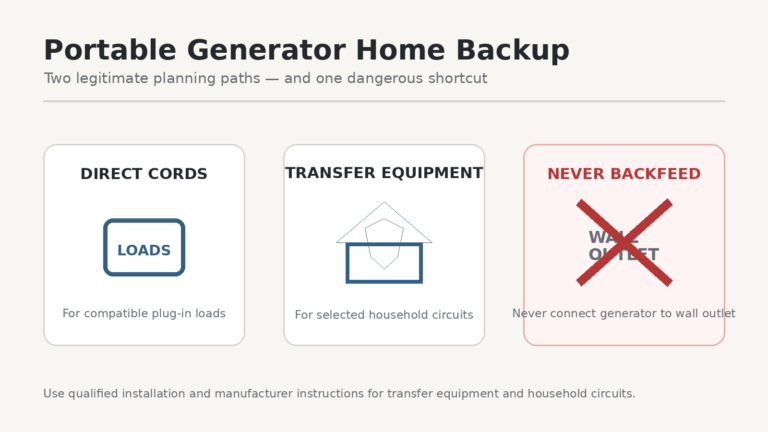
Safety: Portable generators produce deadly carbon monoxide. Follow the manufacturer’s instructions and operate the generator outdoors, well away from doors, windows, vents, and occupied spaces. Never backfeed a building through a receptacle. Home connections should use properly installed transfer equipment.
Plain-English Snapshot
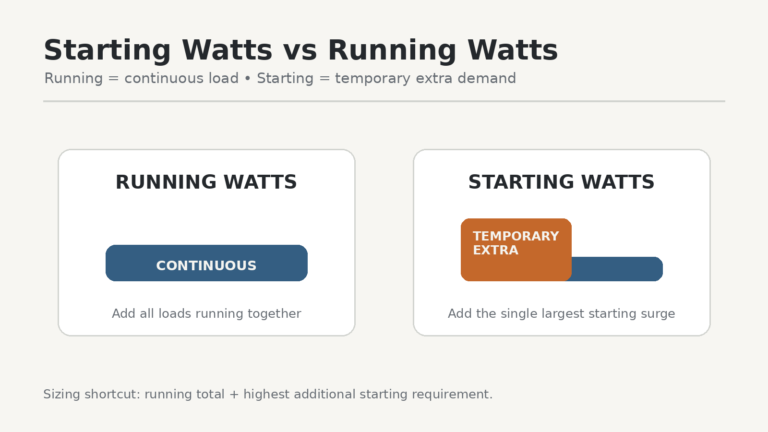
- 9,500 running watts on gasoline: That is the continuous gasoline rating. The 12,500-watt figure is a peak/startup rating and should not be treated as continuous output.
- 8,500 running watts on propane: Propane reduces the published running output by about 10.5% compared with gasoline.
- A 50-amp outlet is not 50 amps of continuous generator output: At 240V the published gasoline running current is about 39.5A. The receptacle rating and the generator’s actual available power are separate limits.
- A 30A / 240V path tops out at 7,200 watts: A 30-amp transfer connection cannot carry the full 9,500-watt gasoline running rating through that one path.
- THD is published at ≤23%: This is a conventional generator, not a low-THD inverter generator. Equipment with power-quality requirements should be checked against that specification.
- 212.1 lb dry weight: This is a large, heavy portable generator. Wheel-kit transport is not the same thing as easy lifting or towing.
In short: the WGen9500DFc headline wattage is only useful when you also account for fuel type, outlet limits, transfer-path amperage, power quality, and the loads that must start at the same time.
Core Specifications
| Specification | Gasoline | Propane |
|---|---|---|
| Running power | 9,500 W | 8,500 W |
| Peak power | 12,500 W | 11,200 W |
| Running current at 240 V | 39.5 A published | 35 A published |
| Peak current at 240 V | 52 A published | 47 A published |
| Running current at 120 V | 79 A aggregate rating | 71 A aggregate rating |
| Peak current at 120 V | 104 A aggregate rating | 93 A aggregate rating |
| Published runtime at 50% load | 8 hr | 7 hr on a 20-lb tank |
| Other specification | Published value |
|---|---|
| Voltage / frequency | 120/240 V, 60 Hz |
| Gasoline tank | 6.6 gal / 25 L |
| Gas runtime at 25% load | Up to 12 hr |
| Engine | 457 cc OHV 4-stroke |
| Noise | As low as 74 dBA |
| Total harmonic distortion | ≤23% |
| Grounding system | Neutral bonded to frame |
| Starting | Remote, electric, recoil |
| CO sensor | Yes, automatic shutdown system |
| Oil | 10W-30; 1.1 qt / 37.2 oz |
| Dimensions | 27.2 × 26.1 × 26.5 in |
| Dry weight | 212.1 lb |
| Residential warranty | 3-year limited |
| Amazon ASIN | B099KTHXMK |
Outlet Map: What Each Connection Can Actually Carry
- Two duplex 120 V 5-20R GFCI household receptacles
- One 120/240 V L14-30R 30 A twist-lock receptacle
- One 120/240 V 14-50R 50 A receptacle
- ST Switch connection
A connector’s maximum rating and the generator’s available power are two different limits. The smaller limit wins.
Derived Data
| Derived value | Result | Meaning |
|---|---|---|
| Gasoline running current at 240 V | 39.6 A | 9,500 W ÷ 240 V, matching the published 39.5 A figure |
| Propane running current at 240 V | 35.4 A | 8,500 W ÷ 240 V |
| Gasoline peak current at 240 V | 52.1 A | 12,500 W ÷ 240 V |
| Propane peak current at 240 V | 46.7 A | 11,200 W ÷ 240 V |
| Propane running-power reduction | About 10.5% | 8,500 vs 9,500 W |
| Propane peak-power reduction | About 10.4% | 11,200 vs 12,500 W |
| 30 A / 240 V path limit | 7,200 W | 30 A × 240 V; below the generator’s 9,500 W gas running rating |
| 50 A / 240 V connector rating | 12,000 W | 50 A × 240 V; generator output remains the governing continuous limit |
| Cabinet footprint | About 4.93 sq. ft. | 27.2 × 26.1 in rectangular envelope |
| Weight per footprint | About 43 lb/sq. ft. | Dry weight ÷ external footprint |
| Average gas use implied at 50% load | About 0.825 gal/hr | 6.6 gal ÷ 8 hr published runtime |
| Average gas use implied at 25% load | About 0.55 gal/hr | 6.6 gal ÷ 12 hr published runtime |
The fuel-use figures above are arithmetic implied by the published tank size and “up to” runtime ratings. They are not a measured fuel-consumption curve. Real use changes with load, temperature, altitude, fuel, engine condition, and other factors.
Why a 30-Amp Transfer Connection Cannot Use All 9,500 Running Watts
At 240 volts, a 30-amp connection represents 7,200 watts. The generator can produce 9,500 running watts on gasoline, but the L14-30R path is still a 30-amp path. Westinghouse’s own product Q&A has made the same distinction: a 30-amp transfer connection limits how much of the generator’s total output can be delivered through that one connection.
The 14-50R provides a higher-capacity connection, but a 50-amp receptacle does not turn the generator into a 12,000-watt continuous generator. On gasoline the published continuous output remains 9,500 watts; on propane it is 8,500 watts.
Altitude Derating: What the Manual’s 3.5% Rule Looks Like
The manual says maximum power decreases about 3.5% for each 1,000 feet above sea level. Using that rule alone gives the following rough gasoline and propane running-power figures before considering temperature or other losses:
| Elevation | Approx. gas running watts | Approx. propane running watts |
|---|---|---|
| Sea level | 9,500 W | 8,500 W |
| 1,000 ft | 9,168 W | 8,202 W |
| 3,000 ft | 8,502 W | 7,608 W |
| 5,000 ft | 7,838 W | 7,012 W |
| 7,000 ft | 7,172 W | 6,418 W |
This is a simple application of Westinghouse’s rule, not a dynamometer test. The manual also notes that high-temperature operation reduces maximum power and that altitude kits may be required.
Fuel Efficiency Hidden Inside the Runtime Numbers
At 50% of the 9,500-watt gasoline running rating, load is 4,750 watts. Holding that exact load for the published eight-hour runtime would represent about 38 kWh of electrical output from 6.6 gallons, or about 5.76 kWh per gallon.
At 25% load, 2,375 watts for 12 hours equals 28.5 kWh, or about 4.32 kWh per gallon. Those are rating-derived values, not lab measurements, but they illustrate a useful point: a large conventional generator can be less fuel-efficient per kWh when it is carrying a very light load.
Total Harmonic Distortion: The Spec Buyers Miss
Westinghouse publishes total harmonic distortion of ≤23% for the WGen9500DFc. That is very different from the low-THD figures commonly associated with inverter generators. If a particular appliance, UPS, furnace control, audio system, or other electronic device specifies a power-quality limit, compare that requirement with the generator’s published THD rather than assuming all 120-volt power is electrically equivalent.
See our inverter vs conventional generator guide for the broader distinction.
Buyer FAQ: Questions the Spec Sheet Usually Doesn’t Answer
Does the 50-amp outlet mean the generator makes 50 amps continuously at 240 volts?
No. Its published gasoline running current is about 39.5 A at 240 V, and propane running current is about 35 A at 240 V. The 50-amp receptacle is the connector rating, not a promise of 50 amps continuous generator output.
Can a 30-amp transfer switch use the full 9,500 running watts?
Not through a 30 A / 240 V connection. That path is 7,200 watts by simple volts-times-amps arithmetic. A properly designed 50-amp transfer path can make more of the generator’s rated output available. Building connections should be designed and installed according to code by a qualified electrician.
How much power do I lose on propane?
About 10.5% of running watts and 10.4% of peak watts compared with gasoline, based on the published ratings.
How much gasoline does it use per hour at half load?
The published 6.6-gallon tank and eight-hour 50%-load runtime imply an average of about 0.825 gallon per hour. Treat that as rating arithmetic, not a guaranteed fuel burn.
How much gasoline does it use per hour at quarter load?
The 12-hour 25%-load rating implies about 0.55 gallon per hour.
Will the WGen9500DFc run a 4-ton central air conditioner?
Tonnage alone is not enough to answer that. You need the air conditioner’s running amperage plus compressor starting requirement or LRA/start-watt information, and you must account for other loads operating at the same time. Use our starting watts vs running watts guide and home generator sizing guide.
Can I plug a 50-amp RV into it?
The generator has a 14-50R receptacle and is marketed as RV-ready, but a 50-amp RV service can theoretically represent more power than this generator produces continuously. The generator’s 9,500-watt gasoline / 8,500-watt propane running limit still applies to the total load.
Is the WGen9500DFc neutral bonded?
Yes. Westinghouse lists the grounding system as neutral bonded to frame. That can matter when connecting through transfer equipment, so the grounding/bonding arrangement should be evaluated as part of the actual installation.
Is it an inverter generator?
No. It is a conventional 3,600-RPM portable generator with AVR. Its published THD is ≤23%.
Is it suitable for sensitive electronics?
Do not assume so based only on voltage. Compare the device’s power-quality requirements with the generator’s ≤23% THD specification. If low THD is important, an inverter or explicitly low-THD generator may be a more appropriate power source.
How much does altitude affect it at 5,000 feet?
Applying the manual’s 3.5%-per-1,000-ft rule gives about a 17.5% reduction before temperature and other factors. That takes the 9,500-watt gasoline running rating to roughly 7,838 watts as a simple estimate.
What oil does it use?
Westinghouse specifies SAE 10W-30 and lists an oil capacity of about 1.1 quart.
What is the spark-plug gap?
The manual lists 0.024–0.032 inch (0.60–0.80 mm).
How large is its footprint?
The 27.2 × 26.1-inch external length and width work out to about 4.93 square feet.
Can I tow it by its wheels?
The manual describes the wheel kit for hand transport and says the wheels are not intended for towing the generator on or off road.
Can I run it in a garage if the garage door is open?
No. The manufacturer warns against operating a portable generator inside a home or garage even with doors or windows open. Operate it outdoors, away from openings, and follow the full location instructions in the manual.
Can I connect it to my house with a male-to-male cord?
No. That is dangerous backfeeding. Use approved transfer equipment installed for the application. See our portable generator home-backup safety guide.
Related DDB Guides
- Starting watts vs running watts
- What size portable generator for home essentials?
- Gas vs dual-fuel vs tri-fuel generators
- Inverter vs conventional generators
- Portable generator home-backup safety
- More Data Dossiers
Check the Westinghouse WGen9500DFc on Amazon