Portable Generator Home Backup: Extension Cords, Transfer Switches, and Why Backfeeding Is Dangerous
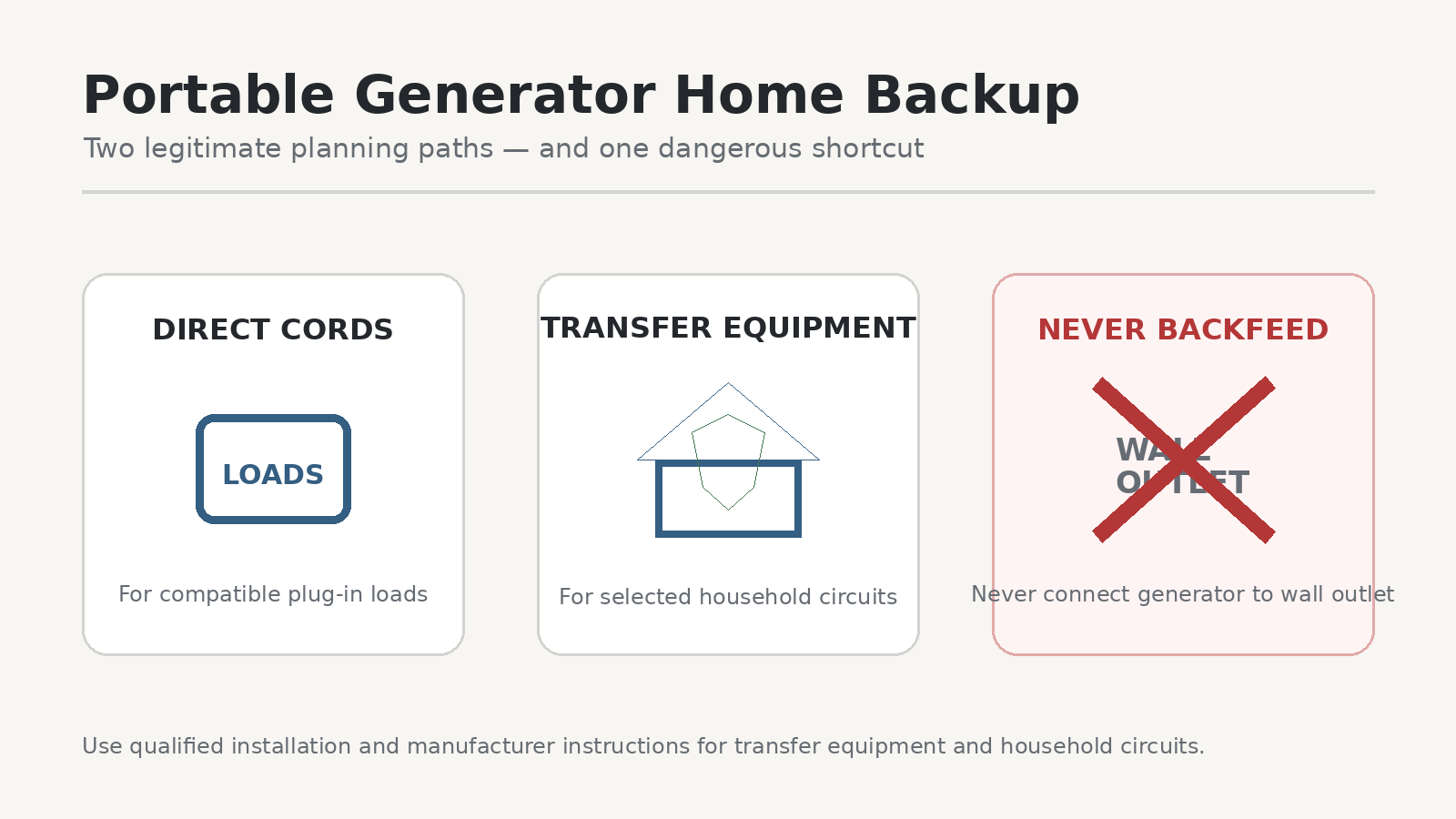
A portable generator can power individual cord-connected appliances or selected circuits through professionally installed transfer equipment. Those are different connection plans with different hardware, loads, and responsibilities.
What it must never do is energize house wiring through a wall receptacle. That is backfeeding. It can put lethal voltage on utility lines, defeat household protections, start a fire, and expose a live plug end.
Quick Answer
- Use correctly rated outdoor extension cords for compatible cord-connected appliances.
- Use qualified-electrician-installed transfer equipment for selected household circuits and hardwired loads.
- Never use a male-to-male cord and never connect a generator to a wall outlet.
- Operate every fuel-burning portable generator outdoors only, at least 20 feet from homes and buildings, with exhaust directed away.
Connection Plan 1: Direct Extension Cords
Direct cords can be practical for a refrigerator, freezer, lamp, router, charger, or another appliance designed for cord connection. The appliance plugs into a heavy-duty outdoor-rated cord, and that cord connects to a compatible generator receptacle.
CPSC says each cord’s wattage rating should exceed the total load connected to it. It should be long enough to keep the generator outdoors and far from windows, doors, and vents, with the entire length free of cuts or tears and all three grounding prongs intact.
Match conductor size to current and distance. Voltage drop grows with load and length, so the cord that works across a room may not be appropriate for the safe outdoor placement a generator requires. See Extension Cord Gauge Explained.
Extension-Cord Planning Checklist
- Outdoor-rated jacket and intact three-prong connectors
- Amp or watt rating above the connected load
- Gauge appropriate for both load and length
- Generator receptacle voltage and breaker compatible with the cord
- No crushed, pinched, taped, scorched, or missing-prong sections
- Connections kept dry according to the generator manual
- Routing that does not create a trip hazard or hold a door or window open in the exhaust path
Do not use a power strip or household extension cord to multiply a load beyond the generator receptacle, cord, or strip rating.
Connection Plan 2: Transfer Equipment
A transfer switch or other approved interconnection equipment isolates generator power from utility power. It allows selected circuits to be supplied from one source at a time.
Honda describes a transfer switch as the safe way to connect a generator directly to household wiring. Generac likewise directs owners to have a transfer switch installed by a qualified electrician rather than connecting through an outlet.
This matters for hardwired loads such as many furnace blowers, well pumps, and selected lighting circuits. It also avoids routing multiple appliance cords through the home.
Planning Questions for the Electrician
- Which circuits are genuinely essential?
- What are their running and motor-starting watts?
- Are any loads 240V?
- What generator receptacle, voltage, amperage, and neutral configuration are available?
- Is the proposed switch or interlock listed and approved for the exact panel and application?
- Where can a weatherproof inlet be installed while preserving the generator’s safe outdoor location?
- How will the user manage loads so the generator is not overloaded?
- What grounding and bonding requirements apply to this generator and transfer configuration?
This article intentionally does not provide wiring or operating sequences. The equipment manufacturer, transfer-equipment instructions, applicable code, and qualified electrician control the installation and use.
Transfer Switch vs. Interlock: Planning-Level Difference
A manual transfer switch commonly supplies a selected group of circuits through a separate switching assembly. A listed panel interlock, where permitted and compatible, mechanically prevents the main utility breaker and generator breaker from being on together.
Either concept must prevent simultaneous connection of utility and generator sources. Compatibility cannot be determined from appearance or breaker size alone. The panel model, listing, local rules, generator neutral arrangement, inlet, conductors, and installation all matter.
Never improvise an interlock, defeat one, or rely on a handwritten reminder to turn off the main breaker. Human memory is not isolation equipment.
What a Power Inlet Does
A power inlet is a fixed, weather-resistant connection point used with approved transfer equipment. It accepts a compatible generator cord so the outdoor generator can supply the installed system without an open window or a wall-outlet shortcut.
An inlet is not a normal receptacle and is not a stand-alone backfeeding solution. It must be part of a properly designed and installed transfer system.
Why Backfeeding Is Dangerous
CPSC warns that powering house wiring through a wall outlet can send electricity back through utility lines, creating an electrocution risk to utility workers and neighbors served by the same transformer. It can also bypass household circuit protections and create a fire hazard.
A male-to-male cord is especially dangerous because the exposed plug can become energized. CPSC has warned consumers to stop using and discard these products because of shock, electrocution, fire, and carbon-monoxide hazards.
There is no safe “careful” version of this shortcut. Do not build, buy, borrow, or use such a cord.
Size Loads Before Choosing Connection Hardware
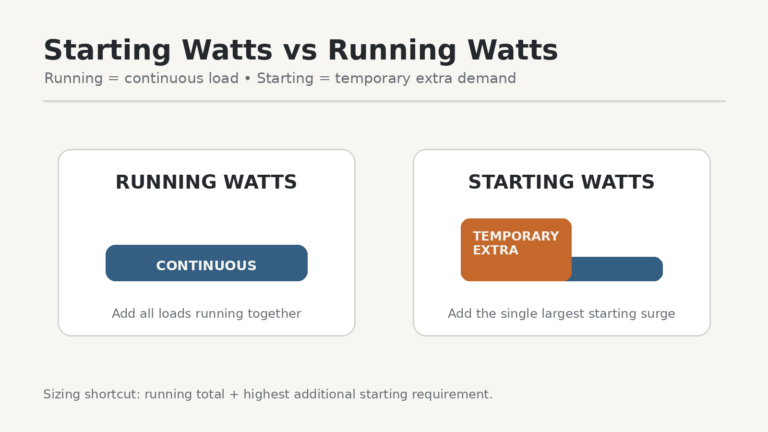
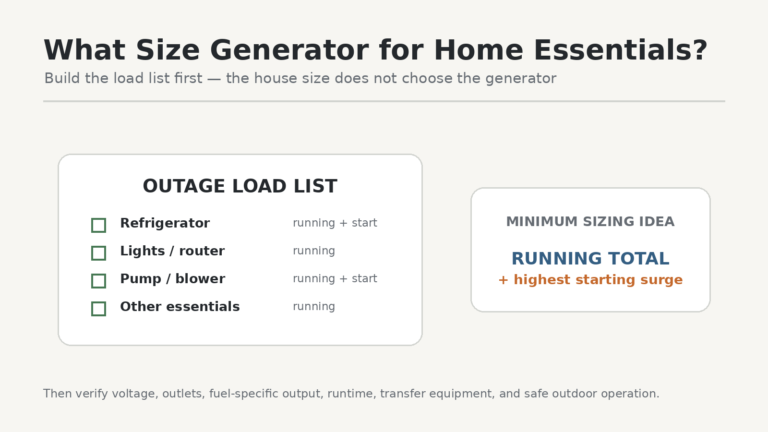
Transfer equipment does not increase generator capacity. Add the running watts of loads that may operate together and account for motor starting. Then confirm the generator’s fuel-specific output, voltage, receptacles, and breakers.
Use Starting Watts vs Running Watts and What Size Portable Generator for Home Essentials? to build the plan.
Large panels can contain far more load than a portable generator can supply. Even with approved equipment, the user needs a documented load-management plan.
Carbon Monoxide Safety Controls the Layout
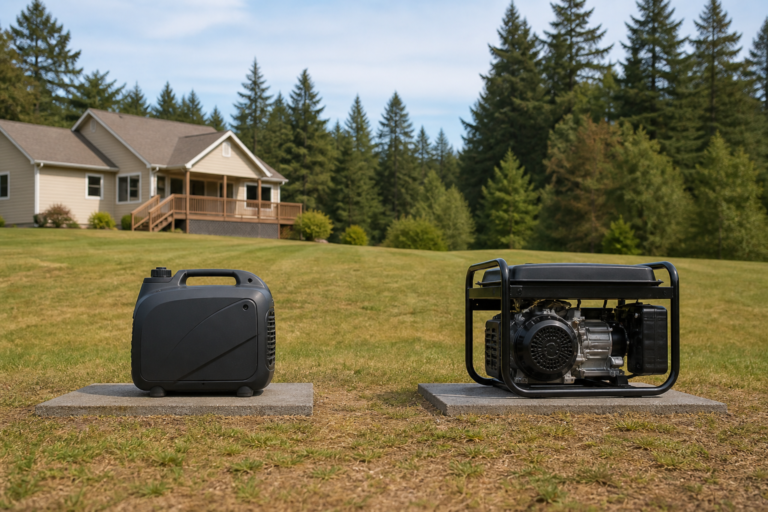
CPSC says to operate a portable generator outdoors only, at least 20 feet from homes and buildings, with exhaust directed away from doors, windows, vents, and any occupied structure. Never operate one in a home, basement, garage, shed, crawlspace, carport, porch, or other enclosed or partly enclosed area—even with doors open.
Close openings in the exhaust path and use working battery-operated CO alarms or alarms with battery backup on every level and outside sleeping areas. A generator’s CO shutoff is useful backup protection, not permission to move it closer.
The cord or inlet location must support this distance. If the only proposed setup puts the generator near a garage door, porch, window, air intake, or neighbor’s building, redesign the plan before the outage.
Wet-Weather and Refueling Planning
Follow the generator manufacturer’s specific wet-weather instructions. Do not operate or handle electrical equipment in standing water, and do not place a running generator where water can reach it or collect underneath.
Before refueling, shut the generator down and allow it to cool as directed. Store fuel outside living areas in approved containers and away from ignition sources.
Primary Safety Sources
- CPSC Portable Generator Hazards
- CPSC male-to-male cord warning
- OSHA portable-generator grounding and connection guidance
- Honda transfer-switch guidance
- Generac portable-generator safety guidance
Bottom Line
Use direct outdoor-rated cords for compatible plug-in appliances. Use professionally installed, approved transfer equipment for household circuits and hardwired loads. Never connect a generator to a wall outlet and never use a male-to-male cord.
Design the entire system around safe outdoor operation at least 20 feet from buildings, exhaust directed away, working CO alarms, adequate cord or inlet capacity, and a realistic load-management plan.