What Size Portable Generator for Home Essentials?
A portable generator for “home essentials” can mean a small unit for a refrigerator and a few lights or a much larger 120/240-volt machine for pumps and selected hardwired circuits. The right size comes from your outage load list, not a generic house-size chart.
This guide gives you a practical sizing process, example load plans, and the connection and carbon-monoxide rules that must be part of the decision.
Quick Answer
Many basic refrigerator-plus-lighting plans fall within roughly 2,000 to 4,000 running watts, while plans that include a well pump, sump pump, furnace blower, or window air conditioner often move into the 5,000-to-8,000-watt class. Those are planning ranges, not buying prescriptions.
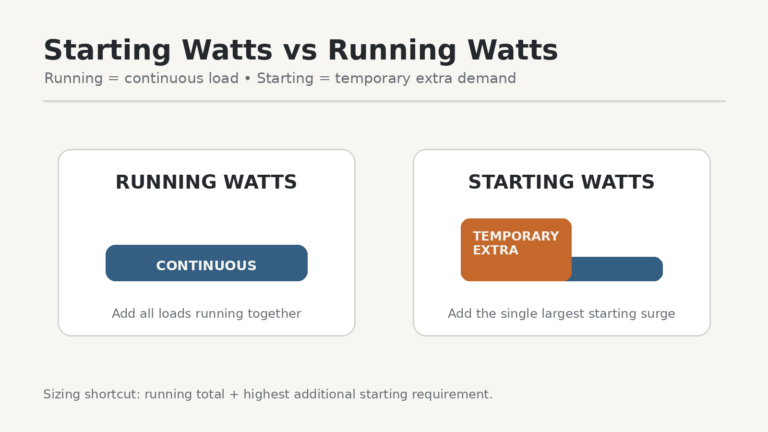
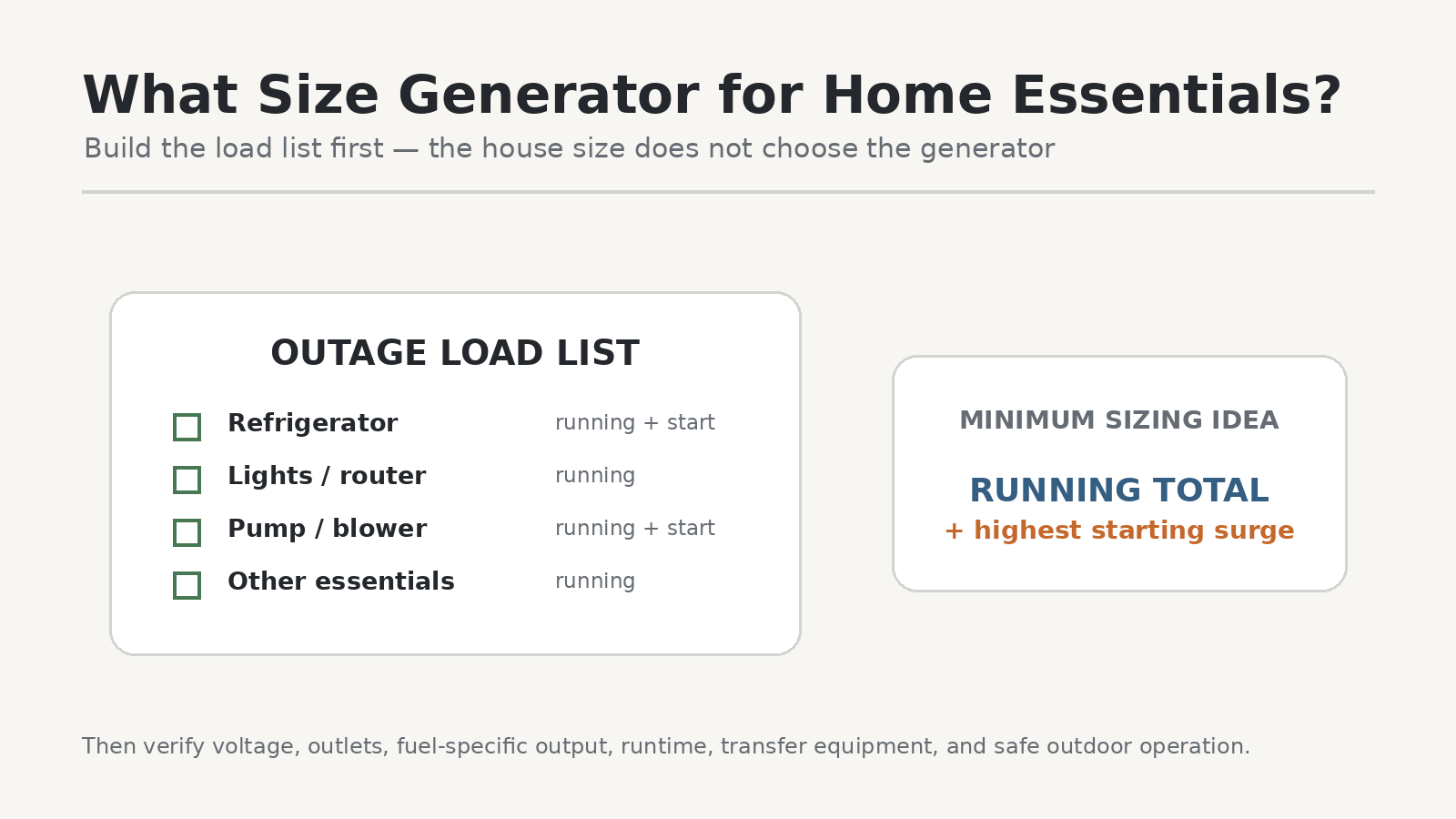
Add the running watts of loads you expect to operate together, then add the highest single additional starting-watt requirement. Verify both numbers against the generator’s ratings and confirm voltage, receptacles, breakers, cords, and transfer equipment.
Start with our cornerstone guide, Starting Watts vs Running Watts, if you need the full calculation method.
Step 1: Define “Essential” Before You Add Watts
Do not begin with every appliance in the house. Build a short list around safety, food, water, heat support, communications, and any equipment whose manufacturer says generator power is appropriate.
| Need | Loads to verify | Question to answer |
|---|---|---|
| Food | Refrigerator, freezer | Can their compressors start without another large motor starting? |
| Water | Sump pump, well pump | What voltage and starting load are on the nameplate? |
| Heat support | Furnace controls and blower | Does it require approved transfer equipment? |
| Lighting and communication | LED lamps, router, phone chargers | Which small loads truly need to run at once? |
| Cooling | Fans or one window air conditioner | What other load will be turned off during compressor startup? |
Electric resistance heat, electric water heating, electric ranges, clothes dryers, and central air conditioning can dominate a portable-generator plan. Treat them as separate engineering decisions rather than casually adding them to an “essentials” list.
Step 2: Use Actual Equipment Data
Record watts from the appliance label, manual, or manufacturer. If only volts and amps are listed, volts multiplied by amps gives a basic watt estimate, but motors, power factor, and startup behavior can make a manufacturer wattage figure more useful.
Manufacturer charts are estimates. Champion, for example, publishes ranges for refrigerators, pumps, furnace fans, and window air conditioners, but it also directs buyers to calculate their own loads. Your specific appliance controls the final plan.
Do not mix “starting watts” definitions. Some worksheets list additional starting watts, while others list the total wattage during startup. Our generator wattage worksheet uses additional starting watts.
Step 3: Build a Simultaneous-Load Plan
Total the running watts of everything that may be on together. Then add the single highest additional starting requirement, provided you will manage loads so large motors start one at a time.
If two pumps or compressors may start together, the one-surge shortcut may understate the peak. Change the operating plan or get qualified sizing help.
Example A: Food, Lights, and Communications
| Example load | Running watts | Additional start watts |
|---|---|---|
| Refrigerator | 400 | 800 |
| Freezer | 300 | 700 |
| Six LED lamps | 60 | 0 |
| Router and phone charging | 60 | 0 |
| Total | 820 | 800 highest |
This illustrative plan needs about 1,620 watts during the largest planned start. A buyer would still allow practical margin and verify exact labels, outlet capacity, cord ratings, and runtime.
Example B: Add a Sump Pump and Furnace Blower
| Example load | Running watts | Additional start watts |
|---|---|---|
| Food, lights, communication above | 820 | 800 |
| 1/2-hp sump pump | 1,050 | 1,300 |
| 1/2-hp furnace fan | 800 | 1,550 |
| Total | 2,670 | 1,550 highest |
The illustrative estimate becomes about 4,220 watts. Because the pump and blower are motor loads, the plan must prevent simultaneous starts or account for them. Furnace connection normally involves the home’s wiring, so use equipment selected and installed by a qualified electrician.
Example numbers are deliberately not promises. Generac’s worksheet and Champion’s chart show how widely common-appliance estimates can vary.
What Generator Size Classes Usually Mean
About 2,000 to 3,000 Running Watts
Often suitable for a deliberately small direct-cord plan: one refrigerator or freezer, lights, chargers, and perhaps a modest additional load. Capacity for pumps, heat-producing appliances, or air conditioning is limited.
About 3,500 to 5,000 Running Watts
Can support a broader essentials plan with disciplined load management. A sump pump or furnace blower may fit if its voltage, starting load, and safe connection method are compatible.
About 5,000 to 8,000 Running Watts
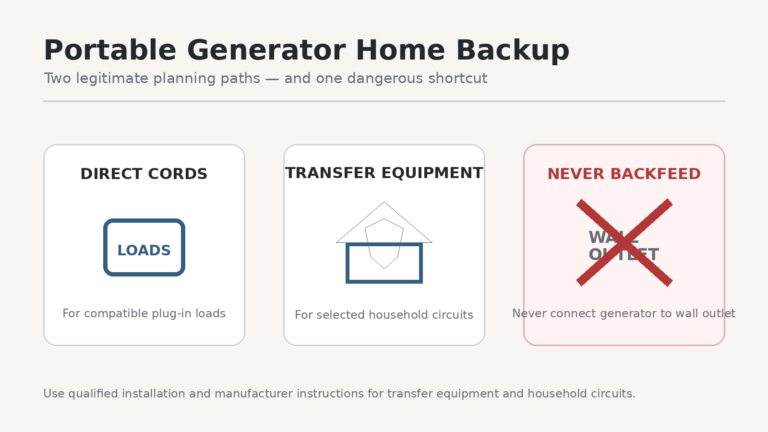
May cover several selected household circuits and larger 120/240-volt loads, but a larger rating does not authorize a homemade connection. A transfer switch or other approved interconnection must match the electrical system and generator.
Check Voltage and Receptacles Before Buying
Total watts are not enough. A 120-volt-only generator cannot power a 240-volt well pump. A receptacle also has its own voltage, amperage, wiring configuration, and breaker. Confirm the exact outlet and usable amperage needed by cords or transfer equipment.
Generac warns that a receptacle’s standardized plug pattern does not necessarily mean the generator can continuously provide the plug’s full nominal amperage. Read the specification sheet and breaker rating.
Direct Cords vs. Home Wiring
Appliances designed for cord connection can plug directly into the generator using outdoor-rated, grounded cords sized for the load and distance. Check every cord for damage and keep connections dry according to the generator manual. Our extension-cord gauge guide explains why length and conductor size matter.
Never power house wiring by plugging a generator into a wall receptacle. CPSC calls this backfeeding and warns that it creates an electrocution risk to utility workers and neighbors. OSHA says a portable generator should not connect directly to a structure’s electrical system unless a properly installed transfer switch is used.
Carbon Monoxide Rules Are Non-Negotiable
CPSC says to use a portable generator outside only, at least 20 feet from the home, with exhaust directed away. Never run one in a house, basement, garage, shed, carport, porch, or other enclosed or partly enclosed space—even with doors open.
Use working battery-operated CO alarms or alarms with battery backup on every level and outside sleeping areas. A generator’s CO shutoff feature is backup protection, not permission to operate closer to a building.
Source guidance: CPSC Carbon Monoxide Information Center, CPSC Portable Generator Safety Alert, and OSHA portable-generator guidance.
Compare Runtime at the Same Load
Runtime claims are meaningful only with their test load. Ten hours at 25% load is not equivalent to ten hours at 50%. Estimate the watts you will actually use, compare manufacturer runtime at similar loads, and plan safe outdoor refueling only after shutdown and cooling as directed by the manual.
Use the Generator Wattage Worksheet
Enter the exact loads you plan to run together. Use the highest additional motor-starting requirement and build a sequence that prevents large motors from starting at the same time.
Generator Wattage Worksheet
Add the loads you expect to run together. Enter additional starting watts (the amount above running watts), not total surge watts.
Total running watts: 0 W
Highest additional starting watts: 0 W
Minimum estimated generator requirement: 0 W
Safety: This planning estimate does not verify voltage, outlets, simultaneous motor starts, transfer equipment, or installation. Never run a fuel-burning generator indoors or in a garage. Operate it outdoors at least 20 feet from the home with exhaust directed away, and never backfeed a wall outlet.
Bottom Line
For many homes, the practical answer is not “power the whole house.” It is a carefully chosen essentials list, an accurate running-and-starting-watt calculation, compatible voltage and outlets, safe cords or professionally installed transfer equipment, and a realistic fuel plan.
Start small, verify actual labels, and treat carbon monoxide and backfeeding controls as part of the generator specification—not as optional accessories.