18V vs 20V MAX Tools: What the Voltage Labels Really Mean
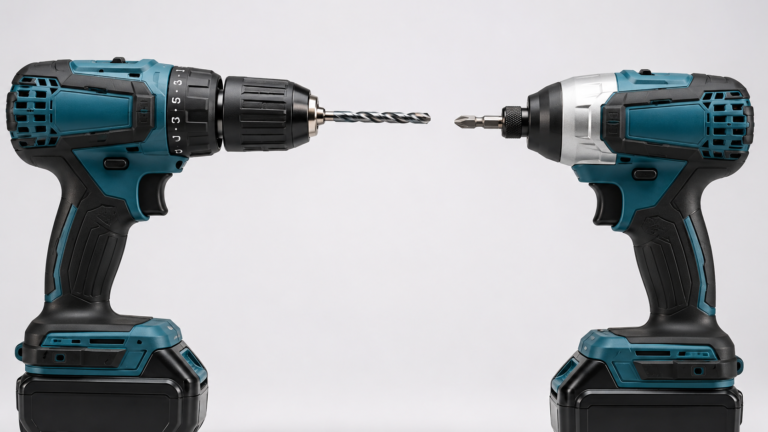
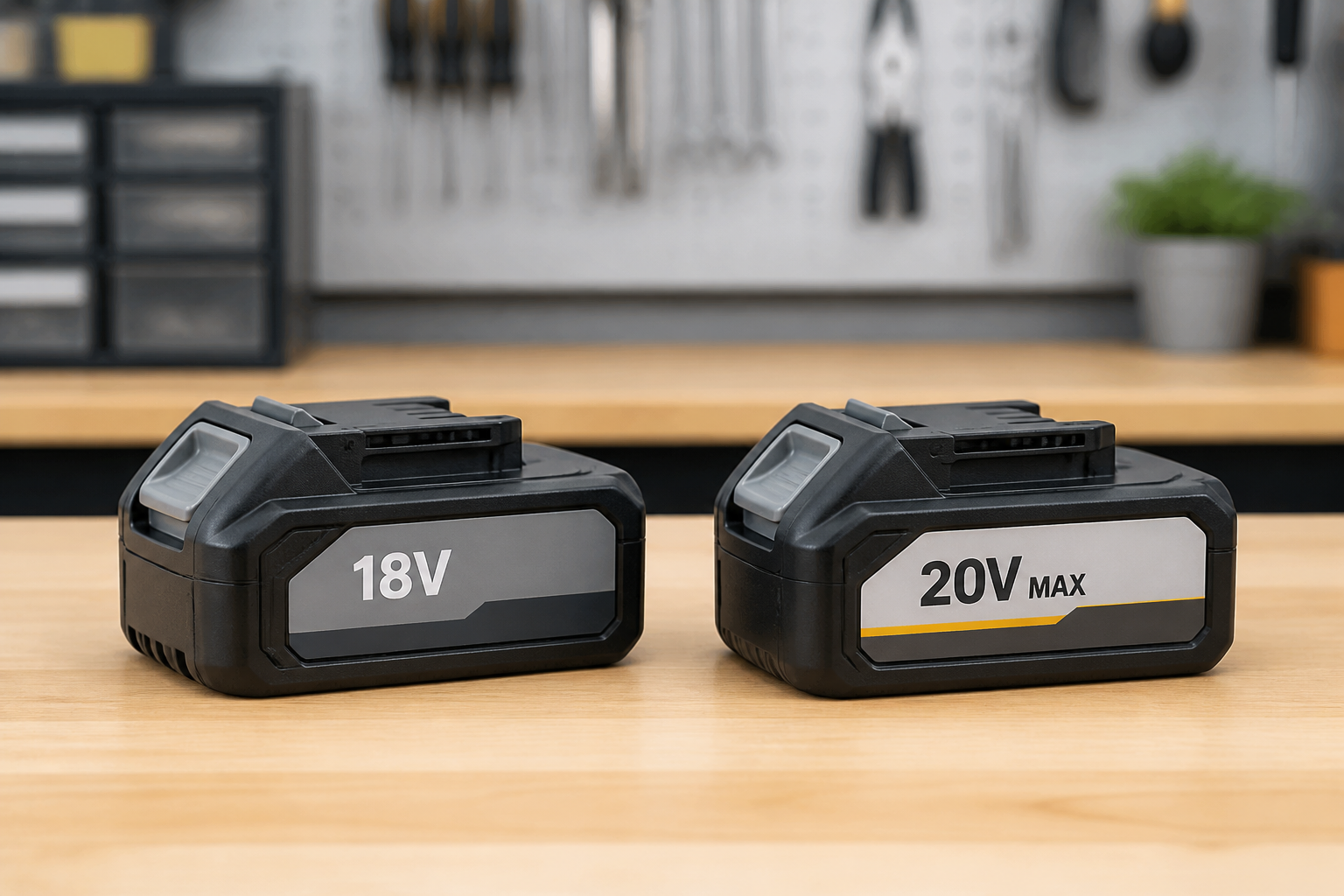
If one cordless drill says 18V and another says 20V MAX, it is reasonable to assume the 20V tool has about 11 percent more voltage and therefore ought to be stronger.
That assumption is exactly why the label deserves a closer look.
For at least one of the biggest cordless platforms, the manufacturer says it plainly:
So an 18V label and a 20V MAX label do not necessarily represent two fundamentally different voltage classes.
That does not mean every 18V and 20V battery is interchangeable. It definitely does not mean every 20V-labelled tool performs the same as every 18V tool.
It means the number on the battery is only the beginning of the comparison.
The short answer
When comparing modern cordless platforms:
- Nominal voltage is the typical operating voltage used to describe a battery system.
- Maximum voltage is a higher unloaded/initial value the battery can reach.
- DeWalt explicitly says its 20V MAX system is 18V nominal.
- An 18V tool from one brand is not automatically weaker than a 20V MAX tool from another.
- Battery compatibility is determined by the platform, electronics, physical interface, and manufacturer design — not just the voltage number.
- Tool performance also depends on motor, electronics, gearing, battery current capability, and the actual job.
If you are trying to compare battery capacity rather than voltage, DDB’s existing Battery Voltage vs Amp-Hours article should be the next stop.
Why one company says 18V and another says 20V MAX
A battery does not sit at one exact voltage from full charge until the instant it goes dead.
Its voltage changes with state of charge and load.
That gives manufacturers more than one legitimate voltage number they can talk about.
DeWalt chooses to market its mainstream platform as 20V MAX while putting the explanation directly in its specifications: maximum initial battery voltage is 20 volts without workload; nominal voltage is 18.
That little asterisk is doing real work.
So is 20V MAX just marketing?
The MAX part is clearly a marketing-friendly way of describing the higher initial/unloaded figure. DeWalt tells you that in the footnote.
But I would not turn that into “20V MAX tools are fake.”
The tools and batteries are real. The performance differences between actual products can be very real.
The mistake is assuming the 20 printed on one battery proves that tool is more powerful than an 18 printed on another brand’s battery.
It does not.
Can I use an 18V battery on a 20V MAX tool?
Not just because the nominal voltage is similar.
Battery packs have:
- different physical rails and latches;
- different electrical contacts;
- different communication and protection electronics;
- different cell configurations and current capabilities;
- brand- and generation-specific compatibility rules.
DeWalt even sells a specific adapter for certain older 18V tools to use selected 20V MAX lithium-ion batteries. The existence of the adapter is a good demonstration of the point: similar voltage does not make the connectors magically compatible.
Follow the manufacturer’s compatibility chart.
Does 20V MAX have more power than 18V?
You cannot answer that from the label alone.
Power is not simply “whichever battery has the larger marketing number.”
Two tools in nominally similar voltage classes can perform very differently because of:
- motor design;
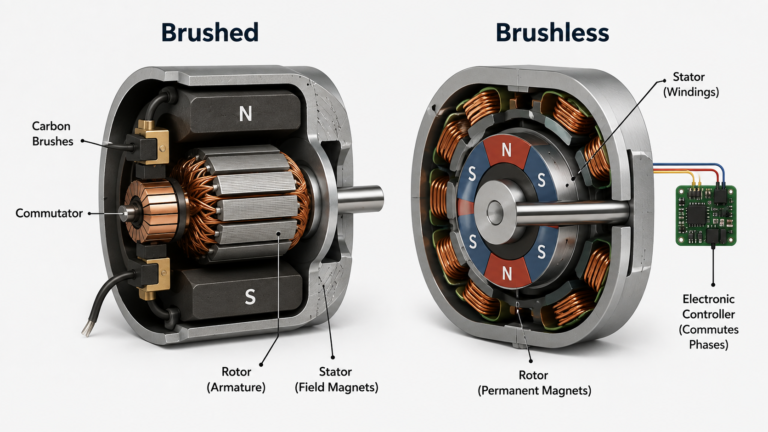
- brushless vs brushed construction;
- controller electronics;
- gear ratios;
- battery cell chemistry and current delivery;
- battery size;
- thermal limits;
- tool efficiency;
- software/control strategy.
A high-performance 18V saw with a large battery can absolutely outperform a mediocre tool carrying a 20V MAX label.
The specification that matters is the performance of the actual tool-and-battery combination.
What voltage does tell you
Voltage is still important.
It helps define the electrical architecture of the system and the family of tools/batteries designed to work together.
Moving from a compact 12V-class platform to an 18V-class platform, for example, can support more demanding tools and higher power levels.
Moving into 36V, 40V MAX, 60V MAX, 80V, and similar higher-voltage outdoor/professional systems can support even heavier loads.
I just would not use the difference between 18 and 20 MAX as though it were the same kind of jump.
What about DeWalt FLEXVOLT?
DeWalt’s FLEXVOLT system is a useful example of why battery labels can get more complicated than one number.
DeWalt says FLEXVOLT batteries automatically switch voltages and are compatible with its 20V MAX tools while also powering higher-voltage FLEXVOLT tools.
That system changes how cells are electrically configured depending on the application.
The takeaway is not that everyone needs FLEXVOLT. It is that the cordless-tool world has moved well beyond “count the volts and buy the biggest number.”
Where amp-hours fit
Voltage tells you one thing. Amp-hours tell you another.
A 2Ah battery and a 5Ah battery on the same platform have the same nominal voltage class but different charge capacity.
That does not translate into a simple “5Ah runs 2.5 times longer in every tool” promise because load, efficiency, battery design, temperature, cutoff behavior, and tool output matter.
It does mean you should not compare a little compact pack with a large high-output pack as though voltage were the only difference.
This is exactly why the existing DDB article on Battery Voltage vs Amp-Hours belongs at the center of the cordless-battery cluster.
Does a bigger Ah battery make the tool more powerful?
Sometimes a larger or higher-output battery can let a demanding tool deliver more performance because the pack can supply current with less voltage sag and heat.
But that is pack-specific.
Manufacturers increasingly sell compact, high-output, stacked-cell, pouch-cell, and other battery designs that complicate the old assumption that the physically largest Ah number always means the highest power.
I would check the tool manufacturer’s performance claims for the exact battery combination instead of inventing a formula from the label.
What should I compare when choosing a cordless platform?
If I were starting over with no batteries, I would care about these things before arguing over 18V vs 20V MAX:
- Does the platform have the tools I actually want?
- How expensive are additional batteries?
- Are compact and high-output battery options available?
- How good are the specific tools in independent testing and specifications?
- Is the platform likely to cover my future outdoor or specialty tools?
- How heavy are the batteries/tools I will actually use?
- What is compatible with what?
A great battery ecosystem saves you from buying five chargers and six nearly identical batteries that refuse to speak to each other.
If I already own 18V or 20V MAX batteries, should I switch?
Not because of the number.
If your existing platform has the tools you need and they perform well, I would need a better reason to start over than “the other box says 20 instead of 18.”
Switch when:
- your platform lacks a tool you need;
- another system solves a real performance problem;
- battery availability or pricing is becoming poor;
- you are moving into a different class of equipment;
- the economics of the new system actually work.
Do not switch because arithmetic made the label look 11 percent better.
The number I would look past
For DeWalt specifically, the manufacturer has already answered the headline question: its 20V MAX batteries are 18V nominal.
That should be enough to stop treating 18V versus 20V MAX as a horsepower contest.
Compare the tool. Compare the battery. Compare the platform.
The sticker has had enough attention.