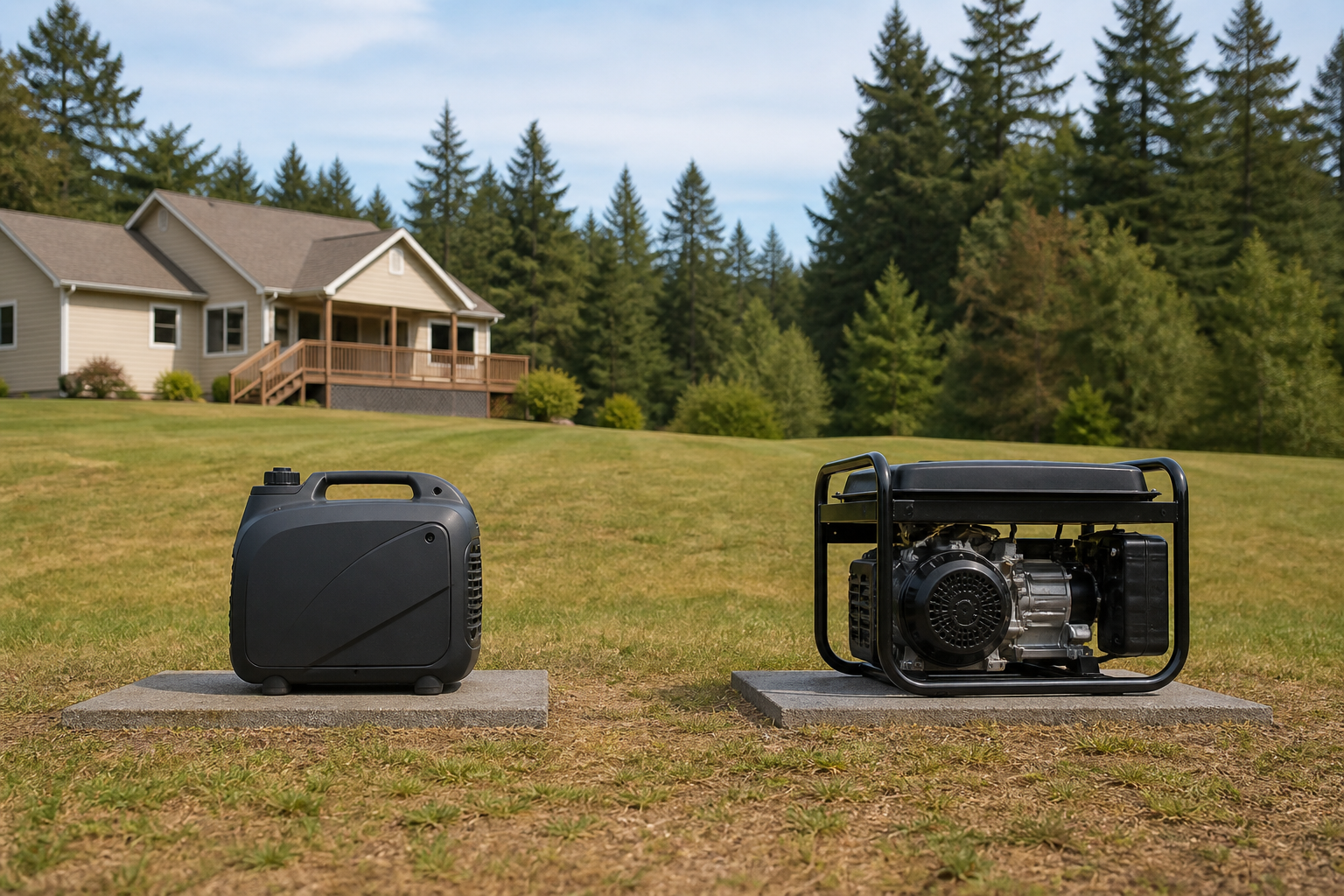
Inverter vs Conventional Generator: Which Is Better?
“Inverter” and “conventional” describe how a generator produces and regulates electricity. They do not tell you whether a model has enough watts, the right voltage, safe carbon-monoxide protection, or the outlets your backup plan requires.
Inverter generators are often quieter and more fuel-efficient at light loads. Conventional open-frame generators often deliver more watts per dollar. The better choice depends on the loads, runtime, portability, noise constraints, and connection plan you actually have.
Quick Comparison
| Factor | Inverter generator | Conventional generator |
|---|---|---|
| Engine speed | Often varies with load | Often runs near a fixed speed to maintain frequency |
| Noise | Frequently lower, especially in enclosed models at light load | Often higher in open-frame designs |
| Fuel use | Can improve at partial load | May be less efficient when lightly loaded |
| Power quality | Electronically converted and regulated; check published THD | Varies by alternator and regulation; check published THD |
| Capacity and price | Common in compact sizes; high-output models cost more | Often more running watts per purchase dollar |
| Portability | Compact models can be easier to carry | Large open-frame units are commonly heavier |
How an Inverter Generator Works
Honda explains that its inverter system produces multiphase AC, converts it to DC, and then converts it back to controlled AC. This electronic stage lets the engine operate at a load-dependent speed while the inverter maintains the requested output.
The important buying result is not the conversion diagram by itself. It is the model’s actual continuous watts, surge capability, voltage, receptacles, runtime, noise test, and published power-quality specification.
How a Conventional Generator Works
A conventional portable generator generally produces AC directly through an engine-driven alternator. Engine speed and the generator design maintain the target frequency and voltage. Many traditional models operate near a fixed engine speed even when the electrical load is modest.
This simpler open-frame approach can offer high output at a lower price. It can also mean more noise and fuel consumption at light loads, though individual designs vary.
Are Inverter Generators Really Quieter?
Often, yes—but “inverter” is not a noise measurement. Enclosures, mufflers, engine size, fan design, load, and test distance all matter.
Honda publishes 48 dB(A) at one-quarter load and 57 dB(A) at rated load for its EU2200i. Its published industrial-generator figures are higher. These are useful examples because load conditions are stated. Do not compare a number measured at 25% load with another measured at full load.
For neighborhood backup, compare the manufacturer’s dB(A), load, and distance together. Remember that a quieter generator is still a carbon-monoxide source and must remain outdoors at least 20 feet from the home.
Fuel Efficiency Depends on Load
Load-dependent engine speed is one of the strongest inverter advantages. Honda’s Eco Throttle documentation says the engine slows when demand is low, reducing fuel use and noise. Its EU2200i specifications list 3.2 hours at rated load and 8.1 hours at one-quarter load on the same tank.
That does not mean every inverter is equally efficient or that a small inverter saves fuel when operated near its limit. Compare runtime at the same percentage or watt load and note the tank capacity.
What “Clean Power” Really Means
Inverter marketing often uses “clean” or “stable” power. Those phrases are not substitutes for a specification. Look for total harmonic distortion (THD), voltage regulation, and the requirements of the equipment you intend to power.
An inverter architecture usually makes tight electronic regulation easier, but conventional generators can vary widely. Some regulated conventional models may be appropriate for a given load, while a poorly specified inverter model does not earn automatic trust.
If power quality matters for a medical device, furnace control, computer, or other sensitive equipment, consult both manufacturers. A portable generator may not provide the uninterrupted operation some critical equipment requires.
Capacity: Where Conventional Models Often Win
Compact inverter generators commonly occupy the 1,000-to-3,500-watt range. Large inverter models exist, including 120/240-volt home-backup units, but they can be expensive and heavy.
Open-frame conventional generators are widely available at 5,000 running watts and above. That can make them attractive for pumps, selected household circuits, and larger outage plans.
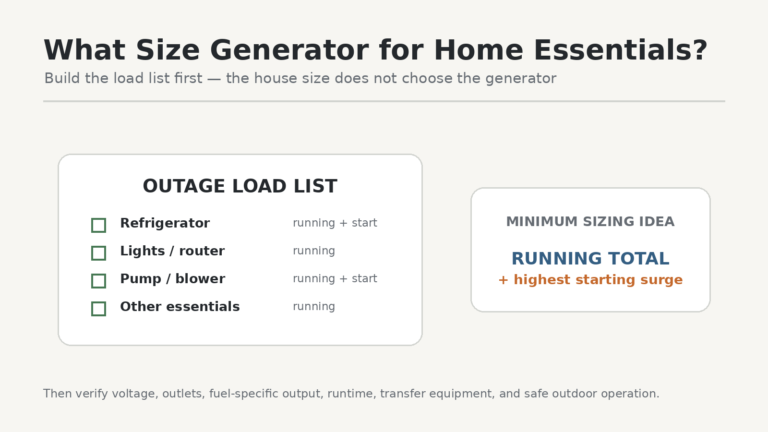
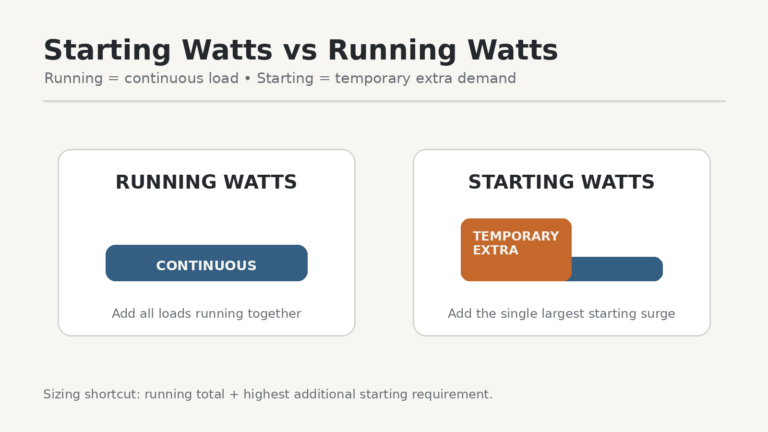
Size the loads before choosing the architecture. See Starting Watts vs Running Watts and What Size Portable Generator for Home Essentials?.
Parallel Capability Is Useful, Not Universal
Some inverter generators can connect in parallel to a compatible second unit. This can provide a light, efficient single-generator setup for small loads and more output when both units are connected.
Use only the manufacturer-approved pairing, cable or kit, and operating instructions. Parallel capability does not combine arbitrary generators, and the available receptacle still limits how power can be delivered.
Check 120V vs. 120/240V
Many compact inverter generators are 120V only. That can be fine for direct-cord appliances but cannot power a 240V well pump or a 120/240V transfer setup requiring both legs.
Do not assume a 30-amp outlet means home-backup compatibility. Confirm voltage, configuration, breaker, neutral arrangement, and approved transfer equipment with a qualified electrician.
Which Type Fits Common Buyers?
Choose an Inverter Generator When…
- You have a modest, carefully calculated load.
- Noise at a stated load is a major concern.
- You expect long periods at partial load.
- Low weight and compact storage matter.
- The model publishes power quality suitable for your equipment.
Choose a Conventional Generator When…
- You need high running and starting capacity at a tighter budget.
- Pumps, larger tools, or multiple selected circuits dominate the plan.
- Weight and noise are acceptable at the only safe outdoor location.
- The model provides the correct 120/240V outlets and breaker capacity.
Safety Rules Do Not Change
Both types produce carbon monoxide when they burn fuel. CPSC says to operate portable generators outdoors only, at least 20 feet from homes and buildings, with exhaust directed away from windows, doors, and vents. Never run one in a garage, basement, shed, carport, porch, or other enclosed or partly enclosed area.
Use working CO alarms on every level and outside sleeping areas. A CO shutoff is backup protection, not permission to operate closer.
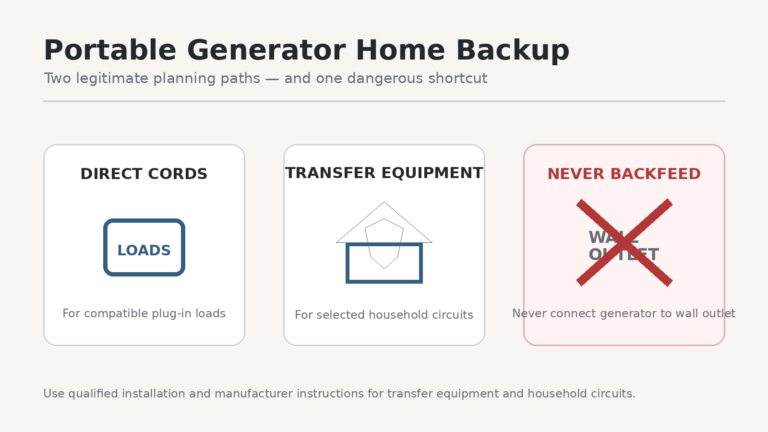
Never power house wiring by plugging a generator into a wall outlet. CPSC identifies that as dangerous backfeeding. Use properly installed transfer equipment selected for the generator and electrical system.
Primary sources: Honda inverter-generator technology, Honda Eco Throttle, Honda generator specifications, and CPSC carbon-monoxide guidance.
Bottom Line
An inverter generator is usually the better fit for quiet, efficient partial-load operation and compact backup plans. A conventional generator is often the value choice for higher wattage and heavy starting loads.
Do not buy by type alone. Compare continuous watts, starting watts, voltage, outlets, runtime at the same load, dB(A) under stated conditions, THD, weight, fuel plan, and safe connection equipment. The generator that fits those requirements is the right architecture for your outage plan.