Shop Vac Filters Explained: Cartridge vs HEPA vs Foam vs Bags
A shop vac can have plenty of suction and still make a mess if the filtration setup does not match what you are picking up.
Large debris, fine dry dust, and water are different jobs. The filter that makes sense for one can be the wrong choice for another.
That is why “Does it have a HEPA filter?” is not the first question for every cleanup.
The first question is: What are you actually collecting?
Quick Answer
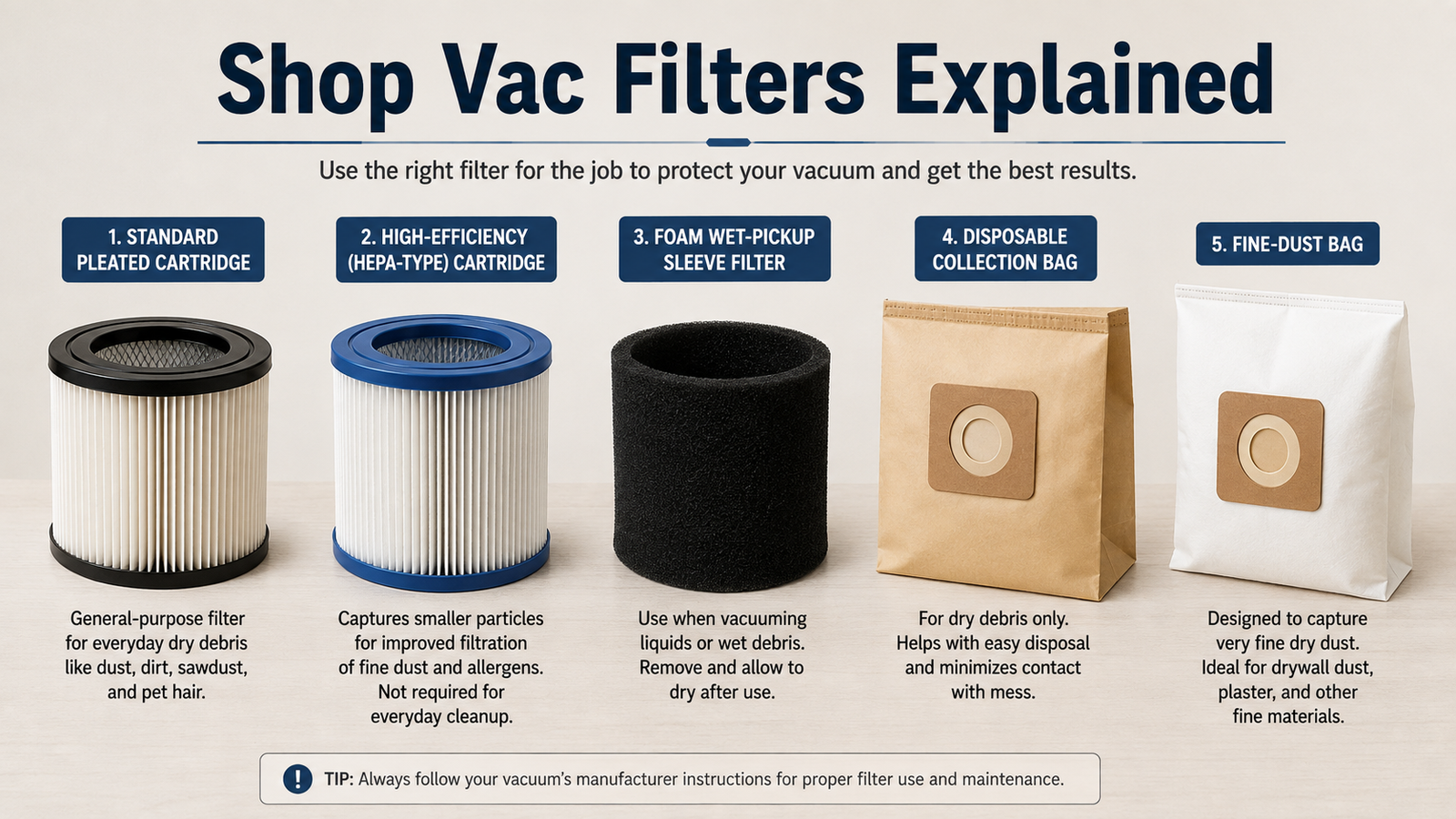
- Standard cartridge filter: general dry pickup.
- High-efficiency or HEPA-type cartridge: finer dry material, when the specific vacuum/filter system is rated for the task.
- Disposable collection bag: keeps dry debris contained and can reduce mess when emptying.
- Fine-dust bag: useful for extra-fine dry debris where compatible.
- Foam sleeve: commonly used for wet pickup on compatible wet/dry vacuums.
Always follow the vacuum manufacturer’s filter instructions. Not every filter fits every model, and installing a HEPA-labeled cartridge does not automatically turn the entire vacuum into a certified hazardous-dust collection system.
Standard Cartridge Filters
Shop-Vac describes its standard cartridge filters as all-around filters for dry pickup.
That makes them a reasonable default for:
- sawdust
- dirt
- chips
- ordinary garage debris
- larger dry particles
A cartridge provides much more filter area than a simple flat filter and is easy to remove for cleaning or replacement.
The limitation appears when the dust becomes very fine. Fine particles can load a basic filter quickly or pass through a filtration setup that is not designed to capture them effectively.
High-Efficiency and HEPA Filters
Shop-Vac says its HEPA cartridge filters are intended to filter finer dry material than standard cartridge filters. Its FAQ recommends HEPA or high-efficiency filtration options when fine dust is blowing back into the room.
That is useful guidance for ordinary fine-dust cleanup, but the word HEPA deserves care.
A HEPA filter is a filtration specification. The performance of an entire vacuum system also depends on sealing, bypass leakage, filter installation, and the way the equipment was tested.
For regulated hazardous dust, use equipment and control methods that meet the applicable standard. Do not assume that any wet/dry vacuum accepting a HEPA cartridge is automatically suitable for lead, silica, asbestos, or another hazardous material.
For drywall-specific considerations, see Can You Use a Shop Vac for Drywall Dust?.
Disposable Collection Bags
A disposable bag sits inside the tank and collects dry debris before it coats the tank and filter.
Benefits can include:
- cleaner disposal
- less dust released while emptying the tank
- reduced mess inside the canister
- less direct loading on the cartridge filter in some setups
The bag is not automatically a substitute for the required filter. Shop-Vac offers combinations of cartridge filters and collection bags depending on the model and dust type.
Compatibility matters because bag collars, inlet positions, and tank sizes differ.
Fine-Dust Bags
Fine-dust collection bags are designed for smaller dry particles than ordinary collection bags.
Shop-Vac specifically lists fine-dust bags for “extra fine dry messes.”
For dusty remodeling or woodworking cleanup, a compatible fine-dust bag can be one of the simplest upgrades because it catches material before it spreads across the inside of the tank.
Again, use the vacuum manufacturer’s compatibility chart rather than choosing by gallon size alone.
Foam Sleeves for Wet Pickup
Shop-Vac identifies foam sleeves as the preferred filter type for wet pickup on compatible machines.
That is a very different job from filtering dry dust.
Before picking up water:
- confirm that the vacuum is actually rated for wet pickup
- follow the manual’s instructions for removing or changing dry filters and bags
- use the specified wet filter or foam sleeve
- do not vacuum flammable or hazardous liquids unless the equipment is specifically designed and approved for that use
Wet/dry does not mean “safe for every liquid.”
Why a Dirty Filter Makes a Strong Vac Feel Weak
Filtration creates resistance.
As a filter loads with dust, airflow can fall. That can make a vacuum with perfectly good motor performance feel weak at the hose.
This is one reason peak horsepower is a poor way to judge real shop-vac performance. Hose diameter, filter condition, filter type, and the restriction created by accessories all affect what happens at the pickup point.
See Peak HP Is Not What Makes a Shop Vac Suck Better.
Cartridge vs Bag: It Is Often Not Either/Or
A common mistake is treating the cartridge and bag as competing choices.
On many wet/dry vacuums, a dry pickup setup can use both: the bag captures debris while the cartridge provides another filtration stage.
The exact configuration depends on the manufacturer and model.
For fine dry debris, that combination can be more useful than simply installing the fanciest cartridge and dumping everything directly into the tank.
A Practical Filter Selection Table
| Cleanup | Typical starting point | What to verify |
|---|---|---|
| Sawdust and ordinary dry debris | Standard cartridge | Model fit and filter condition |
| Very fine dry dust | High-efficiency/HEPA-type filter plus compatible bag when recommended | Manufacturer rating and task suitability |
| Drywall dust | Fine-dust/high-efficiency setup | See drywall guide; avoid hazardous-dust assumptions |
| Water | Foam sleeve/wet filter on compatible wet/dry vacuum | Manual instructions and liquid restrictions |
| Large wet debris | Wet pickup setup; manufacturer may allow tear-resistant bag | Exact model instructions |
Do You Need the Most Expensive Filter?
Not necessarily.
Using a premium fine-particle filter for large wood chips can add cost and restriction without giving you much practical benefit.
Using a basic dry filter for very fine dust can be false economy if dust escapes or the filter clogs immediately.
Match the filter to the mess.
That is the same logic DDB uses for hose diameter and tank size: buy the specification that solves the actual problem, not the one with the fanciest label.
Related Shop Vac Guides
Filter restriction is only one part of the airflow path. See Shop Vac Hose Size Explained for the hose side of the system, and Shop Vac vs Dust Extractor when filtration and tool-connected dust control become the bigger issue.
Bottom Line
For ordinary dry cleanup, start with the cartridge filter specified for your vacuum.
For finer dust, move to the manufacturer’s high-efficiency or HEPA filtration options and consider a compatible collection or fine-dust bag.
For water, use the wet-pickup filter configuration specified in the manual—commonly a foam sleeve on Shop-Vac models.
The right filtration setup protects airflow, keeps more debris contained, and can matter more than another half-step of advertised motor power.