Starting Watts vs Running Watts: How to Size a Portable Generator
Portable generator labels usually lead with the largest wattage number. That number may be the generator’s short starting output, not the power it can deliver continuously.
If you size a generator by the biggest number on the box, you can still end up with too little continuous power, the wrong outlets, or a machine that struggles when a refrigerator, pump, or air conditioner starts.
This guide explains running watts, starting watts, and a practical way to total loads before buying. It is part of the site’s Specs Explained approach: identify what the headline number measures, then check what it leaves out.
Quick Answer
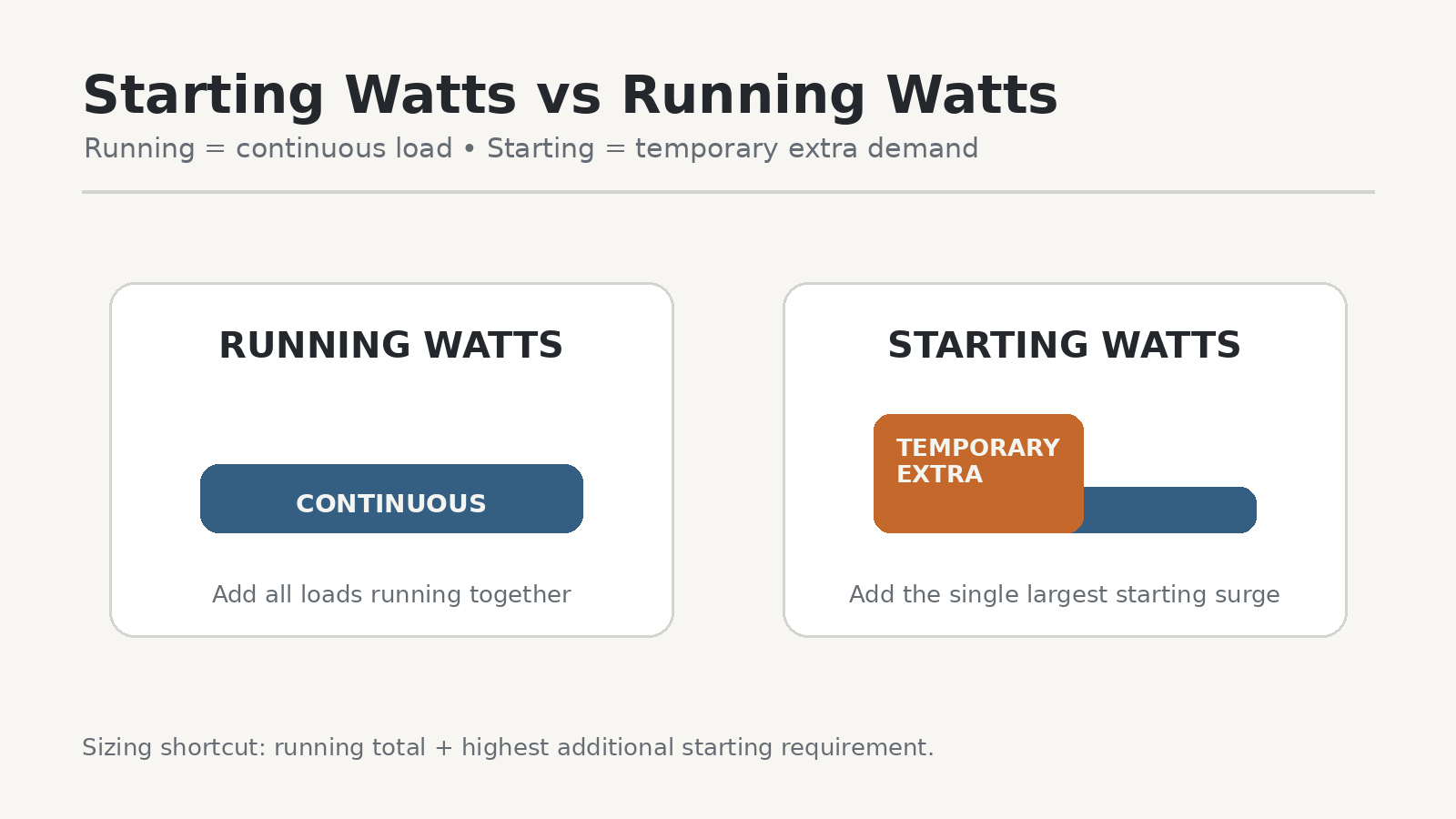
Running watts are the continuous watts a generator can supply. Starting watts are a temporary extra allowance used while certain motor-driven equipment starts.
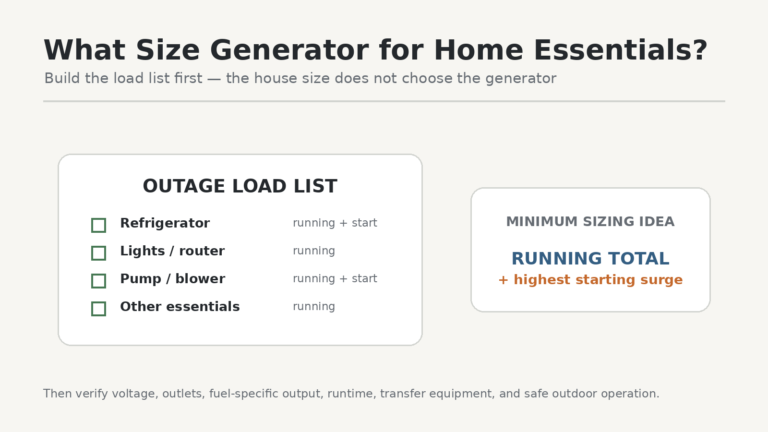
For a basic backup plan, add the running watts of everything you expect to operate at the same time. Then add the single highest additional starting-watt requirement among the loads likely to start. That method assumes you manage the loads so large motors do not start together.
The result is a minimum sizing estimate, not the only specification to check. Outlet voltage and amperage, fuel, runtime at a stated load, noise, transfer equipment, and carbon-monoxide safety all affect the purchase. For example load plans, see What Size Portable Generator for Home Essentials?
Running Watts Are the Number You Live With
Running watts may also be called rated watts or continuous watts. This is the useful number for loads that stay on: lights, electronics, a refrigerator after startup, a furnace blower while running, or a sump pump during operation.
For continuous-load planning, use the published running-watt rating. The higher starting number describes temporary headroom, not capacity you can use all day.
When comparing two generators, start with running watts. Starting watts matter next.
Starting Watts Cover Short Motor Surges
Motors often need extra power for a brief period while starting. Refrigerators, freezers, well pumps, sump pumps, furnace blowers, air conditioners, and some power tools can have a starting requirement above their running load.
Generac describes starting watts as the extra watts needed for a few seconds to start motor-driven equipment. Resistive loads such as many basic lights and heating elements generally do not have the same motor-starting surge, although their running wattage can still be high.
Do not estimate a specific appliance from its name alone. Two refrigerators or pumps can have different requirements. Use the appliance nameplate, manual, or manufacturer data.
How to Calculate the Generator Size You Need
- List only the loads you genuinely expect to run during an outage.
- Record each item’s running watts.
- Record its additional starting watts, if applicable.
- Add the running watts of loads that may operate together.
- Add the highest single additional starting-watt requirement.
- Choose a generator whose continuous and starting ratings both cover the result, with reasonable operating margin.
Generac’s published worksheet uses this example:
| Calculation | Watts |
|---|---|
| Total running loads | 4,250W |
| Highest additional starting load | 2,350W |
| Estimated requirement | 6,600W |
Source: Generac wattage worksheet.
The worksheet adds the highest starting requirement once rather than adding every motor’s starting watts together. That shortcut works only when the load plan prevents large motors from starting together. If simultaneous starts are possible, simple addition can understate the peak; use manufacturer data and qualified sizing help rather than assuming the starts will never overlap.
Where Do You Find the Correct Wattage?
Look for a data plate or label on the appliance. It may list watts directly or give volts and amps.
For a simple load, watts are approximately:
Volts × amps = watts
A 120-volt device marked 5 amps represents about 600 watts for a basic estimate. Motors, power factor, compressor startup, and electronic controls make nameplate or manufacturer wattage better than a rough calculation when available.
Online appliance charts are useful for planning, but their numbers are estimates. The exact refrigerator, pump, furnace, or air conditioner in your home should control the final list.
Do Not Add Every Appliance in the House
A portable generator does not need to reproduce normal life during an outage. Decide what is essential.
| Priority | Possible loads to evaluate | Buying question |
|---|---|---|
| Food and basic power | Refrigerator, freezer, lights, phone charging | Can these run together continuously? |
| Water and drainage | Well pump, sump pump | What are the motor starting requirements? |
| Heating support | Furnace blower and controls | Is professional transfer equipment required? |
| Comfort | Window air conditioner or selected fans | What must be turned off before this starts? |
| Medical or critical equipment | Equipment identified by its manufacturer | Is a portable generator appropriate and reliable enough? |
Load management can save money and fuel. Running a sump pump and a large air conditioner at different times may let a smaller generator handle the essential work. It also requires someone to manage the sequence safely.
Why Extra Capacity Helps—but Bigger Is Not Free
Operating at the continuous limit leaves no room for a missed load or an unexpected motor start. Allow practical margin, but do not use an arbitrary percentage in place of an accurate appliance list.
Oversizing has costs. A larger machine is heavier, costs more, and may be harder to move and store. Fuel use depends on engine design and load, so compare manufacturer runtime or consumption data at the same load instead of assuming the larger tank is more efficient.
Compare runtime only at the same stated load. “Ten hours of runtime” may be measured at 25% or 50% load. Those claims are not comparable until the test condition matches.
The Outlets Can Limit You Before Total Wattage Does
A generator’s total running-watt rating is shared across its receptacles, but each outlet also has a voltage, amperage, wiring configuration, and circuit breaker.
Generac notes that a receptacle’s plug pattern does not always equal the generator’s usable output through that outlet. For example, a standardized 50-amp receptacle may be protected by a lower-amperage breaker because the generator cannot supply a full 50 amps continuously.
Check the specification sheet for:
- 120V-only or 120/240V output
- 20A, 30A, or 50A receptacles and their breaker limits
- Whether the outlet your equipment needs is included
- The generator’s total continuous output at the required voltage
See Generac’s portable-generator outlet guidance.
Extension Cords Are Part of the Load Path
When appliances plug directly into a generator, use cords with the correct conductor size, length, grounding, jacket, and marked capacity. A long undersized cord can add voltage drop even when the generator itself is large enough.
For a practical gauge-by-length explanation, see Extension Cord Gauge Explained: 16 vs 14 vs 12 AWG for Homeowners.
Never Backfeed a House
Do not connect a portable generator to a home by plugging it into a wall receptacle. That can energize wiring unexpectedly and put occupants, utility workers, and equipment at risk.
OSHA states that a portable generator should not be attached directly to a structure’s electrical system unless it uses a properly installed transfer switch. A transfer switch or other approved interconnection equipment should be selected and installed by a qualified electrician under applicable codes and manufacturer instructions.
See OSHA’s portable-generator grounding and connection guidance. For a planning-level comparison of cords, transfer equipment, inlets, and backfeeding hazards, read our portable generator home-backup safety guide.
Carbon Monoxide Safety Is a Buying Requirement
A fuel-burning portable generator produces carbon monoxide. It should never run in a house, basement, garage, shed, carport, or other enclosed or partly enclosed space—even with doors open.
The CDC says to operate generators outdoors at least 20 feet from windows, doors, and vents. CPSC likewise stresses outdoor operation, exhaust directed away from buildings, and working CO alarms. Follow the generator manual as well, but never treat a shorter manufacturer clearance as permission to operate in or near an enclosed space.
See the CDC power-outage guidance and CPSC carbon-monoxide guidance.
A “CO shutoff” feature is useful backup protection, not permission to move the generator closer or operate it indoors.
Other Specifications That Matter
Fuel Type and Fuel Storage
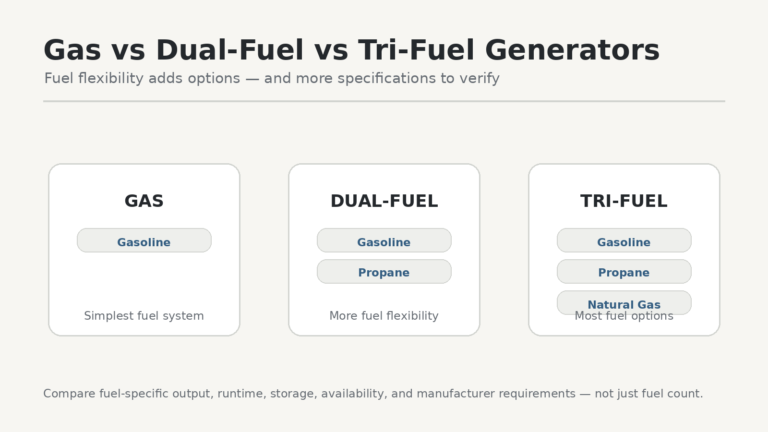
Gasoline, propane, and dual- or tri-fuel machines have different output, storage, and refueling tradeoffs. Compare running watts on the fuel you intend to use; output can vary by fuel. Our gas vs dual-fuel vs tri-fuel generator comparison explains those tradeoffs.
Runtime at a Stated Load
Tank size alone does not tell you runtime. Look for hours at 25% or 50% load and compare like with like.
Noise
Use published dBA figures only when the test distance and load are stated. An unlabeled “quiet” claim is marketing, not a comparison.
Weight and Starting Method
Wheels, handles, recoil effort, electric start, and battery maintenance affect whether the generator will be usable when it is needed.
Power Quality
If you plan to power sensitive electronics, look for a published total harmonic distortion specification and the equipment manufacturer’s requirements. The word “inverter” does not replace an actual power-quality rating, and it says nothing about whether capacity is adequate. See Inverter vs Conventional Generator for the broader noise, fuel-use, capacity, and power-quality comparison.
Common Sizing Mistakes
- Buying by starting watts instead of continuous watts
- Ignoring the largest motor-starting load
- Adding estimated chart values without checking actual equipment
- Assuming the biggest receptacle can supply its full plug rating
- Comparing runtime claims measured at different loads
- Planning to run every appliance instead of managing priorities
- Forgetting cords, transfer equipment, fuel, storage, and CO alarms
Bottom Line
Start with total running watts. Add the highest additional starting requirement for loads that will be managed so they start one at a time. Then verify the generator’s continuous rating, surge rating, voltage, outlets, breakers, and runtime at a stated load.
The best portable generator is not the one with the largest number on the box. It is the one that can start and run the loads you have chosen, connect to them safely, and operate outdoors with a realistic fuel plan.
Use the Generator Wattage Worksheet
Enter the running watts for the loads you plan to operate together, then add each motor load’s additional starting watts. The worksheet totals the continuous load and adds the highest single extra starting requirement.
Generator Wattage Worksheet
Add the loads you expect to run together. Enter additional starting watts (the amount above running watts), not total surge watts.
Total running watts: 0 W
Highest additional starting watts: 0 W
Minimum estimated generator requirement: 0 W
Safety: This planning estimate does not verify voltage, outlets, simultaneous motor starts, transfer equipment, or installation. Never run a fuel-burning generator indoors or in a garage. Operate it outdoors at least 20 feet from the home with exhaust directed away, and never backfeed a wall outlet.
This is a planning estimate. Verify actual equipment nameplates, the generator manual, outlet voltage and amperage, and transfer equipment with a qualified electrician.