SJTW vs SJT vs SJOOW Extension Cord Ratings Explained
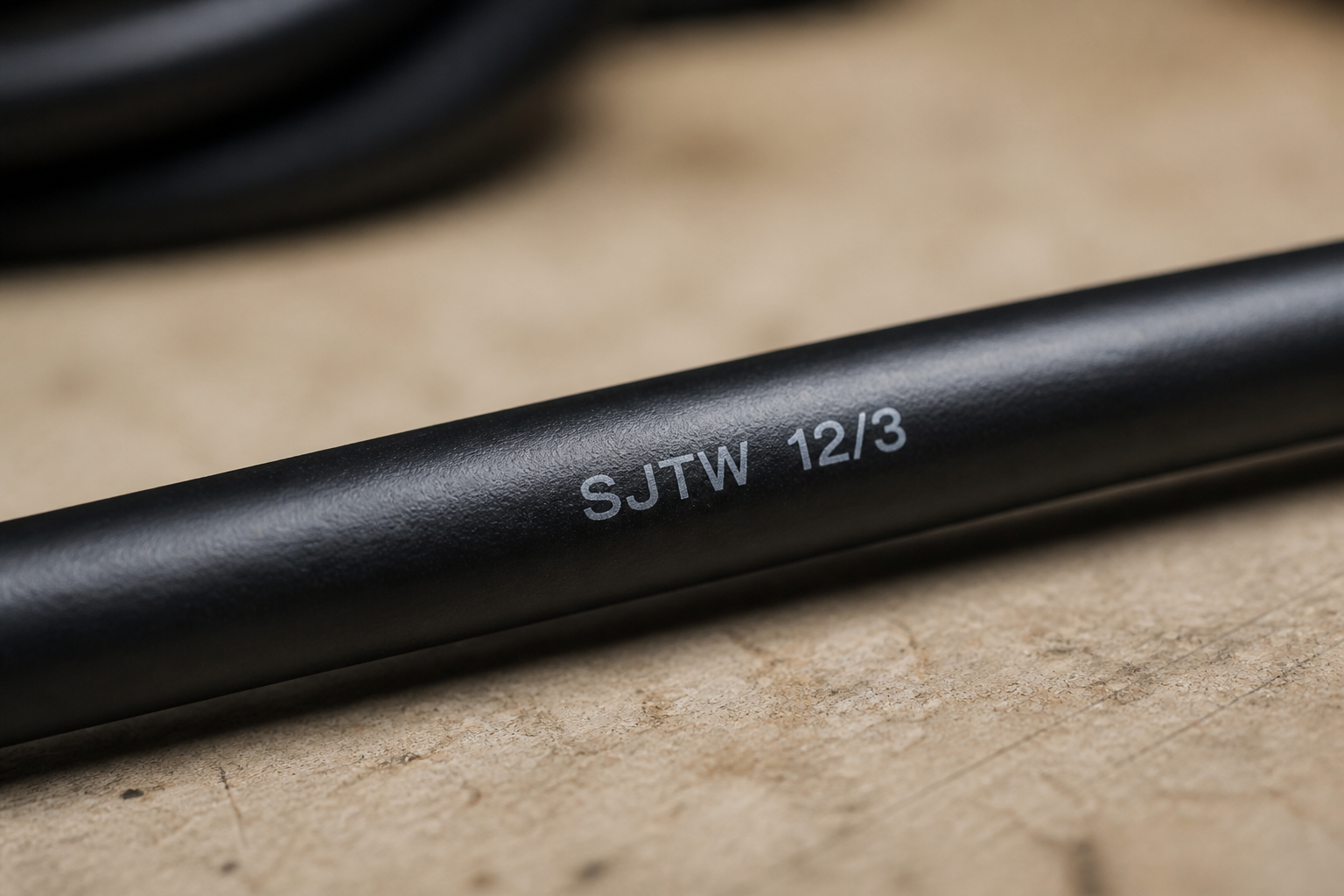
If you have ever looked closely at an extension cord, you have probably seen something like SJTW 12/3 printed down the jacket.
It looks like the cord is trying to tell you a password.
It is actually giving you useful information about how the cord was built and the conditions for which it was evaluated.
The letters can tell you things such as whether the cord is intended for hard service, whether it uses thermoplastic materials, whether it has oil resistance, and — most important for ordinary homeowners — whether it is rated for outdoor/wet-location use.
The most useful letter: W
If you are trying to answer “Can I use this extension cord outside?”, the letter I would look for first is W at the end of the cord-type designation.
UL’s Wire and Cable Application Guide says:
W as the last letter means the flexible cord is suitable for use in wet locations and is sunlight resistant.
UL also says a product evaluated for outdoor use can have a W in its type designation, giving SJTW as an example.
So an SJTW cord is a normal thing to see on an outdoor extension cord.
What S means
UL identifies S as extra-hard-usage flexible cord.
These are service cords intended for demanding portable applications.
Do not confuse “extra hard usage” with the cord physically feeling hard. It is a use classification, not a texture review.
What SJ means
SJ means hard-usage flexible cord under UL’s current guide.
The J distinguishes the junior-service/hard-usage family from the heavier S extra-hard-service family.
OSHA’s flexible-cord guidance lists S, ST, SO, and STO as examples of hard/extra-hard service types and SJ, SJO, SJT, and SJTO as junior hard-service types used in the code framework it references.
For homeowners, SJ cords are common because they can be flexible and practical without being the heaviest industrial cord available.
What T means
When T appears after the first letter in one of these designations, UL says it indicates thermoplastic insulation and jacket.
That is where the T in SJTW comes from.
So, simplified:
SJTW = hard-usage flexible cord + thermoplastic insulation/jacket + wet-location/sunlight suitability.
That is much more informative than “orange cord.”
What O and OO mean
O is about oil resistance.
UL says a single O means the jacket is oil resistant.
A double O means both the jacket and conductor insulation are oil resistant.
That is why you may see types such as SJO, SJOO, SOOW, or SJOOW depending on the construction and rating.
Oil resistance matters more in garages, shops, industrial settings, and around equipment where the cord may be exposed to petroleum products.
It does not mean you should soak the cord in oil for entertainment.
What about E?
UL uses E after the first letter to indicate thermoplastic-elastomer insulation and jacket in the flexible-cord designation system.
You may therefore see cords with E in place of T depending on the construction.
For a normal homeowner trying to pick an outdoor extension cord, I would not memorize the entire alphabet. I would read the actual markings and product listing.
So what does SJTW mean?
Using UL’s definitions:
- SJ = hard-usage flexible cord;
- T = thermoplastic insulation and jacket;
- W = suitable for wet locations and sunlight resistant.
This is one of the most common useful outdoor extension-cord designations.
What does SJT mean?
SJT has the hard-usage SJ classification and thermoplastic construction, but it lacks the W suffix.
I would not assume it is outdoor-rated just because it looks exactly like an outdoor cord.
Check the complete marking and listing.
What does SJOOW mean?
Breaking it down:
- SJ = hard-usage flexible cord;
- OO = oil resistance for both jacket and conductor insulation;
- W = wet-location and sunlight suitability.
This kind of cord makes sense in tougher environments where oil resistance and outdoor suitability matter.
What does 12/3 mean?
The letters and the gauge marking tell you different things.
12/3 normally means 12-AWG conductors with three conductors in the cord.
For a grounded 120-volt extension cord, those three conductors are typically hot, neutral, and equipment ground.
The gauge tells you conductor size. The letter designation tells you about cord construction/use characteristics.
You need both pieces.
A 12-gauge cord is not automatically an outdoor cord.
Why the cord can say plenty and still be wrong for your tool
Imagine you find a heavy 12/3 SJTW cord.
Great. It is heavy wire and it has an outdoor-use designation.
You still need to check:
- the cord’s amp and voltage rating;
- the tool’s load;
- cord length;
- plug and receptacle configuration;
- grounding requirements;
- temperature/environment limits;
- whether the cord is damaged.
The letters solve one part of the problem, not every part.
Why outdoor rating is more than “it can get rained on”
UL says cords with the W suffix are suitable for wet locations and are sunlight resistant.
That includes two different outdoor problems:
- water/moisture exposure;
- ultraviolet exposure from sunlight.
An indoor cord jacket may not be evaluated for those conditions.
If I knew a cord would spend time outside, I would buy one marked for outdoor use rather than deciding that a thick-looking jacket is probably good enough.
Outdoor-rated does not mean waterproof
This distinction matters.
A W-rated cord is suitable for the location conditions covered by its rating. It does not make every energized plug connection safe to leave submerged in a puddle.
OSHA’s electrical rules for workplaces require equipment used in highly conductive locations or where contact with water is likely to be approved for those locations, and they address grounding and GFCI protection separately.
For home use, follow the cord, tool, receptacle, and GFCI instructions. Keep connections out of standing water.
Check the actual cord, not the packaging you threw away three years ago
One nice thing about these designations is that the cord is normally marked along its jacket.
OSHA notes that flexible-cord type markings are intended to be durably marked on the cord itself in regulated applications.
So if you pull a mystery extension cord from a basement bin, look along the jacket.
You may be able to find:
- cord type;
- gauge and conductor count;
- voltage rating;
- temperature or other markings;
- listing/certification information.
The molded color of the jacket is not a reliable substitute for those markings.
Orange does not mean outdoor
This deserves its own heading because hardware stores have trained our brains well.
Orange is a color.
Manufacturers often use orange for outdoor cords because it is visible, but the color itself is not the electrical rating.
Read the letters.
A black, blue, yellow, pink, or neon-green cord can be outdoor-rated if it carries the appropriate listing and markings. An orange cord does not earn a W by being orange enough.
Gauge and length still matter
Once you know the cord is suitable for the environment, you still have to size it for the load and length.
Longer runs and higher-current equipment can require heavier conductors to control voltage drop and heating.
That is covered in Why Longer Extension Cords Need Heavier Gauge Wire.
Extension Cord Gauge: 16 vs 14 vs 12 AWG Explained is the central guide for comparing conductor size, amp draw, and length.
The five things I would read on an extension cord
- Gauge/conductor count: for example 12/3.
- Type designation: SJTW, SJOOW, etc.
- Current/voltage rating: make sure it fits the load and system.
- Listing/certification markings: do not rely on a product photo that merely looks heavy duty.
- Condition: ratings do not help if the jacket is cut, the plug is burned, or the ground pin is missing.
Once you know what the letters mean, the printing down the side of the cord stops looking like manufacturing noise.
It is basically the cord’s résumé.