Do Stud Finders Work Through Plaster, Tile, and Thick Walls?
“Works through plaster and tile” sounds like a yes-or-no feature. It is not. Plaster can mean wood lath, metal lath, gypsum lath, repairs, and several thicknesses. A tiled wall may contain drywall, cement board, mortar, waterproofing, mesh, and moisture. “Thick wall” says even less about what the sensor must read through.
A stud finder works only when its sensing method can distinguish the target from the layers in front of it and the other objects around it. The useful buying question is not whether a package claims a deep scan. It is whether the technology matches the wall assembly.
Why Standard Drywall Is the Easy Case
Ordinary drywall provides a relatively uniform surface over alternating framing and cavities. Electronic stud finders can look for a change in the sensed material as the tool crosses a stud. Magnetic finders can locate steel screws or nails near the surface.
The surface is not perfectly uniform—joint compound, texture, seams, patches, insulation, wiring, and pipes still matter—but the basic pattern is predictable. Most consumer stud-finder demonstrations and standard scan modes make the most sense in this setting.
Difficult walls remove that clean baseline. The surface gets thicker, contains repeated structural layers, or includes material that produces a broad response before the sensor reaches the framing.
Why Plaster and Lath Are Different
Traditional plaster is applied over lath rather than broad drywall sheets. Wood lath creates many narrow strips across the wall. Plaster keys project through the gaps, and thickness can vary. An electronic finder looking for a change between cavity and framing may see repeated changes from the lath and plaster instead.
Some walls use metal lath, while others include repairs made with drywall or different plaster systems. Two walls both described as “plaster” can present completely different sensing problems.
Zircon has published guidance on lath-and-plaster walls explaining why conventional stud-scanning approaches can struggle with material-density variation. That is manufacturer guidance for its tools, not proof that every electronic detector fails on every plaster wall. It does show why buying based only on a maximum depth number misses the real problem.
What Metal Lath Does to Detection
Metal lath distributes metal across a broad area. A magnetic finder may be attracted across much of the wall rather than at individual fasteners. A detector’s metal mode may likewise report a large continuous region instead of a narrow framing line.
That does not make every technology useless, but it makes ordinary metal detection much less selective. A tool cannot locate a stud by finding isolated metal if metal is already present across the scanning surface.
Do not assume a broad metal indication identifies metal studs. It may be lath, mesh, shielding, foil, fasteners, or another conductive layer. Material identification is valuable only if the tool can separate the relevant signals under the documented conditions.
Tile Over Drywall or Backer Board
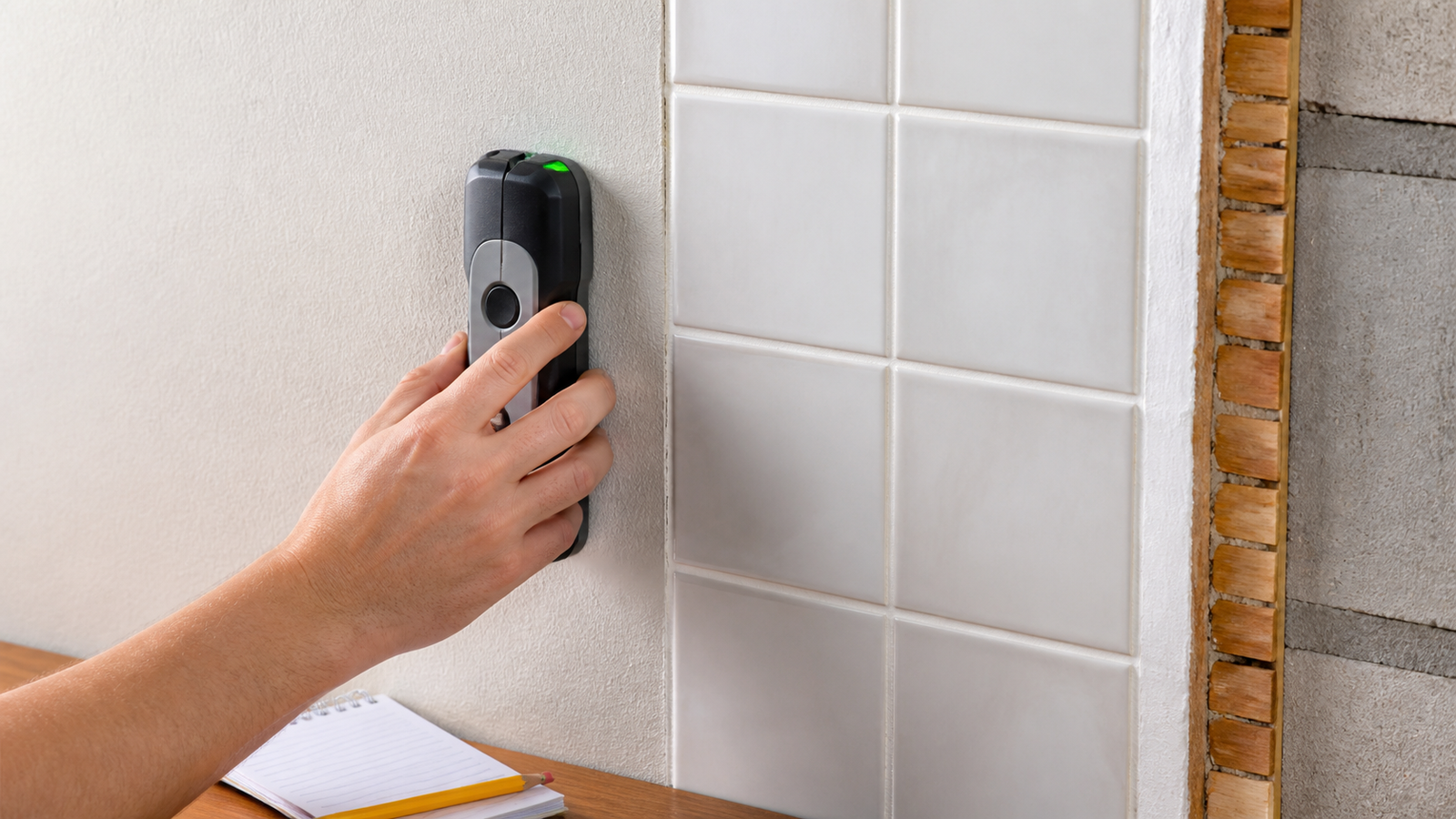
A tiled wall is a layered assembly. The detector may need to read through tile, adhesive or mortar, backer board or drywall, waterproofing, and possibly mesh before it reaches framing. Each layer adds thickness and can change the sensor response.
Tile composition also varies. Moisture in or behind the assembly can affect electronic sensing. Metallic trim, mesh, foil, or conductive materials can create broad readings. A model that works through one dry ceramic-tile assembly may not work through a thicker stone or wet-area assembly.
Check the manufacturer’s supported surfaces and operating instructions. A claim such as “deep scan” is not the same as documented tile compatibility. Do not generalize one successful scan—or one manufacturer’s supported assembly—to every tiled wall.
Calibration and Surface Contact Matter More
Electronic finders need a stable relationship with the surface. Heavy texture, uneven plaster, grout lines, curved tile, and projecting trim can tilt the tool or create gaps under the sensor. That changes the measurement before wall depth becomes the issue.
Some models establish a baseline when first placed on the wall. If the starting point is already over dense material or the wall changes thickness during the pass, the baseline can be misleading. Other models continuously adapt, but they still require the contact and movement described in the manual.
Automatic calibration is convenient; it is not a promise that the wall is compatible. Watch for the tool’s error or uncertainty indicators. Repeatedly restarting until one pass produces a clean center can hide the very inconsistency that should make you cautious.
On tile, scan across grout lines only if the manufacturer permits it and understand that the surface height may change. On rough plaster, a thin nonmetallic spacer is sometimes discussed online as a way to improve movement, but adding any layer changes the sensing distance. Do not improvise a spacer unless the tool manufacturer documents that method.
Thick or Double Drywall
Extra drywall layers are a simpler problem than lath or metal mesh, but depth starts to matter. The framing and fasteners are farther from the tool. Magnetic attraction weakens with distance, and a standard electronic mode may not reach the framing reliably.
Zircon describes Stud Scan and DeepScan on certain models in terms of about 3/4-inch and 1-1/2-inch depth. DEWALT likewise markets current center-detect models with 3/4-inch and 1-1/2-inch ratings. Those are model-specific claims, not universal performance guarantees.
The larger number is useful only when the surface requires it. Deeper sensing can also respond to plumbing, wiring, or other objects farther into the wall. The broader guide to stud-finder depth ratings and detection technologies explains why the deepest mode is not automatically the most trustworthy one.
Foil, Mesh, and Conductive Materials
Foil-backed insulation, metallic wallpaper, metal mesh, and other conductive layers can interfere with capacitive sensing or create a large metal response. Manufacturer manuals commonly list wall composition, shielding, moisture, and nearby conductive material among conditions that affect detection.
The practical warning is narrow: identify the wall assembly where possible and check the exact tool’s limitations. Do not infer that a generic “metal mode” can see through a continuous metal layer or distinguish every object behind it.
Moisture Can Change the Reading
Electronic sensing can be affected by moisture because damp material has different electrical properties from dry material. That matters around tile and wet-area assemblies, but a stud finder is not a moisture meter and cannot diagnose a leak from an odd reading.
If a detector behaves differently in a damp-looking area, treat the result as uncertain. Do not use the scan to conclude that the wall is dry, that an alert is framing, or that electrical detection remains reliable. Follow the detector manufacturer’s environmental limitations and address suspected moisture separately.
When a Magnetic Approach May Help
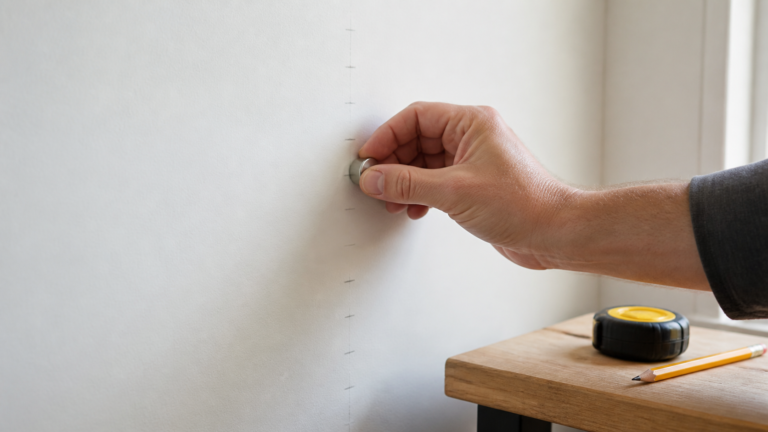
A magnet avoids electronic calibration and looks for ferrous fasteners rather than density changes. On a wall with thick but nonmetallic finishes, a strong magnet may still locate screws or nails if they are close enough to the surface.
Several hits in a vertical line can support the idea that framing is behind them. One hit does not prove that. Thick plaster weakens the pull, tile adds distance, and metal lath can make the whole method ambiguous by attracting the magnet across a wide area.
Magnetic verification is inexpensive and different enough from an electronic scan to make a useful second method. It is not automatically better on every difficult wall. The guide to finding studs without an electronic finder explains how to combine fasteners with trim, outlet, spacing, and surface clues.
When an Advanced Wall Scanner Makes More Sense
Advanced scanners may use radar or other sensing systems and may classify material, show an object center, or provide more information about depth. Bosch’s D-tect 120 and GMS120-27 are examples of current designs that provide richer object information than a basic edge finder.
That extra information can justify the cost when wall construction is complicated and knowing whether a response appears to be metal, wood-like material, or energized wiring changes the plan. It still does not create an X-ray view or guarantee that every object will be found.
Read the supported materials, depth conditions, and safety warnings for the exact scanner. “Radar” sounds definitive; it is still a measurement interpreted by software through a particular wall assembly.
How to Approach an Unknown Wall
- Identify the likely construction. Age, location, visible edges, renovation history, and exposed areas may help distinguish drywall, plaster, tile, or masonry. Treat the conclusion as provisional.
- Choose a documented mode and tool. Start with the shallowest appropriate mode rather than maximum depth by default.
- Scan systematically. Keep the tool flat, follow calibration instructions, and mark repeatable indications rather than every beep.
- Repeat from another direction and height. A framing hypothesis should usually form a consistent vertical pattern.
- Corroborate with another method. Magnetic fasteners, visible construction clues, and a different sensing technology can add independent evidence.
- Stop at unexplained conflicts. A broad, shifting, or nonrepeatable response is an unknown condition, not permission to choose the most convenient mark.
Safety note: Wall scanners and live-wire indicators can miss objects. No warning signal does not prove a location is clear. Use appropriate electrical, plumbing, and wall-construction precautions before drilling, cutting, nailing, or screwing. Get qualified help when the wall assembly or consequence of a mistaken reading is uncertain.
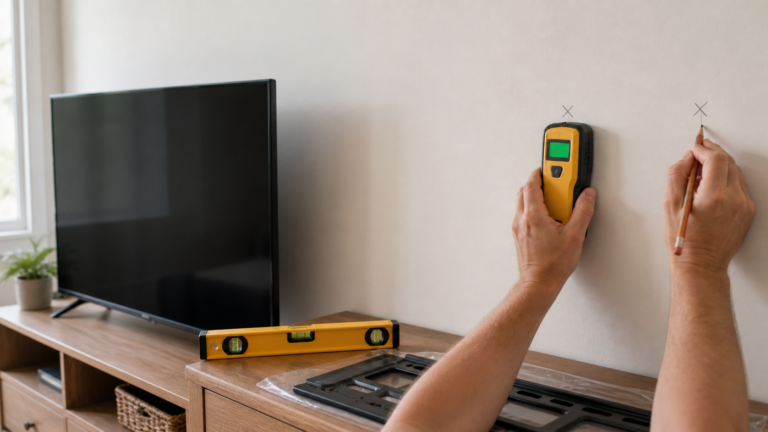
When the result will support a heavy attachment, use a higher verification standard; see the TV-mounting guide for a full-area mapping workflow.
Which Features Earn Their Cost on Difficult Walls?
Greater detection depth helps when a supported surface is genuinely thicker than a standard mode can handle. It does not solve interference from metal lath or conductive layers, and it can expose the sensor to more hidden objects.
Material identification matters when knowing that a response is likely metal changes the next decision. It is more useful than a generic “stud” light, but only within the conditions the manufacturer documents.
Wider sensor coverage can make a broad or irregular response visible. That helps the user recognize that the wall does not look like a simple stud-and-cavity pattern. More sensors alone are not a measure of accuracy.
An advanced scanner may be worth paying for when richer classification and mapping reduce meaningful uncertainty across repeated projects. For one unusual wall, rental or qualified assessment may make more sense than buying a tool whose limitations still do not match the assembly.
The feature list matters only after the wall is understood. A tool designed for deep drywall is not automatically a plaster tool, and a metal mode is not automatically useful through metal mesh.
Bottom Line
There is no universal stud finder that “works through everything.” Standard drywall is comparatively easy because it gives the sensor a predictable pattern. Plaster, lath, tile, extra layers, foil, mesh, and moisture change that pattern in different ways.
Match the sensing method to the wall, use the shallowest suitable mode, repeat the scan, and corroborate the result. A larger depth claim is valuable only when depth is the actual problem.
Frequently Asked Questions
Do stud finders work through plaster?
Some tools and methods may work on some plaster assemblies, but thickness, wood lath, metal lath, repairs, and density variation can confuse basic electronic modes. Check the exact tool’s documented compatibility.
Can a stud finder work through tile?
It may work through a supported tile assembly, but tile, mortar, backer board, waterproofing, mesh, moisture, and total thickness all matter. “Deep scan” alone does not establish tile compatibility.
Will deep scan work through double drywall?
A documented deep mode is intended for thicker supported surfaces and may help. It can also detect unrelated objects farther into the wall. Repeat the reading and follow the model-specific instructions.
Why does my finder show metal everywhere?
The wall may contain metal lath, mesh, foil, metallic covering, or many closely spaced fasteners. A broad response does not prove metal studs are everywhere and may make ordinary metal detection unhelpful.
Is a magnetic finder better for plaster?
It can help if ferrous fasteners are close enough to the surface and the wall does not contain widespread metal. Thick plaster weakens attraction, while metal lath can create a broad, ambiguous pull.
Does a radar wall scanner find everything?
No. Advanced sensing can provide more object information, but performance still depends on depth, material, wall construction, calibration, and manufacturer limitations.