Air Compressor Duty Cycle Explained: What the Percentage Actually Means
Two air compressors can have similar CFM, PSI, and tank size and still behave very differently during a long job.
Duty cycle is one reason.
It describes how much of an operating cycle the compressor is designed to spend running under the conditions defined by the manufacturer. A compressor that can deliver enough air for a short burst may still be a poor match for a tool that keeps asking for air minute after minute.
Quick Answer
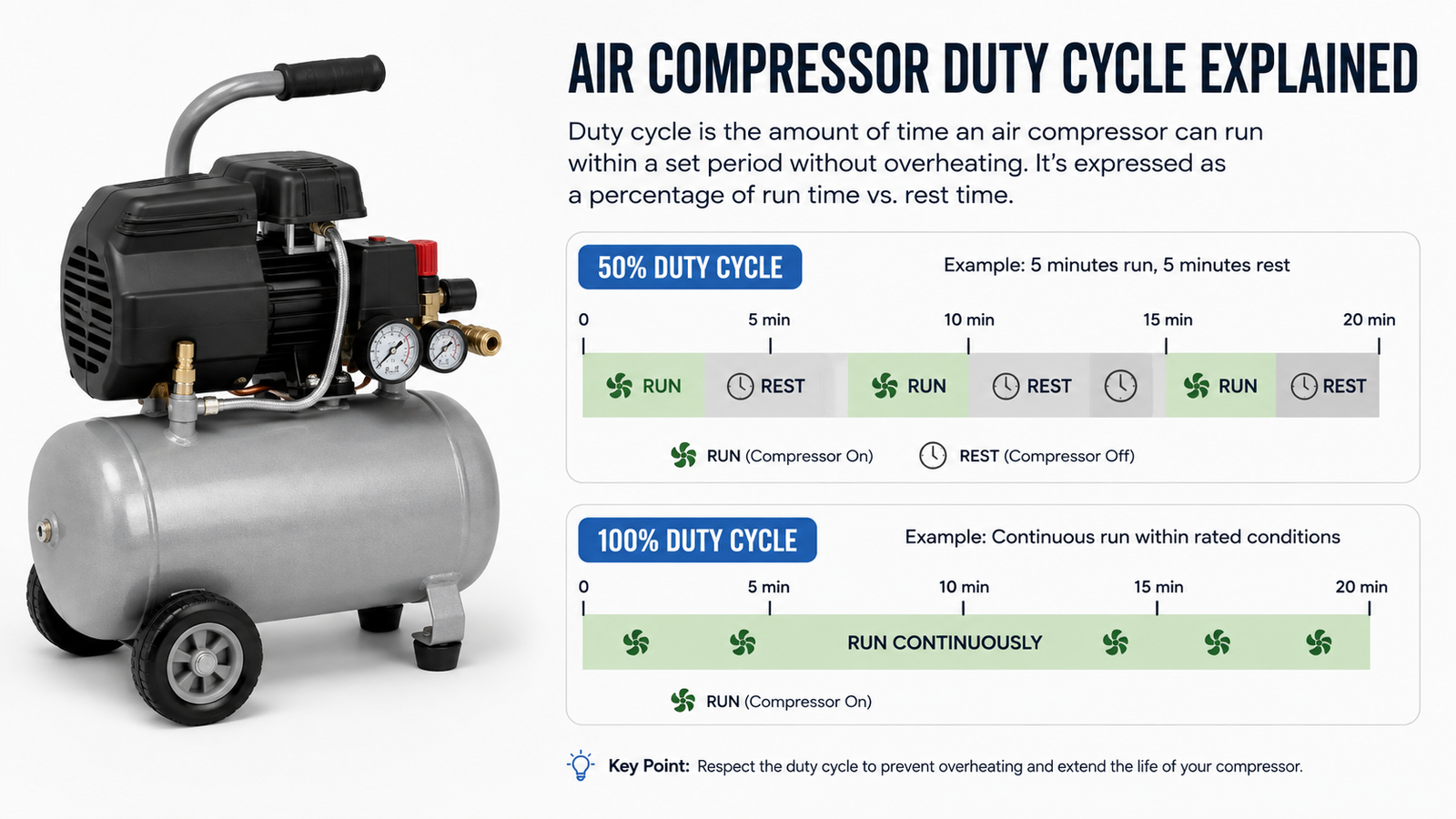
Duty cycle is the percentage of a cycle that an air compressor can safely spend running before it needs the rest or unloaded time specified by the manufacturer.
A 50% duty-cycle rating generally means the compressor is intended to run for roughly half of the relevant cycle and spend the other half not loaded. A 100% duty-cycle machine is designed for continuous operation under its rated conditions.
Do not assume the reference period or test conditions. Check the compressor manual because manufacturers can define duty-cycle limits differently.
Why CFM Alone Does Not Finish the Sizing Job
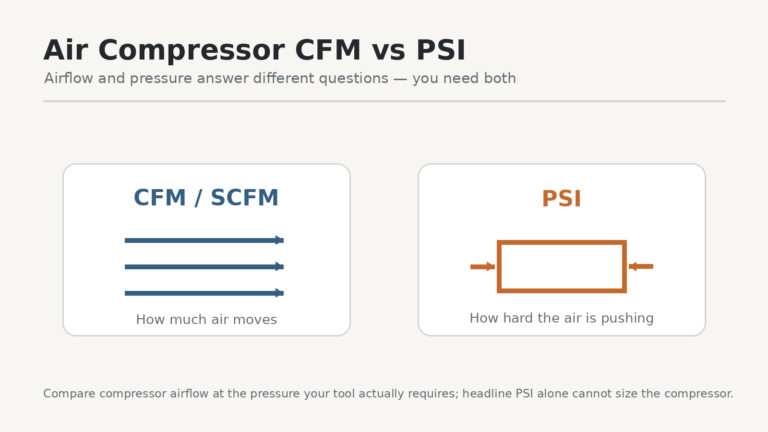
CFM tells you how much air the compressor can deliver at a stated pressure.
That is critical, but it does not by itself tell you whether the compressor is designed to keep doing it continuously.
Imagine a tool that needs 5 CFM at 90 PSI for a long sanding job. A compressor may be able to produce that airflow but still have an operating limit that requires regular rest.
For intermittent tools, that may never matter.
For continuous-demand tools, it can become the limiting specification.
That is why the DDB air-compressor sizing process should be:
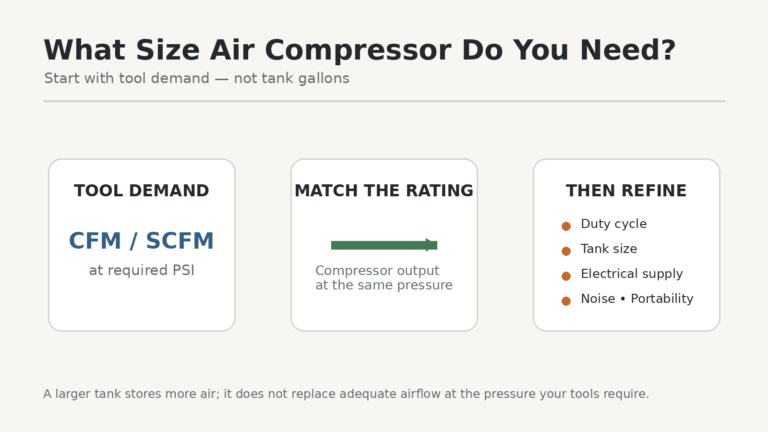
- Match the tool’s required CFM or SCFM at its working PSI.
- Check simultaneous demand if more than one tool will run.
- Check duty cycle.
- Use tank size to understand storage and cycling—not to replace pump output.
See Air Compressor CFM vs PSI and What Size Air Compressor Do You Need? for the broader sizing picture.
What 50% Duty Cycle Means
Quincy Compressor describes duty cycle as the percentage of time a compressor can safely run within a cycle without overheating or excessive wear. Its basic example says a 50% duty-cycle compressor runs half the time and rests half the time.
The important caution is the word cycle.
Do not automatically turn 50% into “30 minutes on and 30 minutes off every hour” unless the manufacturer defines the rating that way. Some documentation uses different reference windows or operating definitions.
The owner’s manual is the deciding source.
What 100% Duty Cycle Means
A compressor rated for 100% duty is designed for continuous operation under the manufacturer’s stated conditions.
That can matter for applications such as:
- sustained sanding
- grinding
- some spray work
- production fastening
- continuous air blowing where allowed and properly controlled
- other processes with little natural downtime
A 100% duty rating still does not make the compressor large enough for every tool. It also has to deliver the required airflow and pressure.
A continuously rated 3 CFM compressor is still not enough for a tool that genuinely needs 10 CFM continuously.
Intermittent Tools Hide Duty-Cycle Limits
Many homeowner air tools do not run constantly.
A nailer may use a short pulse of air and then sit idle. An inflator may run for a few minutes and stop. An impact wrench may be used in short bursts.
Those pauses give the compressor time to recover.
That is why a small compressor can feel perfectly adequate for intermittent work even if it would struggle badly with a sander whose trigger stays down for minutes at a time.
The work pattern matters as much as the tool category.
Tank Size Can Delay the Problem, Not Eliminate It
A larger tank stores more compressed air.
That reserve can let a high-demand tool run longer before pressure drops enough for the compressor pump to catch up.
If the pump produces less air than the tool consumes, the tank eventually loses the race.
A larger tank can smooth demand and reduce cycling. It does not change the compressor pump’s duty-cycle rating or create continuous airflow that the pump cannot produce.
See Air Compressor Tank Size Explained.
How Duty Cycle Changes the Buying Decision
Nailers and staplers
These are usually intermittent. CFM, tank reserve, recovery, portability, and noise may matter more than a high continuous-duty rating.
Tire inflation
Again, usually intermittent. The compressor needs enough pressure and reasonable recovery time, but most homeowner inflation work does not resemble industrial continuous air demand.
Impact wrenches
Usage pattern matters. Short bursts can work well with modest tanks and pumps. Sustained shop use is a different problem.
Sanders and grinders
These can expose an undersized or low-duty-cycle compressor quickly because they may demand air continuously.
Spray guns
Spray work combines airflow demand with air-quality concerns. Check the gun’s actual CFM requirement, compressor duty cycle, and moisture control rather than sizing from tank gallons alone.
What to Look for on the Product Page or Manual
When duty cycle matters, look for:
- an explicit duty-cycle percentage
- whether the rating is at a particular pressure or ambient condition
- the manufacturer’s definition of the reference cycle
- thermal protection or operating limitations
- CFM or SCFM at the pressure your tool requires
If the seller page does not list duty cycle, the manual or manufacturer support documentation may.
If you still cannot find it and you plan to run a continuous-demand tool, that missing specification is worth treating as a question rather than assuming the compressor can run indefinitely.
Bottom Line
Duty cycle tells you whether a compressor is designed to keep working at the pace your job demands.
For nailers, inflation, and other intermittent work, the limit may barely show up. For sanding, grinding, and other sustained air use, it can be one of the most important specifications on the machine.
Start with CFM at the required PSI. Then make sure the duty cycle fits how long you actually expect the compressor to run.