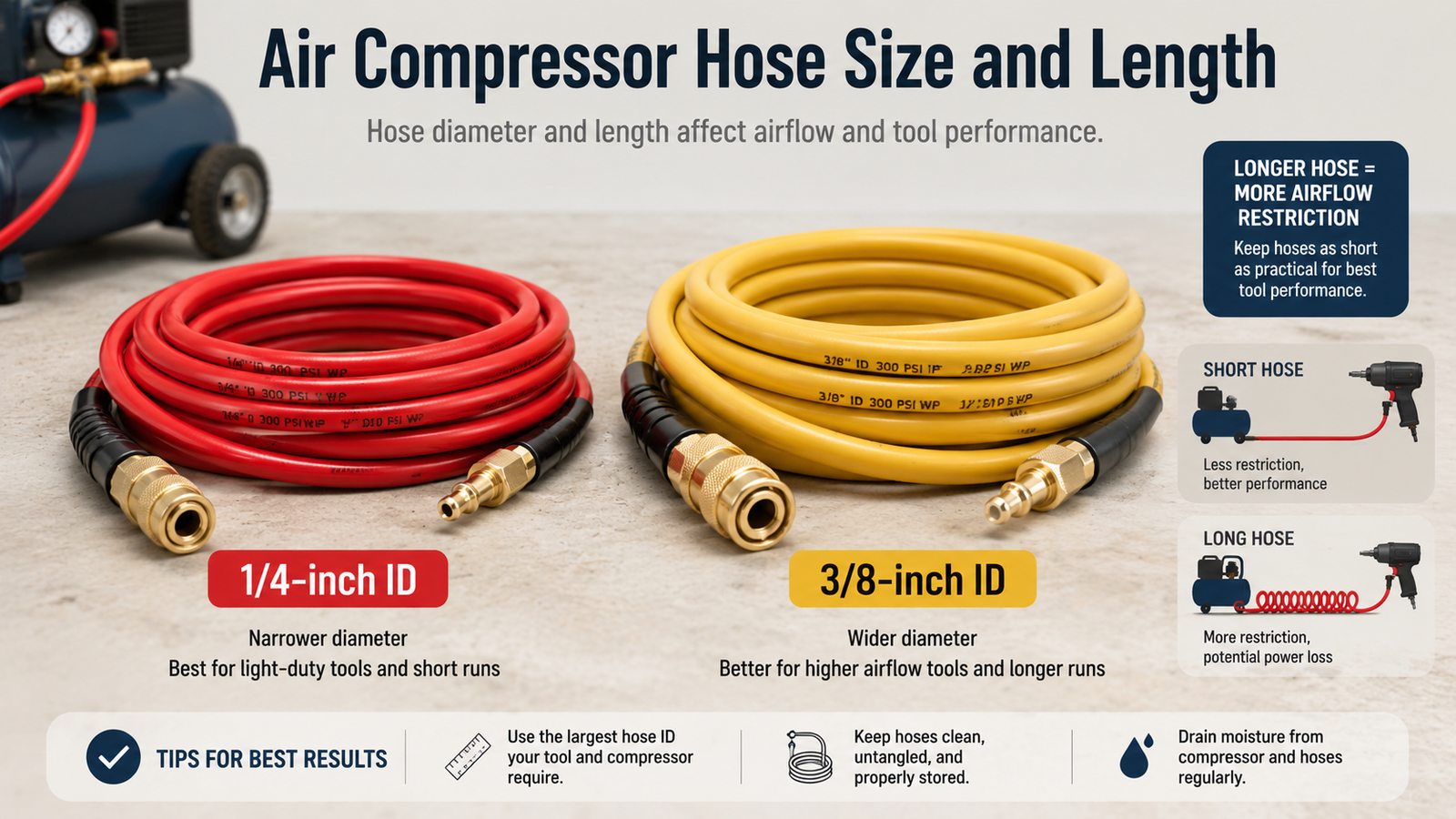
Air Compressor Hose Size and Length: 1/4 vs 3/8 Inch and Why It Matters
Buying an air compressor by CFM and then choking it through a restrictive hose is an easy way to make a correctly sized compressor feel undersized.
The hose is part of the air-delivery system.
Diameter, length, fittings, regulators, filters, and the tool’s airflow demand can all affect how much pressure remains at the tool while air is actually flowing.
Quick Answer
For light, intermittent homeowner tools, a 1/4-inch hose can be compact, light, and convenient.
A 3/8-inch hose generally gives more flow capacity and becomes more attractive as tool demand or hose length increases.
There is no universal rule that every air tool above a certain CFM requires one hose size. Pressure drop depends on flow, inside diameter, length, fittings, and system pressure. Use the tool and compressor documentation when available.
Why Hose Diameter Affects Pressure Drop
Compressed air moving through a hose loses pressure to friction and restrictions.
A smaller inside diameter increases flow resistance for a given airflow. Ingersoll Rand makes the same point for compressed-air piping: undersized lines create higher pressure drop, and diameter selection has to account for flow and distance rather than simply matching a connection size.
A homeowner air hose is much smaller than an industrial piping system, but the physics is the same.
The harder you try to push air through a long, narrow path, the more pressure you can lose before the air reaches the tool.
Why the Gauge Can Fool You
The tank gauge can still look healthy while the pressure at the tool falls under load.
That is because static pressure and flowing pressure are not the same situation.
When the tool is not using air, there may be little flow through the hose and little pressure loss. Pull the trigger on a high-demand tool and the restriction suddenly matters.
This is one reason a sander or impact wrench can feel weak even though the regulator appears to be set correctly.
1/4-Inch Hose: Where It Makes Sense
A 1/4-inch hose has practical advantages:
- lighter weight
- easier coiling
- less bulk around a workbench
- easier handling with small nailers and inflators
- often perfectly adequate for short, lower-demand use
If you mainly run a brad nailer, stapler, blow gun used appropriately, or tire chuck, there may be no reason to drag around a thick 3/8-inch hose.
The mistake is treating compactness as free. As airflow demand and length rise, the smaller hose has less margin.
3/8-Inch Hose: Why Higher-Demand Tools Benefit
A 3/8-inch hose offers a larger flow path.
That can help with:
- impact wrenches
- air hammers
- sanders
- grinders
- spray equipment with substantial airflow demand
- longer hose runs
It is also heavier and bulkier.
For a homeowner who mostly uses a nailer, the extra hose size may add inconvenience without a meaningful performance benefit. For someone trying to run a high-CFM sander at the end of a long run, it can be a much smarter choice.
Length Matters Too
Every additional foot adds friction.
A short hose has less opportunity to lose pressure than a long hose of the same diameter at the same airflow.
That does not mean long hoses are bad. Sometimes moving the compressor is worse than adding hose.
It means that a hose size that works well at 25 feet may not behave the same way at 100 feet with a demanding tool.
When reach increases, increasing diameter can help reduce pressure loss.
Fittings Can Become the Smallest Part of the System
A large hose does not help much if air has to squeeze through restrictive couplers, tiny fittings, a clogged filter, or an undersized regulator.
Think of the system as a chain:
compressor outlet → regulator/filter → coupler → hose → coupler → tool inlet
The narrowest or most restrictive parts can dominate the result.
If you upgrade from 1/4-inch to 3/8-inch hose but keep a very restrictive fitting system, the improvement may be smaller than expected.
Do Not Fix Pressure Drop by Cranking Up the Regulator Blindly
If a tool needs a specified operating pressure, the goal is to deliver that pressure while the tool is flowing air—not simply raise tank or regulator pressure until the tool feels stronger.
Tools and hoses have maximum pressure ratings. Follow those ratings and the manufacturer’s instructions.
If pressure collapses under load, identify the restriction or undersized component rather than exceeding rated pressure.
A Practical Homeowner Selection Guide
Choose 1/4 inch when:
- the hose run is short
- tools are intermittent or low-demand
- portability matters
- you are using nailers, staplers, inflation tools, or similar light-duty equipment
Consider 3/8 inch when:
- the tool has substantial continuous CFM demand
- the hose run is long
- you are experiencing pressure drop under load
- you are using sanders, grinders, larger impacts, or other demanding pneumatic tools
Look beyond hose diameter when:
- pressure still falls after increasing hose size
- the regulator or filter is small
- fittings are restrictive
- the compressor itself cannot meet tool CFM demand
How This Fits With Compressor Sizing
A bigger hose cannot rescue an undersized compressor.
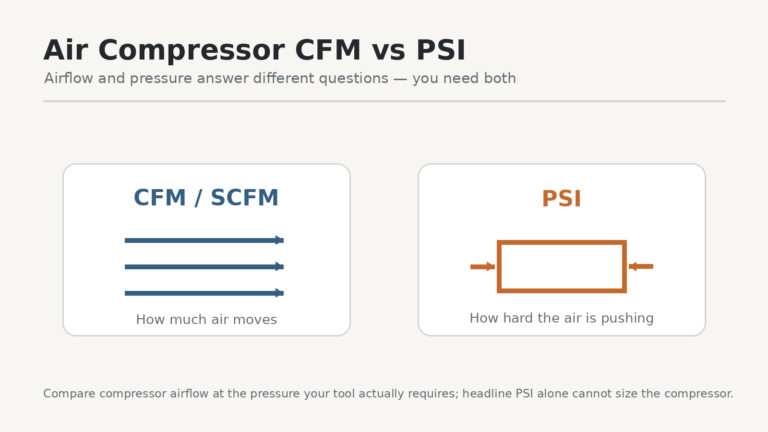
If the tool needs 8 SCFM and the compressor can only deliver 4 SCFM at the required pressure, the problem is pump capacity.
The hose only determines how effectively the available air gets from the compressor to the tool.
Start with How Much CFM Do Air Tools Need? and What Size Air Compressor Do You Need?, then choose the hose and fittings that do not unnecessarily restrict the system.
Bottom Line
Use a 1/4-inch hose when light weight and maneuverability matter and the airflow demand is modest.
Move toward 3/8 inch when flow demand or hose length increases.
Do not choose by hose diameter alone. Length, fittings, regulator capacity, compressor CFM, tool requirements, and pressure ratings all matter.
The best hose is the smallest, lightest setup that can still deliver the air your tool needs without excessive pressure loss.